How Do Language Style and Politeness Strategies Affect LLM Social Reasoning? Controlled Experiments Reveal Limited Effects
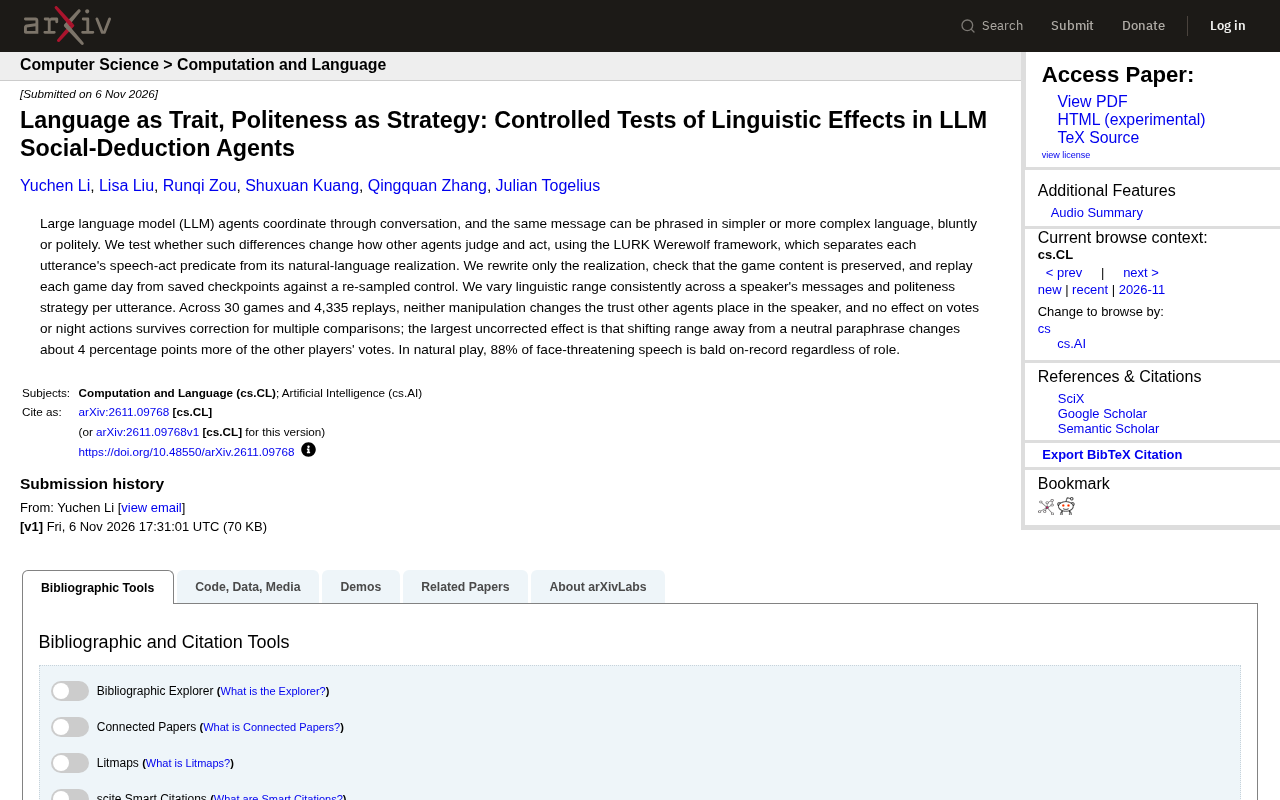
Controlled experiments show LLM social reasoning agents' trust and behavior are insensitive to language style and politeness strategies.
The study conducted controlled experiments in the LURK Werewolf framework, separating speech acts from natural language realization and rewriting only the realization while replaying game days, manipulating two dimensions: linguistic range and politeness strategy. Across 30 games and 4,335 replays, neither manipulation significantly changed other agents' trust in the speaker, and effects on voting and night actions were not significant after multiple comparison correction, with the largest uncorrected effect at only about 4 percentage points. In natural sessions, 88% of face-threatening speech was expressed in a bald on-record manner. The researchers suggest LLM social agents may rely more on the content of speech acts than on expression, or have not yet learned to use language style as a social signal.
In social reasoning games based on large language models (LLMs), such as Werewolf, agents coordinate through dialogue, and the same information can be expressed in simpler or more complex language, or more directly or politely. Does this kind of linguistic variation affect other agents' judgments and behavior? A controlled experiment conducted under the LURK Werewolf framework provides the answer: the influence of language style and politeness strategies is far smaller than expected.
Experimental Design: Separating Linguistic Realization from Game Content
The LURK Werewolf framework handles each utterance's speech-act predicate separately from its natural language realization, allowing researchers to precisely control the linguistic dimension. In the experiment, researchers rewrote only the linguistic realization and verified that the game content remained unchanged, then replayed each game day from saved checkpoints and compared against a resampled control group.
The study manipulated two dimensions of language: first, linguistic range, i.e., systematic variation in the linguistic complexity across all of a speaker's messages; second, politeness strategy, i.e., the politeness level of each utterance. The experiment covered 30 games with a total of 4,335 replays.
Speech Act Theory, proposed by philosophers J.L. Austin and John Searle, centers on the idea that "speaking is acting"—language not only describes the world but also performs acts such as requesting, threatening, promising, and apologizing. In social reasoning games, when a player says "I suspect you're a werewolf," they are not merely conveying information but performing an act of "accusation" that changes the game state and others' perceptions. The LURK Werewolf framework decomposes each utterance into a speech-act predicate (e.g., accuse, defend, threaten) and a natural language realization (specific wording, tone, politeness level); the former determines "what to do," and the latter determines "how to say it." This separation enables researchers to fix the behavioral content and change only the expression, thereby cleanly testing whether surface linguistic features independently affect agent judgments.
Key Findings: Trust and Behavior Are Not Significantly Affected
The experimental results show that neither manipulation changed other agents' degree of trust in the speaker. Moreover, the effects on voting or night actions were not significant after multiple comparison correction. The largest uncorrected effect was that moving linguistic range away from neutral paraphrase changed other players' votes by about 4 percentage points. This effect size is not statistically robust.
In natural game sessions, 88% of face-threatening speech, regardless of role, was expressed in a bald on-record manner.
Face-threatening speech originates from Brown & Levinson's politeness theory. "Face" refers to an individual's social needs for approval and freedom from imposition; face-threatening speech includes commands, criticism, accusations, and threats, which may damage the listener's autonomy or social image. Politeness strategies are precisely the means used to mitigate such threats, for example, using "perhaps you could consider..." instead of "you must..." In Werewolf, accusations and questioning are inherently face-threatening. In the experiment, 88% of such speech adopted a bald on-record manner, i.e., expressed directly without any mitigation—this fits the context of a game that pursues efficiency and clear judgment, and also indicates that agents rarely proactively use politeness modifiers in natural sessions.
Multiple comparisons correction is a key step in statistical inference. When researchers simultaneously test multiple hypotheses (e.g., the effects of linguistic range on multiple outcomes such as trust, voting, and night actions), even if each test individually has a 5% false positive rate, the cumulative probability of obtaining at least one "significant" result is far higher than 5%. Methods such as Bonferroni, Holm, or Benjamini-Hochberg control the overall error rate by adjusting significance thresholds. In this paper, the largest uncorrected effect was about 4 percentage points, but none remained significant after correction, indicating that these effects likely stem from random fluctuation rather than a genuine influence of linguistic manipulation.
Implications: LLM Social Agents Are Insensitive to Surface Linguistic Features
This finding has important implications for the design of multi-agent systems. Although in human communication language style and politeness strategies often affect trust and cooperation, LLM agents in social reasoning tasks did not exhibit sensitivity to such surface linguistic features. This may mean that agents' judgments rely more on the content of speech acts than on how they are expressed, or that current models have not yet learned to use language style as a social signal.
The researchers note that further exploration of more subtle linguistic manipulations or more complex social scenarios is needed to determine under what conditions linguistic effects may emerge.
One-line Summary
Controlled experiments show that LLM social reasoning agents' trust and behavior are insensitive to language style and politeness strategies.
Paragraph Summary
The study conducted controlled experiments under the LURK Werewolf framework, separating speech acts from natural language realization, rewriting only the linguistic realization and replaying game days, and manipulating two dimensions: linguistic range and politeness strategy. Results covering 30 games and 4,335 replays show that neither manipulation significantly changed other agents' trust in the speaker, and effects on voting and night actions were not significant after multiple comparison correction, with the largest uncorrected effect at only about 4 percentage points. In natural sessions, 88% of face-threatening speech was expressed in a bald on-record manner. The researchers suggest that LLM social agents may rely more on the content of speech acts than on expression, or have not yet learned to use language style as a social signal.
Related articles
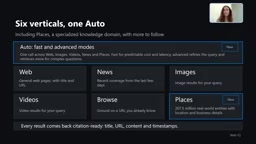
Microsoft WebIQ: Verifiable Real-Time Web Grounding for AI Agents
Microsoft WebIQ gives AI Agents real-time, citable web grounding across web, news, images, videos, and Places—164ms P95 latency, 50% fewer tokens, Scopes source control, and MCP integration.
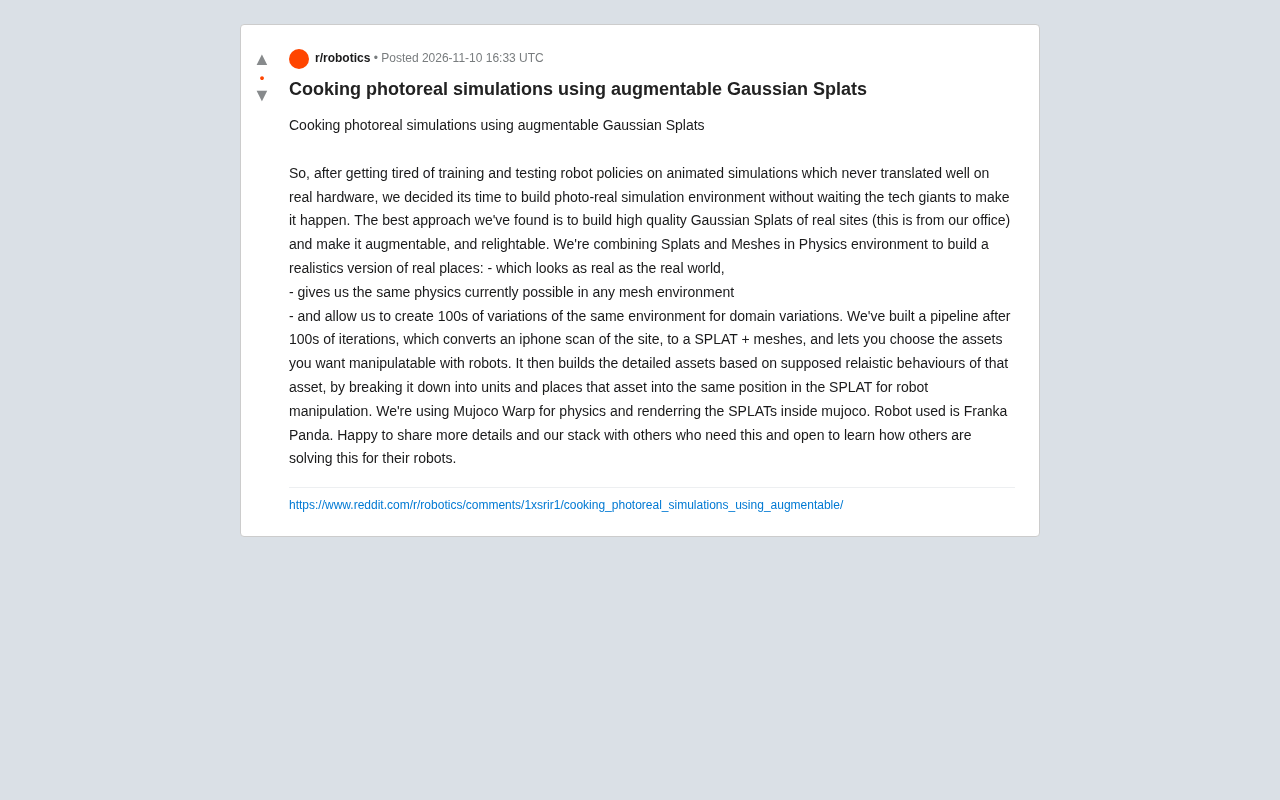
Augmentable Gaussian Splatting: Building Photorealistic Simulation Environments for Robot Training
Team combines Gaussian Splatting with meshes to build photorealistic robot simulation environments, integrating MuJoCo Warp physics and Franka Panda for augmentable, relightable real-site simulation.

Gemini 4 Carbon Released: The Leap from Gemini 3 to Gemini 4 in Under a Year
Google releases Gemini 4 Carbon, less than a year after Gemini 3. In the official demo, Carbon reverse-engineered the Theme Park binary, added a new DeepMind-themed ride, and ported it to the web in one shot.