How Do LLM Platforms Make Money from Ads and Subscriptions? Three Key Findings Reveal Pricing Secrets

Advertising and subscriptions on monopolistic LLM platforms require joint optimization, with menu design at the core.
The study analyzes advertising and subscription strategies for monopolistic LLM platforms within a unified framework of response quality, ad intensity, and subscription pricing. Key findings: ad-supported plans expand coverage but cause utility divergence; a moderate ad cap maximizes consumer surplus; falling compute costs can paradoxically raise total ad revenue; and menu design is central—ads and subscriptions require joint optimization.
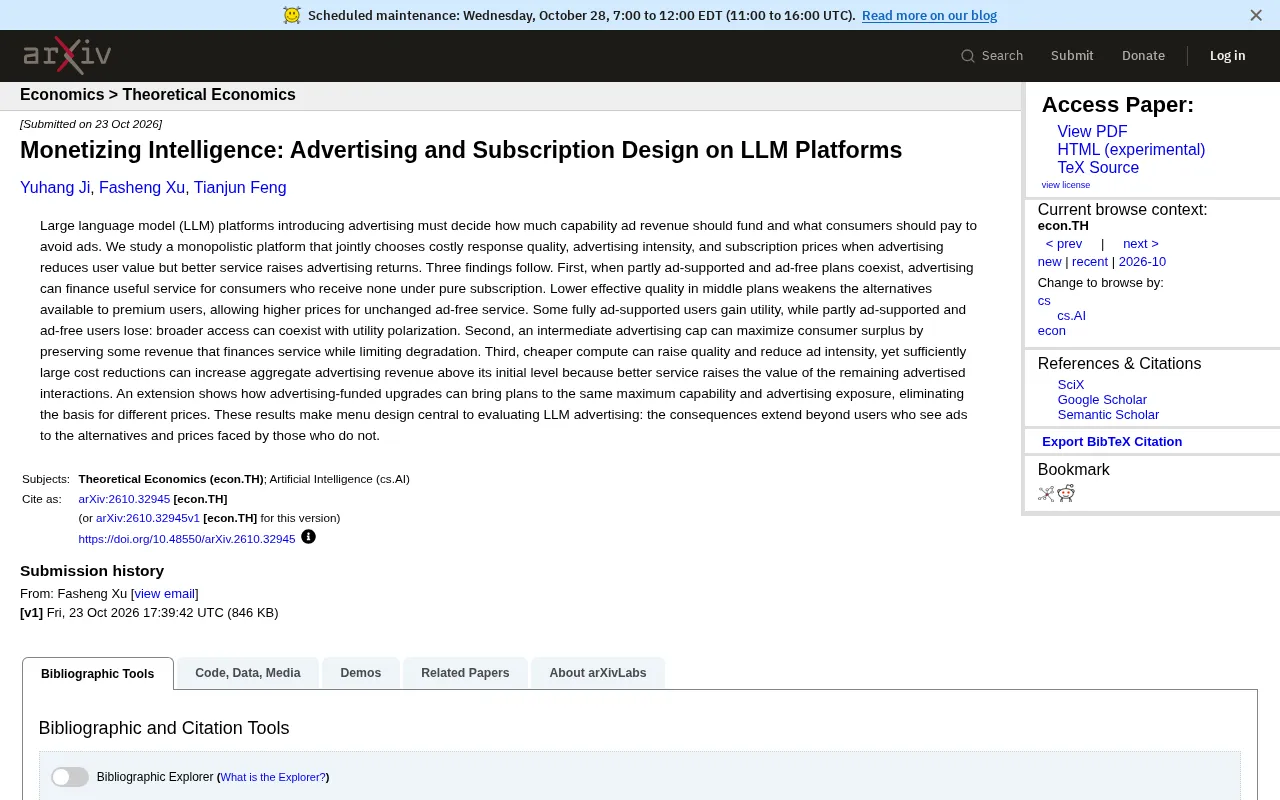
When large language model platforms begin considering the introduction of advertising, a core question emerges: how much capability should ad revenue support, and how much should consumers pay to "remove ads"? A study focused on monopolistic LLM platforms analyzes response quality, ad intensity, and subscription pricing within a single framework, yielding several counterintuitive conclusions.
User Utility Divergence Under Ad Subsidies
The study first establishes a key premise: ads degrade user experience, but better service increases ad returns. The platform must balance three factors—investing costs to improve answer quality, controlling ad intensity, and setting subscription prices.
When the platform offers both "partially ad-supported" and "ad-free" subscription plans, ad revenue can subsidize users who would otherwise be completely unable to access the service under a pure subscription model. This means advertising expands the reach of the service.
But the cost follows. The effective quality of the middle tier (partially ad-supported) is dragged down, which in turn weakens the substitutable options available to high-end users, enabling the platform to maintain or even raise prices for "ad-free" service. The end result is utility divergence: users who rely entirely on ads may see utility gains, while partially ad-supported users and ad-free users may be harmed. Broader service coverage coexists with utility polarization among users.
Consumer surplus is the core economic tool for measuring this welfare change: it equals the difference between the maximum price a user is willing to pay for the service and the price actually paid. "Consumer surplus maximization" in the study refers to maximizing the sum of surplus across all users, not improving every individual user's utility. This also explains why "total surplus improves while some users are harmed" can occur—ad subsidies bring previously unable-to-pay users into the market, increasing total surplus, but middle-tier quality is diluted, reducing some users' actual benefits. When evaluating policy, one typically also applies the compensation principle (whether the harmed can be compensated by the beneficiaries with something left over) to judge whether there is room for Pareto improvement.
A Moderate Ad Cap Actually Benefits Consumers
The second finding challenges the intuition that "fewer ads are always better." The study shows that there exists an intermediate ad cap that maximizes consumer surplus.
The reason: completely banning ads would cut off the revenue source that subsidizes service; while too many ads would severely damage experience. A moderate cap preserves some revenue to support service quality while limiting the degree of experience deterioration. For the platform, this means the ad strategy is not simply "more" or "less," but an intermediate value that requires precise calibration.
The "ad cap" here corresponds in industrial organization theory to the idea of price cap regulation or quantity constraints. Contrary to intuition, setting a cap on ad intensity is not equivalent to banning ads; rather, it restricts the platform's advertising decisions to a range. The economic logic is that ad intensity has negative externalities (harming user experience), and a monopolistic platform has no incentive to internalize this cost, so it will over-advertise. A moderate cap acts as a mild form of regulation, forcing the platform to rebalance revenue and experience. This conclusion aligns with the "Pigouvian tax on the advertising side" idea in two-sided market literature—when the platform cannot self-restrain, external constraints can actually improve social welfare.
The Paradox of Falling Compute Costs
The third finding concerns the impact of compute costs. When computational costs fall, the platform can improve service quality while reducing ad intensity—which sounds like a win-win.
But the study points to a paradox: when the cost decline is large enough, total ad revenue may actually exceed the initial level. The logic chain is as follows: better service raises the value of remaining ad interactions, advertisers are willing to pay higher prices, thereby offsetting the revenue loss from fewer ads. In other words, quality improvement itself can become an amplifier of ad revenue.
This paradox is essentially quality-advertising complementarity at work. In ad auctions (such as pay-per-click or pay-per-impression), the value of an ad slot depends on the quality of user attention and conversion probability. When falling inference costs make model responses more accurate and conversations more fluid, user dwell time and interaction depth increase, and the expected return per ad exposure rises accordingly. As a result, the platform can reduce the number of ads while raising the unit ad price, and total revenue need not fall. This parallels the traditional media mechanism of "content quality driving advertising premiums," but in the LLM context, quality improvement is directly driven by compute costs, creating a non-monotonic relationship between cost declines and ad revenue.
Menu Design Is the Real Key
The study also conducts an extended analysis: if ad-funded upgrades bring different tiers to the same maximum capability and ad exposure levels, then the basis for differentiated pricing disappears.
This points to a broader conclusion: when evaluating an LLM platform's advertising strategy, one cannot focus only on "who sees ads." Menu design—that is, the quality differences, price gradients, and ad intensity combinations across tiers—transmits effects to every user, including those who pay to remove ads. The substitutable options and prices they face are likewise reshaped by the advertising strategy.
For LLM platforms, advertising and subscriptions are not two independent decisions but a product architecture that requires joint optimization.
Menu design originates from screening theory in mechanism design: a monopolist offers a set of quality-price combinations so that different types of consumers self-select, thereby extracting more surplus. In LLM platforms, the menu dimensions include not only price and quality but also ad intensity as a non-monetary cost. When ad-funded tiers converge with high-end tiers in quality and ad exposure, the "incentive compatibility" constraint across tiers is broken, making it difficult for the platform to distinguish high-willingness-to-pay from low-willingness-to-pay users, and the foundation of differentiated pricing collapses. Thus, menu design is essentially a tool for user segmentation under information asymmetry, and advertising strategy must be evaluated within this overall architecture.
One-line Summary
Advertising and subscriptions on monopolistic LLM platforms require joint optimization, with menu design at the core.
Paragraph Summary
The study incorporates response quality, ad intensity, and subscription pricing into a unified framework to analyze advertising and subscription strategies for monopolistic LLM platforms. Key findings include: ad-supported plans expand service coverage but lead to utility divergence, with some ad-supported and ad-free users potentially harmed; an intermediate ad cap maximizes consumer surplus by balancing revenue subsidies and experience damage; when compute costs fall substantially, quality improvements may cause total ad revenue to exceed initial levels; and menu design (quality differences, price gradients, ad intensity combinations) is central to evaluating advertising strategy—advertising and subscriptions are not independent decisions but a product architecture requiring joint optimization.
Related articles

Android Developer Verification: Four Paths and Global Rollout Timeline
Android Developer Verification explained: Google unveils four verification paths—Play developers, independent distributors, students/hobbyists, and power users—plus developer console API automation, 24-hour safety delay, and global phased enforcement timeline.

Compose Performance Optimization: A Practical Guide to Outperforming Yourself
A deep dive into Jetpack Compose performance optimization: release-mode measurement, Baseline Profiles, Perfetto composition tracing, computed vs. derived state, effect API costs, and avoiding unnecessary recomposition.

Bitmap Memory Optimization in Practice: 5 Strategies to Reduce App Memory Usage
Based on Google I/O research across ~500 Android apps, this guide covers the Reduce, Reuse, Recycle Bitmap memory optimization strategies—CDN cropping, downsampling, Bitmap Region Decoder, cache deduplication, onTrimMemory handling, Play Console memory metrics, and local profiling toolchains.