How Do Urban Robots Affect Perceived Safety? Differences Between Multimodal LLMs and Human Perception

A study compared humans with personified multimodal models using synthetic Seoul streetscapes, finding robots reduce perceived street safety.
The study generated 18 Seoul street images varying by time of day, road class, and robot condition, and had 25 human respondents and two multimodal LLMs (each conditioned on 500 synthetic personas) complete paired perceived-safety judgments. Results show robot presence overall reduces perceived safety, delivery robots are more accepted than humanoid robots, robots are chosen more often at night, older personas less often choose robot images, and road class has little effect. Models match humans on the nighttime effect but choose humanoid robots far less often, with Gemma's nighttime effect about 3 times that of humans. Personified MLLMs capture only part of human judgment and cannot replace real human perception.
Robots appearing on city streets is nothing new, but how pedestrians perceive the safety implications of these robots remains an open question. A new study generated Seoul streetscape images and compared multimodal large language models against human respondents, revealing how robot presence, type, and setting alter people's sense of safety.
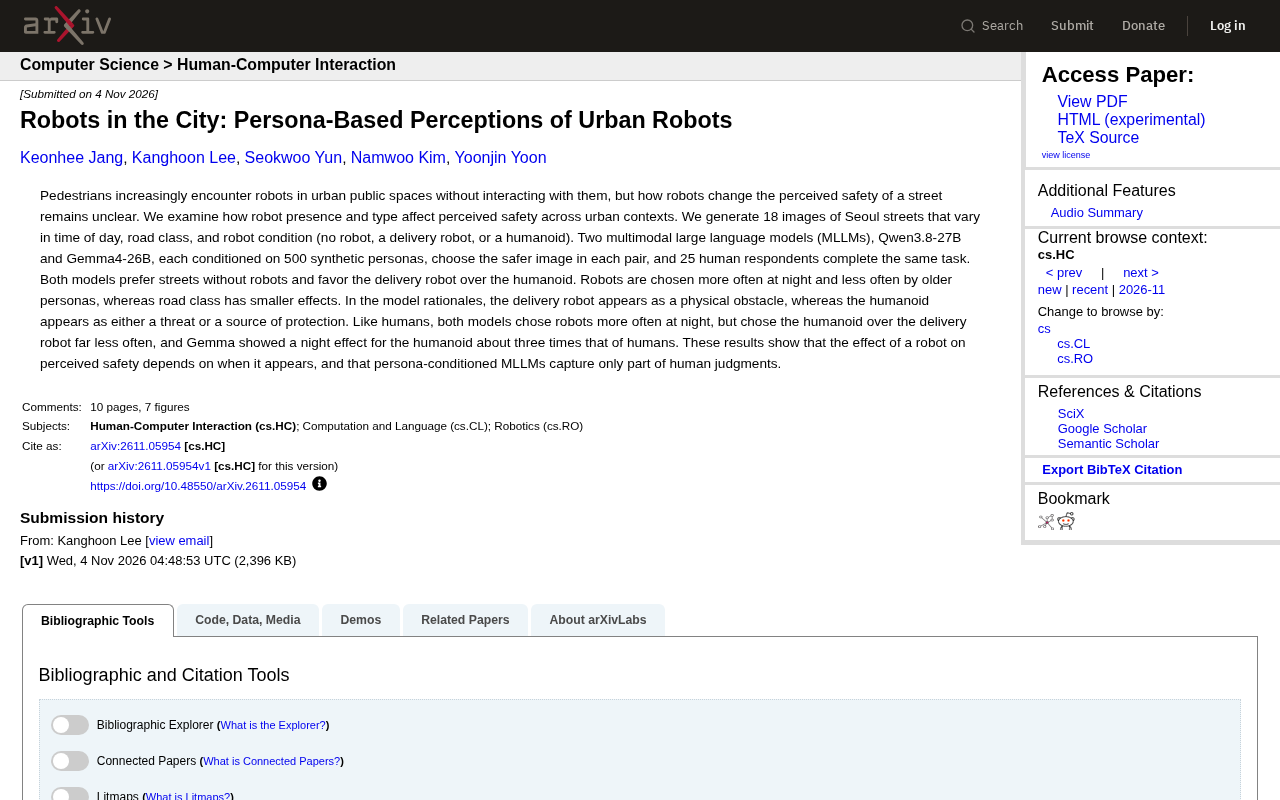
Research Method: Synthetic Images and Personified Models
The research team generated 18 Seoul street images that varied by time of day (day/night), road class, and robot condition (no robot, delivery robot, humanoid robot). To simulate the perceptions of different populations, they used two multimodal large language models (MLLMs)—Qwen3.8-27B and Gemma4-26B—each conditioned on 500 synthetic personas for selection. Meanwhile, 25 human respondents completed the same task: choosing which image in each pair felt safer.
This approach attempts to combine large-scale model simulation with real human judgment to explore the impact of robots on perceived safety.
Multimodal large language models (MLLMs) refer to large language models capable of processing multiple modalities such as text and images simultaneously, with typical examples including GPT-4V, Gemini, and Qwen-VL. Unlike text-only models, MLLMs map images into tokens through a vision encoder and then perform joint reasoning with the language model, enabling them to "look at an image and answer." In this study, MLLMs were used to make binary safety judgments on streetscape images, effectively treating the models as "virtual respondents." Synthetic personas are a prompt engineering technique: given descriptions such as age, gender, and occupation, the model answers as a specific identity, thereby simulating population heterogeneity. Note that personified outputs reflect statistical tendencies in the model's training data rather than the psychological states of real individuals, so their consistency with human judgment can only serve as referential evidence.
Key Findings: Robots Reduce Perceived Safety, but Type and Setting Matter
Both models were more inclined to choose streets without robots, indicating that robot presence overall reduces perceived safety. Regarding robot type, delivery robots were preferred over humanoid robots. However, this preference was moderated by setting: at night, robots were selected more frequently, while road class had little effect.
Age was also a factor: older personas chose images with robots less often. Based on the reasons given by the models, delivery robots were seen as physical obstacles, while humanoid robots could be perceived as either threats or sources of protection.
Perceived safety is a core concept in environmental psychology and criminology, referring to the degree to which an individual subjectively feels free from threat in a given space, as distinct from actual safety measured by objective indicators such as accident rates and crime rates. Research shows that perceived safety is influenced by environmental cues such as lighting, visibility, spatial openness, and the presence of others, and is directly related to whether people are willing to use a particular street or public space. When service robots enter sidewalks, they simultaneously alter physical passage space and social cues: they are both obstacles requiring detours and potentially interpreted as "intentional agents." This is precisely why the study distinguishes delivery robots from humanoid robots—the latter, with their human-like form and facial features, more easily trigger anthropomorphic perception, thereby evoking two opposing psychological responses: threat or guardianship.
Similarities and Differences Between Model and Human Judgment
Like humans, both models were more inclined to choose robots at night. But differences were equally clear: the models chose humanoid robots over delivery robots far less frequently than humans did. In addition, the night effect for humanoid robots in the Gemma model was about 3 times that of humans. These results indicate that personified MLLMs capture only part of human judgment, especially when humanoid robots are involved.
Paired comparison is an experimental paradigm commonly used in psychophysics and preference research: two options are presented to subjects each time, and they are asked to choose the better or safer one. Compared with direct rating, paired comparison reduces individual differences and anchoring effects in scales, and can be converted into comparable preference strength through statistical models (such as the Bradley-Terry model). This study had human respondents and personified models complete the same binary-choice task precisely so that the two could be compared under identical stimuli and response formats. However, paired comparison only reflects relative preference and cannot directly yield an absolute magnitude for "how much perceived safety decreased," which is why results are presented as "selection frequency" rather than score differences.
Implications and Limitations
The study emphasizes that the impact of robots on perceived safety depends on when they appear (e.g., at night), and that although model simulation can provide some insight, it cannot fully replace human perception. For urban robot designers and policymakers, understanding these nuances can help better plan robot deployment and enhance the sense of safety in public spaces.
The study also has limitations, such as a small sample size (25 human respondents) and a focus solely on Seoul streets; future work needs more diverse settings and larger-scale human data for validation.
One-line Summary
A study compared humans with personified multimodal models using synthetic Seoul streetscapes, finding that robots reduce perceived street safety.
Paragraph Summary
This study generated 18 Seoul street images varying by time of day, road class, and robot condition, and had 25 human respondents and two multimodal large language models (each conditioned on 500 synthetic personas) complete paired perceived-safety judgments. Results show that robot presence overall reduces perceived safety, and delivery robots are more readily accepted than humanoid robots; robots were selected more frequently in nighttime scenes, older personas chose images with robots less often, and road class had little effect. The models matched humans on the nighttime effect but chose humanoid robots far less often than humans, with Gemma's nighttime effect about 3 times that of humans. The study shows that personified MLLMs capture only part of human judgment and cannot replace real human perception.
Related articles

64 Releases in 40 Days: How Strata Uses Release Velocity to Define Its AI Local Inference Roadmap
Strata shipped 64 releases in 40 days with 460k+ characters of notes. From 0.1.0 to 0.2.10, a three-step path: make it run, make it fast, make it trustworthy.

Ripple-65B Open-Source Model Tops Community Charts
Ripple-65B open-source LLM debuts atop community charts, using a self-recursive architecture to slash long-context KV cache for low-latency hundred-billion-scale inference on ordinary GPUs, with preview weights, quantized files, and one-click Olema & VLM deployment.

Deploy Open-Source Video Model MiniMax H3 Locally in 5 Minutes and Skip Cloud Generation Fees
Bilibili creator tests local deployment of open-source video model MiniMax H3: three-step ComfyUI install, 5-minute setup, no coding. Same prompt generates in 2 minutes locally vs 4 minutes online with queuing, saving about 30 RMB per 15-second 720P video. Includes VRAM requirements and RTX 5080 test results.