How Does AI Mimic the "Chaotic" Human Mind? Insights from Randomness to Hallucination
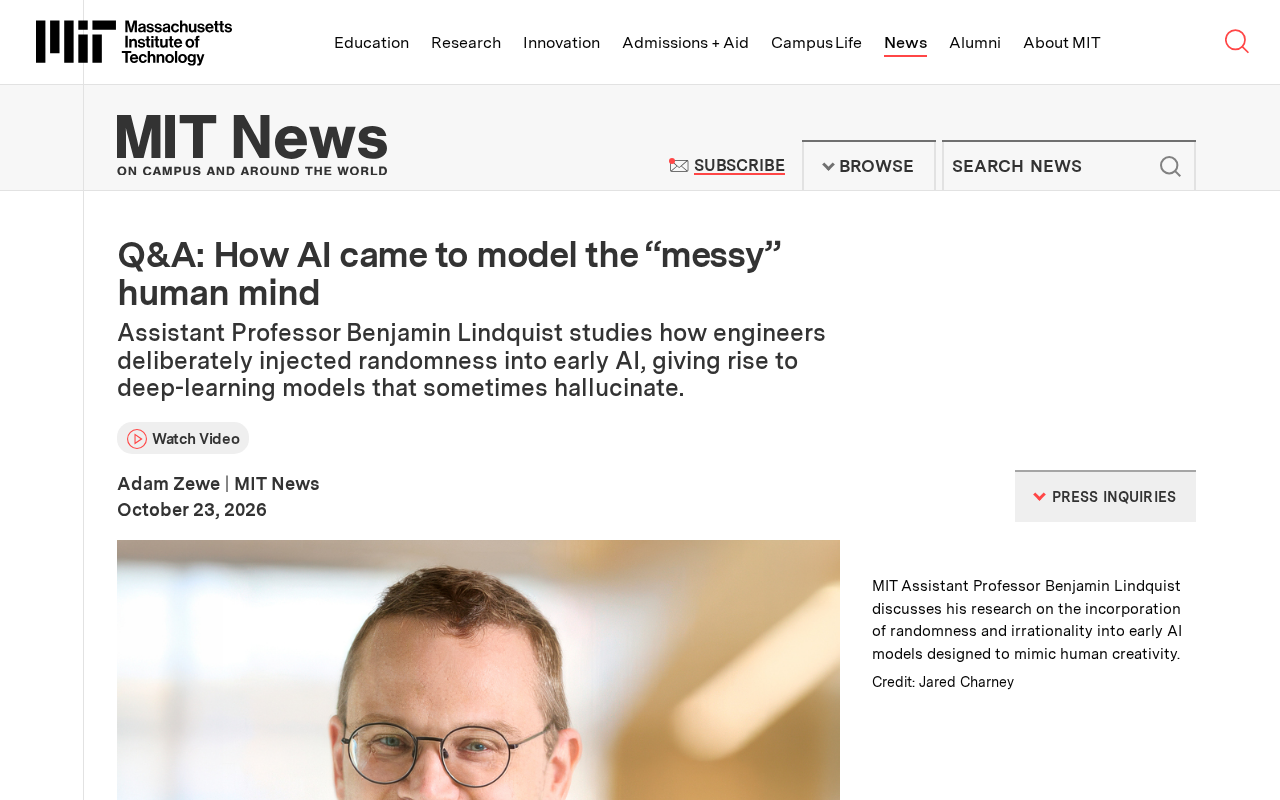
AI hallucinations stem from randomness deliberately injected by early engineers—an imitation of the chaos of the human mind.
Based on research by assistant professor Benjamin Lindquist, this article traces the technical lineage of randomness in AI development. Early engineers did not pursue absolute precision but actively introduced mechanisms such as random initialization and Dropout to simulate the uncertainty of human decision-making, which gave deep learning strong generalization ability while also planting the seeds of output instability. So-called "hallucinations" are not purely malfunctions but a byproduct of models imitating how human thought fills in information gaps, yet they can cause serious consequences in high-stakes domains such as medicine and law. The article raises a core question: should we pursue fully deterministic AI? The answer leans toward establishing "controllable randomness"—suppressing hallucinations when precision is needed and unleashing randomness when creativity is needed, learning to coexist with "chaos" and guide it.
AI "hallucinations" are often seen as a flaw, but research by assistant professor Benjamin Lindquist points out that this unpredictability stems precisely from randomness deliberately injected by early engineers—it is exactly what allowed deep learning models to simulate the "chaos" of the human mind. This article traces this overlooked technical lineage, analyzing how randomness shaped today's AI and what lessons it offers.
The Origins of Randomness: Deliberate "Imperfection"
In Lindquist's research, early AI engineers were not pursuing absolutely precise computation but actively introducing randomness into models. This approach seemed counterintuitive at the time, yet it laid the groundwork for the later development of deep learning. According to Lindquist's analysis, engineers realized that human decision-making is itself full of uncertainty, and that if machines were to simulate human cognition, the models had to be allowed to "make mistakes."
This design philosophy directly influenced how neural networks are trained. Through techniques such as random weight initialization and randomly dropping neurons (dropout), models gained stronger generalization ability—but also planted the seeds of output instability.
Random weight initialization is a fundamental operation in deep learning training: the parameters of each network layer are not manually set before training begins but are randomly sampled from some probability distribution (such as a Gaussian or uniform distribution). This breaks the symmetry among neurons—if all weights were initialized to the same value, neurons within the same layer would receive identical gradient updates during backpropagation, and the network would degenerate into an equivalent single neuron, unable to learn complex features. Random initialization lets each neuron start from a different point, thereby exploring different feature combinations. Meanwhile, Dropout randomly "switches off" some neurons with a certain probability during training, forcing the network not to rely on a few specific nodes—equivalent to an implicit ensemble of a large number of subnetworks, significantly reducing the risk of overfitting. Together, these two techniques form the core mechanisms of randomness injection and are an important source of model output uncertainty.
From Randomness to Hallucination: The Double-Edged Sword of Deep Learning
The power of deep learning lies in extracting patterns from massive amounts of data, but the injection of randomness means models sometimes generate content that seems plausible yet is factually incorrect—this is "hallucination." Lindquist points out that hallucination is not purely a malfunction but a byproduct of the model simulating the human mind. Human thought likewise fills in information gaps and produces associative errors; AI hallucinations are, to some extent, an imitation of this "chaos."
However, this imitation also brings risks. In high-stakes domains such as medicine and law, hallucinations can lead to serious consequences. Researchers are exploring how to balance randomness and reliability—for example, through constrained decoding and the introduction of external knowledge verification.
"Hallucination" is a term borrowed from research on human perception; in the AI field it specifically refers to a model generating fluent, confident content that does not match the facts or the input. Its causes are multi-layered: noise and coverage gaps in training data, the model's probabilistic word-by-word sampling (such as random decoding regulated by the temperature parameter), and the model's tendency to fill in statistically "plausible" patterns rather than verify facts. Notably, hallucination and randomness are not in a simple causal relationship—even with fully deterministic decoding, a model may still fabricate content due to missing knowledge; but randomness amplifies the diversity of outputs and makes errors more likely to surface. Constrained decoding restricts the set of candidate words during generation (for example, forcing output to conform to a certain grammar or entity list), while retrieval-augmented generation (RAG) introduces an external knowledge base for real-time verification. These two are currently the mainstream engineering approaches to suppressing hallucinations.
Implications for AI Development: Accept "Chaos" or Control It?
Lindquist's work raises a fundamental question: should we pursue fully deterministic AI? The answer may be no. The creativity of the human mind often stems from uncertainty, and AI's "chaos" may also become a source of innovation. But the key lies in establishing controllable randomness—suppressing hallucinations in scenarios that require precision, and unleashing randomness in scenarios that require creativity.
This perspective offers new ideas for AI ethics and design: rather than trying to eliminate all uncertainty, we should learn to coexist with "chaos" and guide it toward beneficial directions through technical means.
Controllable randomness already has concrete engineering levers. At the decoding stage, the temperature parameter and nucleus sampling (top-p) can directly adjust the degree of divergence in outputs: low temperatures tend toward determinism, high temperatures toward diversity. In scenarios requiring precision (such as code generation and factual question answering), lower the temperature and combine it with constrained decoding; in scenarios such as creative writing and brainstorming, moderately raise the temperature to unleash diversity. In addition, Bayesian methods provide a quantifiable framework for "uncertainty"—a model can give confidence intervals for its own predictions, thereby proactively declining to answer or requesting human intervention when confidence is low. This ability to "know that it doesn't know" is closer to how the human mind operates than simply suppressing randomness, and it also provides an auditable safety boundary for AI deployment in high-stakes domains.
Conclusion
AI's "hallucinations" are not accidental but the inevitable result of early design choices. Lindquist's research reminds us that understanding AI's limitations requires tracing back to its technical roots. While pursuing more powerful models, how to dance with randomness will be an important challenge for the future development of AI.
One-line Summary
AI hallucinations stem from randomness deliberately injected by early engineers—an imitation of the chaos of the human mind.
Paragraph Summary
Based on research by assistant professor Benjamin Lindquist, this article traces the technical lineage of randomness in AI development. Early engineers did not pursue absolute precision but actively introduced mechanisms such as random initialization and Dropout to simulate the uncertainty of human decision-making, which gave deep learning strong generalization ability while also planting the seeds of output instability. So-called "hallucinations" are not purely malfunctions but a byproduct of models imitating how human thought fills in information gaps, yet they can cause serious consequences in high-stakes domains such as medicine and law. The article thus raises a core question: should we pursue fully deterministic AI? The answer leans toward establishing "controllable randomness"—suppressing hallucinations when precision is needed and unleashing randomness when creativity is needed, learning to coexist with "chaos" and guide it.
Related articles

Meta vs. Publishers: The AI Data Battle Over Terms of Service Changes and the Future of the Internet
Meta changed its business account terms to allow AI training on linked website data, sparking backlash from publishers and creators. Industry groups demanded negotiations, forcing Meta to remove 'training' wording and delay the effective date. The dispute reveals the deeper battle over data authorization and the future of the internet in the AI era.

When Outside Xbox Meets Blood on the Clocktower: A Legion Match in Minecraft
Outside Xbox guests Ellen and Mike play Minecraft Blood on the Clocktower in a Legion game. How can three good players fight an evil majority amid information noise? This article breaks down Legion mechanics, information-role mind games, and the endgame reversal.

Kimi K3.1 Hands-On Test: Open-Source Model Nears Opus, Video Generation Steals the Show
Kimi K3.1 completed motion graphics, 3D rendering, mini-games, and video generation in a live test. Analysis of its 2.8T MoE architecture, gap vs Opus/GPT, and hidden video generation.