How Does Anthropic Get AI Agents to Work for Hours on End?
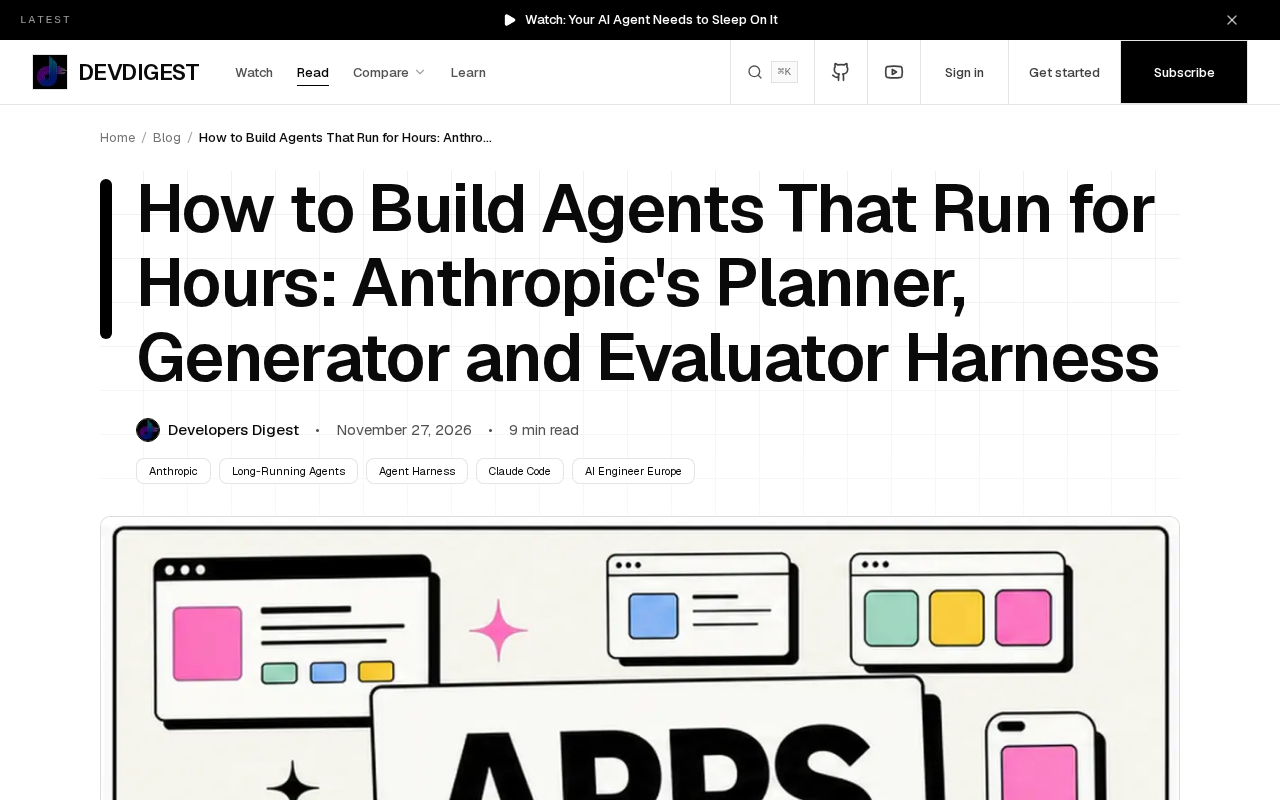
Anthropic uses a closed-loop framework of planning, generation, and evaluation to take agents from 20 minutes to hours of operation.
Anthropic Applied AI team researchers Ash Prabaker and Andrew Wilson shared a key leap in Claude agent capabilities: from 20-minute continuous runs to multi-hour long tasks. This progress stems from a GAN-inspired execution framework with Planner, Generator, and Evaluator. The Planner decomposes vague goals into task graphs with dependencies, the Generator focuses on the current node, and the Evaluator reviews and scores, triggering regeneration or plan adjustment. Closed-loop feedback replaces human checkpoints, enabling continuous self-correction and longer effective operation. Architecture design is as important as model selection for long-running agents.
From 20 Minutes to Hours: A Breakthrough in Sustained Agent Operation
Anthropic Applied AI team researchers Ash Prabaker and Andrew Wilson recently shared a key leap in Claude agent capabilities: from early days when it could only run continuously for 20 minutes, to now supporting multi-hour long-task construction. This progress doesn't rely solely on model upgrades—it stems from an engineering architecture inspired by generative adversarial networks (GANs): an "execution framework" (Harness) composed of a Planner, Generator, and Evaluator.

In traditional conversation scenarios, the model only needs to respond to single-turn or short-context requests. But when an agent needs to handle long-cycle tasks like "building a complete application in one go," maintaining goal consistency, contextual coherence, and self-correction capability over extended periods becomes the core challenge. Anthropic's framework is designed precisely for this.
Generative adversarial networks (GANs) were proposed by Ian Goodfellow in 2014, with the core being an adversarial game between a generator and a discriminator: the generator tries to produce realistic samples, the discriminator identifies real from fake, and both improve together through the game. What Anthropic borrows here is the structural metaphor of "generation—judgment" mutual constraint, not GAN's adversarial training mechanism. The difference is that GAN's discriminator and generator are trained synchronously and compete with each other, whereas the Evaluator in the agent framework typically validates the Generator's output based on rules or models, triggering retries or re-planning—belonging to a quality-control loop at the task execution level. Understanding this distinction helps avoid misinterpreting the agent framework as some kind of adversarial training method.
Three-Component Framework: Division of Labor Between Planning, Generation, and Evaluation
The core idea of this framework borrows from GAN's adversarial thinking, but applies it to the task execution flow rather than image generation.
Planner: Breaking Vague Goals into Executable Steps
The Planner is responsible for decomposing the user's high-level goal (such as "build an accounting app") into a series of verifiable subtasks and milestones. Its output is not a one-time instruction, but a task graph with priorities and dependencies, providing a roadmap for subsequent execution.
Generator: Focusing on Output for the Current Step
The Generator produces specific code, documentation, or operations based on the current task node given by the Planner. It doesn't need to consider the whole picture at once—it only needs to complete the current slice within the established context, thereby reducing per-step complexity.
Evaluator: Serving as Quality Gatekeeper
The Evaluator reviews and scores the Generator's output, determining whether it meets the acceptance criteria for the current step. If not, it triggers regeneration or plan adjustment. This closed-loop feedback allows the agent to continuously correct course without human intervention, extending effective operation time.
In the agent context, "context" refers to the information window accessible to the model during a single inference, including system prompts, task descriptions, historical operation records, and intermediate artifacts. The main difficulty of long tasks is that context keeps expanding with runtime; once it exceeds the window, early goals and constraints get diluted, causing the agent to "drift off." The task graph produced by the Planner and the acceptance criteria of the Evaluator effectively serve as external memory and constraint anchors: each step only needs to load relevant slices rather than the full history. This approach of externalizing long-term goals into a structured task graph is a common engineering strategy for mitigating context drift and supporting multi-hour operation.
The Key to Long-Running Operation: Feedback Loops, Not Model Scale
What's noteworthy is that the benefits of this framework don't come entirely from larger models. Ash Prabaker and Andrew Wilson's sharing emphasizes that separating planning, generation, and evaluation into a loop allows the system to maintain a sense of direction over multi-hour tasks. The Evaluator's continuous involvement replaces human checkpoints at intermediate stages—an important engineering means for agents to move from "minute-level" to "hour-level."
For developers, this means that when building long-running agents, architecture design (how to decompose, how to validate, how to loop back) is as important as model selection. The reuse of GAN-style adversarial thinking at the task orchestration level also provides a new reference paradigm for agent engineering.
One-line Summary
Anthropic uses a closed-loop framework of planning, generation, and evaluation to take agents from 20 minutes to hours of operation.
Paragraph Summary
Anthropic Applied AI team researchers Ash Prabaker and Andrew Wilson shared a key leap in Claude agent capabilities: from early continuous operation of 20 minutes to now supporting multi-hour long tasks. This progress doesn't rely solely on model upgrades but stems from an execution framework inspired by generative adversarial networks, composed of a Planner, Generator, and Evaluator. The Planner decomposes vague goals into task graphs with dependencies, the Generator focuses on output for the current node, and the Evaluator reviews and scores, triggering regeneration or plan adjustment when criteria aren't met. Closed-loop feedback replaces human checkpoints, enabling agents to continuously correct course without intervention and extend effective operation time. The article emphasizes that in breakthroughs for long-running agents, architecture design is as important as model selection.
Related articles

A 19-Year-Old's Rental Horror Story: Ceiling Collapse, Bug Infestation, and the Lessons It Taught Me
At 19, my first off-campus rental brought bug infestations, no heat, a collapsed ceiling, and a ruined laptop with no renter's insurance. Here are the hard-won lessons for first-time student renters.

Veda Nurse's Cranial Nerve Exam: Why ASMR Role-Play Is Going Viral
Bilibili creator Veda's cranial nerve exam ASMR video goes viral, blending humor and sensory triggers through nurse role-play. This article analyzes its unique appeal and the audience psychology behind ASMR role-play.

LG Cinebeam AI Review: 120-Inch Giant Screen + 3000 Lumens, a New Choice for the Living Room Theater
LG Cinebeam AI projector review: 3000 ANSI lumens, 4K, 100 inches from about 8 cm and 120 inches from about 18 cm. Built-in webOS, AI Concierge voice recommendations, AI Sound Pro 11.1.2 virtual surround, and Game Optimizer—positioned for fixed living room installation, complementing the portable Cinebeam S.