How Does Hybrid Retrieval Optimize Government Scheme Search in English and Marathi?

Hybrid BM25 and sentence embedding retrieval modestly improves English-Marathi government scheme search, but lexical signals still dominate.
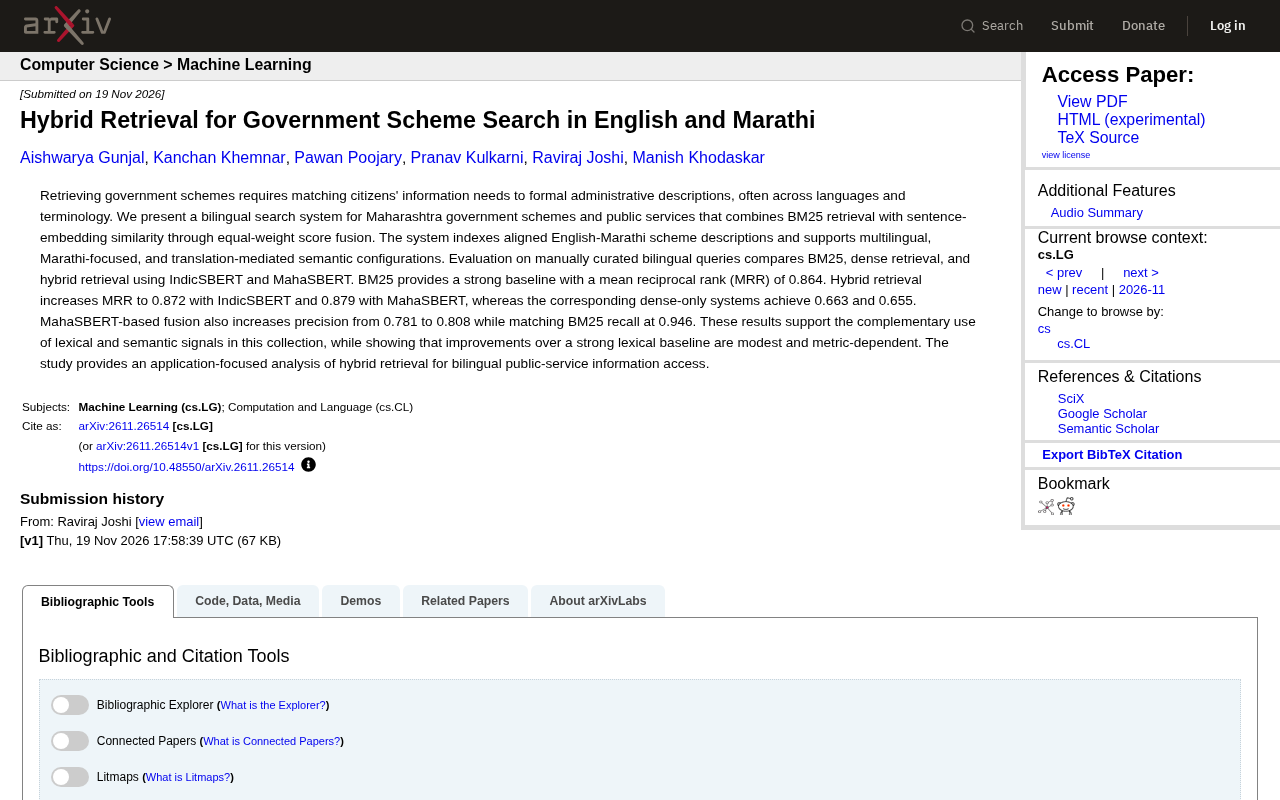
This study addresses bilingual retrieval of Maharashtra government schemes with a hybrid system that equally weights BM25 and sentence embeddings. In English-Marathi, BM25 as a strong baseline achieved MRR 0.864; hybrid retrieval raised MRR to 0.879 (MahaSBERT) and precision from 0.781 to 0.808 while recall held at 0.946. Pure dense retrieval lagged (MRR 0.655), showing semantics cannot replace lexical matching. MahaSBERT slightly beat IndicSBERT. Gains are modest and metric-dependent; lexical signals still dominate in government search, and semantic signals need careful evaluation.
Government scheme retrieval faces a core challenge: citizens express their needs in everyday language, while official documents use formal administrative terminology, often across languages. A study of a bilingual search system for Maharashtra government schemes improved retrieval performance in English and Marathi by hybridizing BM25 with sentence embedding similarity, but the gains were limited—revealing the practical boundaries of how lexical and semantic signals complement each other.
Why does government scheme search need hybrid retrieval?
The essence of government scheme retrieval is matching citizens' information needs with formal administrative descriptions. Citizens may use colloquial expressions like "farmer subsidy" or "low-income family assistance," while official documents use formal terms like "agricultural financial support program" or "economically disadvantaged group assistance scheme." This terminology gap is amplified in cross-lingual scenarios—citizens in Maharashtra may query in Marathi, while some scheme descriptions are primarily in English.
A single retrieval strategy struggles to cover both lexical matching and semantic generalization. BM25 relies on exact term matching and is sensitive to terminology variants; dense retrieval captures semantic similarity through sentence embeddings but may lose key entity words. The hybrid approach proposed in this study attempts to fuse both types of signals, balancing precision and recall in a bilingual setting.
BM25 is a classic retrieval algorithm based on term frequency-inverse document frequency (TF-IDF) that computes relevance scores by exactly matching query terms with terms in documents. BM25 normalizes term frequency and document length, performing robustly in domains with standardized terminology (such as government documents), but it cannot recognize synonyms, abbreviations, or semantic variants and is sensitive to terminology gaps.
Sentence embeddings map entire sentences or paragraphs into dense vectors and measure semantic proximity via cosine similarity. These models are typically fine-tuned from pretrained language models (such as BERT) and can generalize to unseen expressions, but they may overlook key entity words or numbers, leading to imprecise recall. Hybrid retrieval fuses the scores from both, aiming to balance lexical precision with semantic generalization.
System architecture: equal-weight fusion of BM25 and sentence embeddings
The system indexes aligned English-Marathi scheme descriptions and supports three configurations: multilingual mode, Marathi-focused mode, and a translation-mediated semantic mode. The core of hybrid retrieval is equal-weight score fusion—combining BM25's lexical score with sentence embedding cosine similarity scores at equal weights.
The study compared two sentence embedding models: IndicSBERT (a multilingual model for Indian languages) and MahaSBERT (a model optimized for Marathi). The equal-weight fusion design means the system does not rely on complex weight tuning but assumes lexical and semantic signals are equally important. This simplicity reduces deployment complexity but may also cap the upper bound of the fusion strategy.
IndicSBERT and MahaSBERT both belong to the Sentence-BERT (SBERT) family. SBERT encodes sentences into fixed-dimensional vectors through a Siamese network structure and is optimized for semantic similarity tasks, making it suitable for retrieval scenarios. IndicSBERT is a multilingual model trained on corpora from multiple Indian languages, covering Hindi, Marathi, English, and others; MahaSBERT is specifically fine-tuned for Marathi and better captures Marathi's grammatical and lexical features. In hybrid retrieval, the sentence embedding model computes semantic similarity scores between queries and documents, which are added with equal weight to BM25's lexical score to form the final ranking basis.
Evaluation results: gains and limitations of hybrid retrieval
On a manually curated bilingual query set, the study compared the performance of BM25, dense retrieval, and hybrid retrieval. BM25, as a strong baseline, achieved a mean reciprocal rank (MRR) of 0.864, demonstrating the solid foundation of lexical matching in the government scheme domain.
Hybrid retrieval raised MRR to 0.872 (IndicSBERT) and 0.879 (MahaSBERT), while pure dense retrieval achieved MRR of only 0.663 and 0.655, significantly lagging behind. MahaSBERT's fusion approach also improved precision from 0.781 to 0.808 while maintaining recall on par with BM25 at 0.946.
These data convey two key messages: dense retrieval performs poorly when used alone, indicating that semantic signals are insufficient to replace lexical matching in this domain; hybrid retrieval brings improvements but they are limited and vary by metric. The researchers explicitly note that improvements over the strong lexical baseline are "modest" and emphasize that results are "metric-dependent."
Mean reciprocal rank (MRR) is a commonly used evaluation metric for retrieval systems, computing the average of the reciprocal rank (i.e., 1/rank) of the first relevant document for each query. The closer MRR is to 1, the higher relevant documents rank. Precision measures the proportion of relevant documents among returned results, and recall measures the proportion of all relevant documents successfully returned. In government scheme search, high recall ensures citizens do not miss eligible schemes, while high precision reduces interference from irrelevant results. The researchers report all three metrics to comprehensively evaluate the trade-offs of hybrid retrieval across different dimensions.
Model selection in multilingual scenarios
MahaSBERT performed slightly better than IndicSBERT in hybrid retrieval, with MRR of 0.879 and 0.872 respectively, and more pronounced precision improvement. This suggests that embedding models optimized for a specific language may unlock greater value within a fusion framework. However, the gap between the two is small, indicating that multilingual models remain a viable choice when resources are limited.
The translation-mediated semantic configuration's results were not detailed in the abstract, but the system's support for this mode means queries can be translated before semantic matching, providing an additional path for cross-lingual retrieval. For resource-asymmetric language pairs like English-Marathi, translation mediation may alleviate embedding quality issues for the low-resource language but also introduces translation errors.
Implications for public information service retrieval
The application-oriented analysis of this study provides practical reference for government digital service development. BM25's strong baseline performance indicates that in government documents with relatively standardized domain terminology, lexical matching remains a reliable starting point. The modest gains of hybrid retrieval suggest that introducing semantic signals requires careful evaluation—when resources are limited, optimizing lexical indexing and query expansion may be more effective than stacking complex models.
Meanwhile, the pattern of maintained recall with improved precision indicates that hybrid retrieval mainly helps the system reduce false matches while maintaining coverage, which is critical for citizen experience: missing an eligible scheme may cause real losses, while returning irrelevant results wastes query time.
The study also leaves open questions: Is equal-weight fusion optimal? Should different fusion strategies be used for Marathi queries versus English queries? Would the contribution of semantic signals change on a larger scheme repository? These directions warrant further exploration.
Overall, this study reveals through solid evaluation the real value and boundaries of hybrid retrieval in bilingual government search—it is a useful supplement, not a panacea. For building citizen-facing multilingual retrieval systems, understanding the conditions under which lexical and semantic signals complement each other is more critical than simply pursuing model complexity.
One-line Summary
A retrieval system hybridizing BM25 and sentence embeddings modestly improves English-Marathi government scheme search, but lexical signals still dominate.
Paragraph Summary
This study addresses bilingual retrieval of Maharashtra government schemes by proposing a hybrid retrieval system with equal-weight fusion of BM25 and sentence embeddings. In the English-Marathi setting, BM25 as a strong baseline achieved MRR of 0.864; hybrid retrieval raised MRR to 0.879 (MahaSBERT), improved precision from 0.781 to 0.808, and maintained recall at 0.946. Pure dense retrieval lagged significantly (MRR only 0.655), showing semantic signals are insufficient to replace lexical matching. MahaSBERT slightly outperformed multilingual IndicSBERT, but the gap was small. The study emphasizes that hybrid retrieval gains are modest and metric-dependent, lexical signals still dominate in the government domain, and semantic signals as a supplement require careful evaluation.
Related articles

ChatGPT Plus Subscription Pitfall Guide: Go/Plus/Pro Tier Comparison and Quick Activation
A complete ChatGPT Plus subscription guide based on a Bilibili tutorial: from registering an account, comparing Go/Plus/Pro tiers, to the practical steps for quickly completing your subscription.

GPT-6.2 Sol/Astra Released! A Step-by-Step ChatGPT Plus Subscription Guide and Tier Comparison
GPT-6.2 Sol/Astra is out—here's a ChatGPT Plus subscription guide: register an account, compare Go/Plus/Pro tiers, and subscribe in a minute.

Comparing Three Channels for Subscribing to GPT Plus in China: Is Website Top-Up the Easiest?
How to subscribe to GPT Plus in China? This article compares website top-up, credit card, and mobile top-up channels—process, cost, and risk—with steps and tips to help you choose wisely.