How Does Infinity 'Destroy' Mathematics? Lex Fridman Podcast Reveals the Mathematical Crisis

Infinity has repeatedly triggered foundational crises in mathematics, but each rebuilding has made mathematics more solid.
The article reviews the multiple foundational crises in mathematical history caused by infinity. Calculus in the era of Newton and Leibniz relied on intuitive operations like 'ghosts of departed quantities,' lacking rigorous foundations. In the 19th century, Cauchy believed the limit of a sequence of continuous functions remains continuous, but Fourier obtained a discontinuous sawtooth wave through trigonometric series, and the contradiction directly 'destroyed mathematics.' This crisis forced mathematicians to re-examine limits, continuity, and infinity, ultimately giving rise to the ε-δ language and rigorous analysis. The article emphasizes that mathematics is not being 'killed' for the first time; from the ancient Greek crisis to the 19th-century rigorization movement, mathematics has repeatedly collapsed and been rebuilt, and most of the content in modern mathematics curricula is a product of the 19th-century crisis. The rigorous treatment of infinity has become the cornerstone of modern mathematics, and this history reminds us that mathematical progress stems from deep reflection on foundational concepts.
Why Does Infinity Plunge Mathematics into Crisis?
Throughout the history of mathematics, infinity has repeatedly triggered foundational crises. In the Lex Fridman podcast, the guest points out that a large part of modern mathematics is precisely about taking infinity seriously. However, humanity's understanding of infinity did not come overnight—calculus in the era of Newton and Leibniz was full of intuitive operations, such as "dividing by zero" and "ghosts of departed quantities," practices that appear non-rigorous today.
"Newton was mocked in his time for expressions like 'ghosts of departed quantities.'"
This intuitive approach eventually led to a crisis in the 19th century. When Cauchy and Fourier proved mutually contradictory theorems, the foundations of mathematics were shaken.
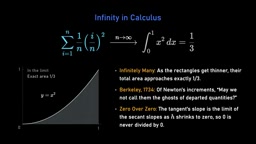
Calculus: Students' First 'Collision' with Infinity
The podcast mentions that many people first truly "hit a wall" when learning calculus. There are two reasons: first, gaps in prior knowledge (e.g., weak foundations in geometry and trigonometry), and second, the first serious encounter with infinity—the need to sum infinitely many infinitely small quantities to obtain a finite number and make that number meaningful.
"You have to do it after they become zero, not when they are zero."
This operation is intuitively confusing and reflects the logical difficulties at the inception of calculus.

The operation in calculus of "summing infinitely many infinitely small quantities to obtain a finite number" depends for its rigor on the establishment of the concept of limit. Intuitively, a limit means: as the independent variable approaches a point indefinitely, the function value approaches a certain number indefinitely. The era of Newton and Leibniz used "infinitesimals"—a quantity that is neither zero nor infinitely close to zero—a concept lacking logical foundation at the time, ridiculed by Bishop Berkeley as "ghosts of departed quantities." It was not until the 19th century that Cauchy and Weierstrass redefined limits using the "ε-δ language," escaping the intuitive dependence on infinitesimals: saying that a function has limit L as x→a means that for any ε>0, there exists δ>0 such that when 0<|x-a|<δ, |f(x)-L|<ε. This rigorous definition does not involve the entity of "infinitesimal" but characterizes the process of "infinite approximation" through arbitrarily small positive numbers ε. It is precisely with the rigorous definition of limit that derivatives (instantaneous rates of change) and integrals (infinite sums) acquired a solid logical foundation.
The 19th-Century Mathematical Crisis: The Contradiction Between Cauchy and Fourier
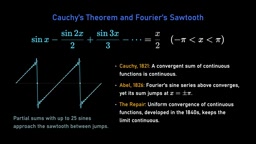
In the 19th century, Cauchy believed that the limit of a sequence of continuous functions is still a continuous function, because "the limit is a continuous process, and the limit of continuous functions must be continuous." But Fourier, by summing sine and cosine series, obtained a sawtooth wave—a discontinuous function. The conflict between the two theorems directly "destroyed mathematics."
"They broke mathematics. Then we had to start facing it."
This crisis forced mathematicians to re-examine the foundations of infinity, limits, and continuity.
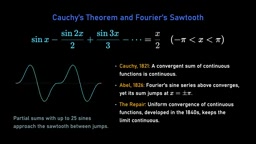
The contradiction between Cauchy and Fourier involves the distinction between pointwise convergence and uniform convergence of function sequences. Cauchy once believed that the pointwise limit of a sequence of continuous functions is still continuous, but this holds only under uniform convergence. Fourier series provided a counterexample: an infinite series formed by superimposing continuous sine and cosine functions can have a sawtooth wave (discontinuous) as its sum function. Specifically, the partial sums of a Fourier series are continuous functions, but they converge pointwise to a discontinuous function. This shows that pointwise convergence is insufficient to preserve continuity. Weierstrass later pointed out that uniform convergence is required to guarantee the continuity of the limit function. This discovery forced mathematicians to distinguish different types of convergence and to re-examine the concept of "limit" itself. The definition of uniform convergence is: for any ε>0, there exists N such that for all n>N and all x, |f_n(x)-f(x)|<ε. This requirement of uniformity is one of the core achievements of the 19th-century rigorization movement in analysis.
The 'Multiple Deaths' and Rebuilding of Mathematics
The podcast emphasizes that mathematics is not being "killed" for the first time. From the first mathematical crisis in ancient Greece to the rigorization movement of the 19th century, mathematics has repeatedly faced foundational collapse, but each time it has emerged stronger through rebuilding.
"Most of what we study in first-year PhD courses is the result of the 19th-century crisis. Mathematics was destroyed, then rebuilt from scratch."
Today, the rigorous treatment of infinity has become the cornerstone of modern mathematics, and this history reminds us: mathematical progress often stems from deep reflection on foundational concepts.
At the end of the 19th century, the foundational crisis of mathematics erupted again, this time related to set theory. Cantor founded set theory and discovered that an infinite set can be in one-to-one correspondence with a proper subset of itself (e.g., there are as many natural numbers as even numbers), which broke the ancient intuition that "the whole is greater than the part." More seriously, Russell proposed Russell's paradox in 1901: let R be the set of all sets that do not contain themselves. Does R contain itself? If R contains itself, then by definition it does not contain itself; if R does not contain itself, then by definition it contains itself. This paradox shook the foundations of set theory, which was then being used as the cornerstone of all mathematics. To repair the crisis, mathematicians developed axiomatic set theory (such as the ZFC system), avoiding paradoxes by restricting the ways sets can be constructed. This crisis directly gave birth to mathematical logic and the axiomatic method, which became another important pillar of the foundations of modern mathematics.
Conclusion: The Philosophical and Mathematical Significance of Infinity
Infinity is not only a technical mathematical issue but also touches on the philosophical level. From Newton's intuition to the rigorization of the 19th century, humanity's understanding of infinity has undergone a transformation from a "plaything" to a "professional object." As the podcast says, modern mathematics is precisely the product of taking infinity seriously, and each crisis has made mathematics more solid.
Related articles

Deleted Reddit Post Sparks Debate Over AI Content Moderation
A Reddit post removed with only a 'Removed by Reddit' notice highlights AI content moderation's transparency gaps, misjudgment risks, and appeal challenges for platforms and creators.

DSH + Ollama Local LLM Deployment in Practice: Free Chat with Da Fei Yu
Bilibili creator tests DSH + Ollama local LLM deployment end to end: Ollama install, Xunlei-accelerated downloads, ModelScope GGUF model import, DSH custom API address setup, and a comparison of Qwen 3.5 4B, 8B, Gemma, and other models on 8GB VRAM, with advice on choosing local deployment vs. API calls.

Tested: A $899 Mac Mini vs. a $200/Month AI Subscription
Real-world test of whether an M4 Mac mini can replace a $200 AI subscription: 16GB can't fit large models, and both speed and quality fall short—but privacy, no caps, and near-zero running costs make it an ideal host for an always-on agent. Includes buying advice per configuration and money-saving strategies.