How Does Tenex Build an AI-Native SDLC for the Fortune 2000?

Tenex rebuilds the AI-native SDLC for the Fortune 2000, using outcome-based pricing to solve the last mile of adoption.
Tenex co-founders Alex Lieberman and CJ Hess discuss implementing AI for Fortune 2000 clients. Enterprise procurement is shifting from per-seat SaaS to paying for outcomes, requiring AI systems to be accountable for delivery quality and speed. Tenex's AI-native SDLC spans agent collaboration, code and validation, and delivery and feedback. The real bottleneck is organizational approval inertia and engineering culture, not model capability—process reengineering matters more than model selection.
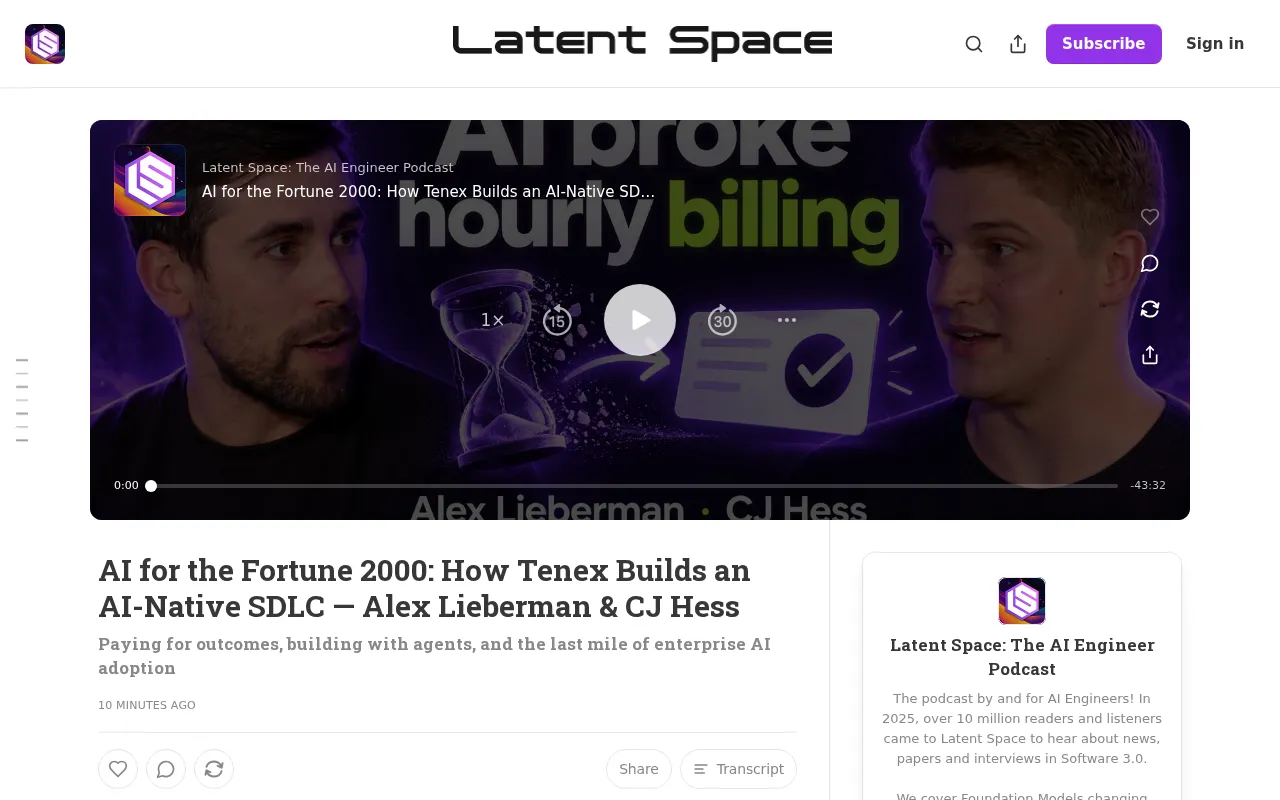
Enterprise AI adoption often gets stuck at the "last mile," and Tenex has chosen a more fundamental path: rebuilding the software development lifecycle itself. In a recent interview, Alex Lieberman and CJ Hess shared how they use AI agents to deliver measurable business outcomes for Fortune 2000 clients.
From "Selling Tools" to "Buying Outcomes"
The logic of enterprise software procurement is changing. Lieberman points out that Fortune 2000 clients are no longer satisfied with the per-seat SaaS model—they prefer to pay for clear business outcomes. Tenex's business model is built around "paying for outcomes," tying AI capabilities directly to quantifiable delivery metrics.
This shift places higher demands on the AI-native SDLC: the system must not only write code but also be accountable for delivery quality, time to launch, and business impact. Hess adds that this means agents must be deeply embedded across the entire chain of requirements decomposition, code generation, test validation, and deployment operations—not just assist at isolated points.
The per-seat SaaS model refers to enterprises paying subscription fees periodically based on the number of software users or accounts. This model treats software as a tool, with revenue tied to usage scale rather than the actual business value customers receive. Fortune 2000 companies are gradually realizing that per-seat pricing easily leads to the problem of "purchased but not adopted," because the vendor's incentive is to expand seat count rather than ensure the software produces real results. Outcome-based pricing, by contrast, ties fees directly to quantifiable business metrics (such as reduced defect rates, shorter launch cycles, or revenue growth), requiring vendors to bear delivery risk. This model is favored in the AI era because AI outputs are uncertain, and enterprises want to transfer risk to vendors while requiring vendors to be deeply involved in the implementation process. Tenex's business model follows this trend, bundling AI capabilities with measurable delivery metrics to align interests with customers.
The Three-Layer Architecture of an AI-Native SDLC
Tenex's practice breaks the AI-native SDLC into three interconnected layers.
Agent Collaboration Layer
In the requirements and design phase, multiple specialized agents divide the work: one translates business goals into technical specifications, another reviews architectural soundness, and a third generates executable development tasks. Hess emphasizes that the "handoff protocol" between agents matters more than the capability of any single agent—unclear handoffs cause rework rates to soar.
The "handoff protocol" between agents refers to the rules and formats that define how a task is passed from one AI agent to the next when multiple agents collaborate on a complex task. This includes the data structures of inputs and outputs, the scope of contextual information passed along, how exceptions are handled, and the division of responsibility boundaries. In software development scenarios, the specification document generated by the requirements-analysis agent must be accurately understood by the architecture-review agent, and the review results must then be translated into a task list executable by the development agent. If the handoff protocol is vague, information is lost or distorted in transit, leading to rework in subsequent stages. Hess emphasizes that the handoff protocol matters more than individual agent capability because even if each agent performs excellently on its own, poor collaboration will sharply reduce overall efficiency. A well-designed handoff protocol typically requires clear task description templates, standardized intermediate artifact formats, and versioned context management.
Code and Validation Layer
Code generation is no longer the core bottleneck—validation is. Tenex builds continuous validation into the AI-native SDLC: generated code automatically enters a testing-agent pipeline covering unit tests, integration tests, and security scans. Lieberman notes that what clients care about most is not how many lines of code AI wrote, but whether the defect escape rate has decreased.
Defect escape rate is a software quality metric referring to the proportion of defects that are not discovered during development and are only found after release (or at a later stage) relative to total defects. The higher the escape rate, the weaker the filtering capability of the testing phase, and the higher the cost of fixing (because the later a defect is found, the greater the effort and risk required to fix it). In AI-generated code scenarios, because code output is fast and high-volume, traditional manual review struggles to keep up, and the risk of defect escape rises significantly. Tenex builds continuous validation into the AI-native SDLC, using an automated testing-agent pipeline to run unit tests, integration tests, and security scans on generated code—precisely to reduce the defect escape rate. Clients focus on this metric rather than lines of code because it directly reflects the reliability and total cost of ownership of AI delivery.
Delivery and Feedback Layer
Going live is not the endpoint. Tenex feeds production monitoring data back to development agents to form a closed loop. This feedback mechanism allows agents to adjust subsequent code generation strategies based on real runtime performance, gradually approaching "self-healing" software delivery.
The "Last Mile" of Enterprise AI Adoption
A judgment that recurred throughout the interview: the bottleneck for enterprise AI is not model capability but organizational fit.
Lieberman observed that IT departments at Fortune 2000 clients generally exhibit "approval inertia"—any AI-generated change requires multiple layers of manual review, causing the speed advantage of AI to be offset by process. Tenex's approach is to embed AI validation results directly into existing approval systems, replacing line-by-line manual review with explainable test reports.
Hess adds from an engineering culture perspective: an AI-native SDLC requires teams to accept the premise that "agents are colleagues, not tools." This involves redefining permission design, accountability, and failure retrospective mechanisms. Without these organizational adjustments, even the most advanced agents can only remain at the demo stage.
Approval inertia refers to the fixed process inertia formed by enterprise IT departments through long-term compliance and risk management practices, requiring multiple layers of manual review for any change. In traditional development models, this inertia is a reasonable risk control measure, but in AI-assisted development scenarios, the speed at which AI generates changes far exceeds the manual review capacity, making the process a bottleneck. For example, an AI agent may generate dozens of code changes within minutes, while each change requires sign-off from architects, security teams, and operations teams level by level, completely offsetting the speed advantage. Tenex's strategy is to embed AI validation results (such as automated test reports and security scan conclusions) directly into existing approval systems, replacing line-by-line manual review with structured, explainable test evidence, thereby significantly compressing approval cycles while retaining necessary risk controls. This approach requires AI validation results to be sufficiently transparent and credible; otherwise, approvers will still demand manual review.
Implications for Developers
Tenex's case shows that the competitive focus of the AI-native SDLC is shifting from "model selection" to "process reengineering." For development teams, understanding agent collaboration protocols, establishing quantifiable validation standards, and driving automated adaptation of approval workflows may be more practically valuable than chasing the latest model versions.
Enterprise AI adoption is not a one-time technology purchase but a restructuring of how delivery works. The system Tenex has built for the Fortune 2000 offers a sample worth observing.
One-line Summary
Tenex rebuilds the AI-native SDLC for the Fortune 2000, using outcome-based pricing to solve the last mile of enterprise adoption.
Paragraph Summary
In an interview, Tenex co-founders Alex Lieberman and CJ Hess shared their experience implementing AI for Fortune 2000 clients. They noted that enterprise procurement logic is shifting from per-seat SaaS to paying for business outcomes, requiring AI systems to be accountable for delivery quality, time to launch, and business impact. Tenex breaks the AI-native SDLC into a three-layer architecture: agent collaboration, code and validation, and delivery and feedback. They emphasize that handoff protocols between agents are more critical than point capabilities, and that defect escape rate in validation is a core client concern. The interview repeatedly stresses that the bottleneck for enterprise AI is not model capability but organizational approval inertia and engineering culture—requiring explainable test reports to replace line-by-line manual review and treating agents as colleagues rather than tools. For developers, process reengineering is more practically valuable than model selection.
Related articles

T3 Code: The Open-Source AI Coding Assistant's Comeback Story
T3 Code is an open-source AI coding assistant that unifies subscriptions like Codex and Claude, with powerful remote control and parallel task management.

Never Elected, Yet Ruled New York for 30 Years: The Ultimate Case Study in the Mechanics of Power
Robert Caro's biographies reveal how unelected Robert Moses ruled New York for 30 years through legal drafting and public authorities, and how Lyndon Johnson built leverage as a "powerless" Senate Majority Leader. Unpacking the underlying logic of accumulating and sustaining power.

The CPython 3.10 Recursion Trap and Synthetic Recovery in TokenGuard, an LLM Circuit Breaker
TokenGuard's author recounts a recursion crash caused by OrderedDict.pop in CPython 3.10 and introduces v0.3.0's Loop Nudge synthetic recovery, inline DLP scanning, and other new LLM agent circuit-breaker capabilities.