How Executable Symbolic Representations Improve the Accuracy Scaling of LLM Arithmetic Reasoning

The controlled benchmark GSM-AB reveals that executable symbolic representations slow the decline in arithmetic accuracy as complexity increases.
The study addresses the issue that high accuracy on math benchmarks does not necessarily indicate reliable reasoning in large language models by constructing the controlled benchmark GSM-AB, which independently manipulates operand digit length and operation count to probe the effects of numerical scale and compositional complexity on accuracy. Comparing natural language reasoning with executable symbolic representations (Lean, Python-PoT), the experiments found that Lean reduced sensitivity to operand digit length across all tested model scales, slowing accuracy decline; on the operation count dimension, this improvement appeared only in larger models, and the Python-PoT control showed the pattern is not unique to Lean. The conclusion is that the form of reasoning representation shapes the scaling trajectory of arithmetic accuracy, and executable representations reduce ambiguity and accumulated errors by forcing structured, verifiable intermediate steps, offering a low-cost strategy for high-reliability numerical scenarios.
High accuracy on math benchmarks for large language models does not necessarily mean their reasoning remains reliable as problem complexity increases. A new study introduces a controlled benchmark, GSM-AB, to systematically examine the differences in accuracy scaling between executable symbolic representations (such as Lean) and natural language reasoning on arithmetic tasks, finding that executable representations not only improve accuracy but also slow the decline in accuracy as complexity increases.
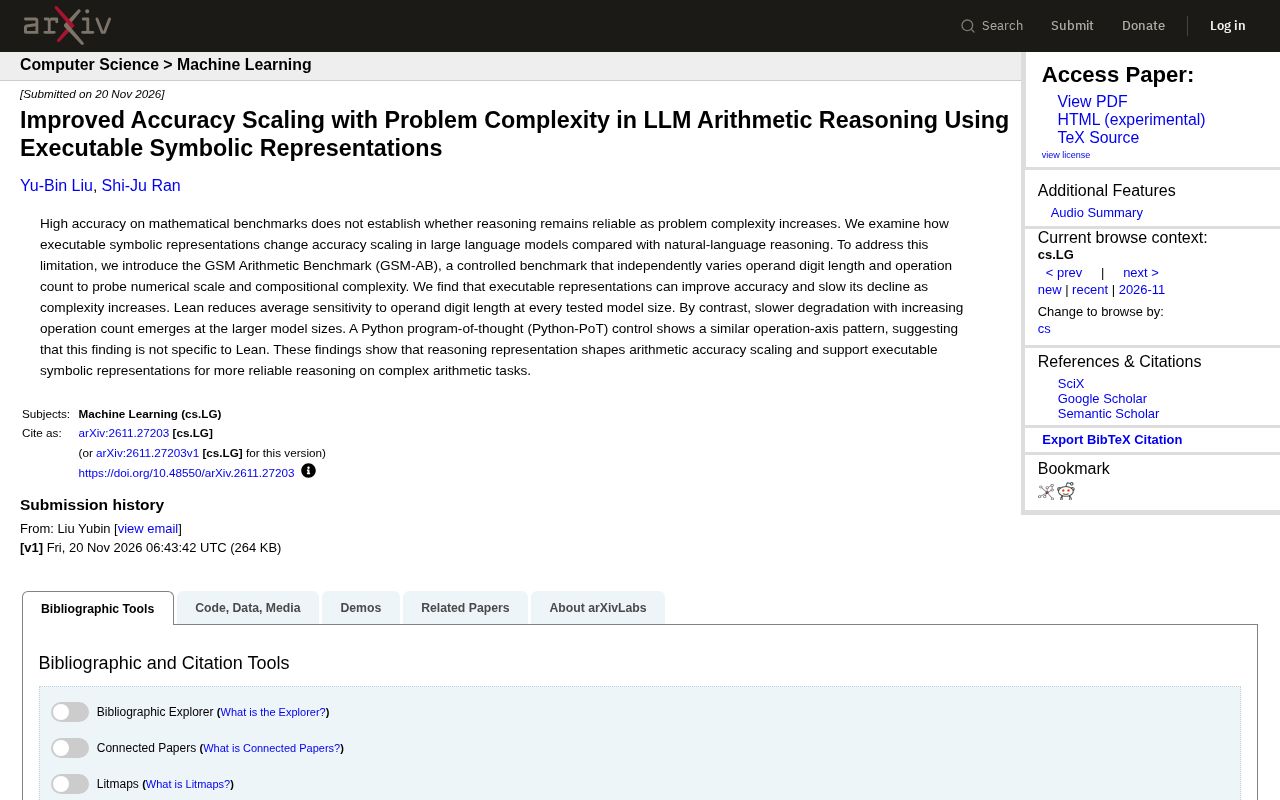
Research Background: High Benchmark Scores ≠ Reliable Reasoning
Current LLMs repeatedly set new records on math benchmarks such as GSM8K, but these benchmarks often mix problems of varying difficulty, making it difficult to independently assess model performance when numerical scale or compositional complexity changes. The paper points out that overall accuracy alone cannot determine the reliability of model reasoning—when the number of operand digits increases or the number of operation steps grows, models may quickly lose accuracy.
To fill this gap, the researchers constructed the GSM Arithmetic Benchmark (GSM-AB), which independently controls operand digit length and operation count to separately probe the effects of numerical scale and compositional complexity on model accuracy. This factorial design allows accuracy changes to be attributed to a single dimension rather than confounding factors.
GSM8K (Grade School Math 8K) is one of the most commonly used benchmarks for grade-school math word problems, containing approximately 8,500 human-annotated English math problems, each requiring multi-step basic arithmetic reasoning to solve. Its original purpose was to evaluate models' chain-of-thought reasoning ability, but because the problems come from diverse sources and the difficulty distribution is opaque, once a model approaches saturation in overall accuracy, it becomes difficult to further distinguish "true understanding of reasoning" from "pattern-matching responses." More critically, GSM8K does not independently control the number of digits or the number of operation steps, so researchers cannot determine whether a model's errors stem from excessively large numerical scale, overly long reasoning chains, or complex problem semantics. GSM-AB is a controlled variant proposed precisely to address this methodological flaw: it retains the shell of grade-school arithmetic problems but factorially manipulates operand digit length and operation count, allowing each complexity dimension to be observed independently, thereby decomposing "accuracy" into a slope metric of "how accuracy changes with complexity."
Experimental Design: Executable Representations vs. Natural Language
The study compared two reasoning representations: natural language reasoning (the model directly generates textual steps) and executable symbolic representations (writing the reasoning process as executable code, such as Lean theorem prover or Python programs). Lean, as an interactive theorem proving language based on dependent type theory, has strict syntax and clear semantics, requiring the model to output symbolic structures that can be machine-verified; Python-PoT (Program of Thought) served as a control to test whether the findings are specific to Lean.
The experiments covered multiple model scales, testing combinations of different operand digit lengths and operation counts on GSM-AB. The core metric is the slope of accuracy as a function of complexity—that is, the sensitivity of accuracy to complexity.
Lean is an interactive theorem prover based on dependent type theory, whose core feature is "proofs as programs": every proof term must pass the kernel's type checking, and any logical leap or undeclared assumption will be rejected. Unlike general-purpose programming languages such as Python, Lean's syntax and semantics are strictly constrained by its type system, and models cannot arbitrarily write expressions that are syntactically correct but semantically ambiguous. In the context of GSM-AB, requiring models to represent arithmetic reasoning in Lean is equivalent to forcing them to write each computation step as a machine-verifiable symbolic structure, thereby eliminating ambiguities caused by vague expressions such as "approximately" or "obviously" in natural language. Python-PoT (Program of Thought) instead has the model generate executable Python code and run it to obtain results; it is also executable but lacks the formal type constraints of Lean, so it was used as a control to determine whether the observed effects come from the general property of "executability" or from Lean's specific formal rigor.
Key Findings: Executable Representations Slow Accuracy Decline
Operand digit length dimension: Lean representations reduced average sensitivity across all tested model scales. That is, when numbers become longer, models using Lean experience a slower decline in accuracy. This suggests that executable symbolic representations help models more robustly handle numerical scale expansion.
Operation count dimension: As the number of operation steps increases, the phenomenon of slower accuracy decline appeared only at larger model scales. Small models did not obtain equivalent benefits from executable representations. This scale dependence suggests that the advantages of executable representations require a certain amount of model capacity.
Python-PoT control: Python Program of Thought exhibited a similar pattern on the operation count dimension, indicating that "slowing the accuracy decline caused by compositional complexity" is not unique to Lean but is a general property of executable representations.
"The slope of accuracy sensitivity to complexity" is the key quantitative metric of this study: the researchers fitted a curve of accuracy as a function of each complexity dimension (operand digit length or operation count), where a more negative slope indicates that accuracy declines faster as complexity increases. Compared with overall average accuracy, the slope can reveal differences in model behavior across different difficulty ranges—two models may have the same accuracy on easy problems but perform very differently in high-complexity ranges. The study compares the difference in slopes between natural language reasoning and executable representations; if the slope for executable representations is flatter, it indicates that they slow the trend of accuracy decay as complexity increases. This measurement operationalizes "reliability" as "the steepness of the accuracy scaling trajectory," which better reflects model robustness in real complex scenarios than a single accuracy number.
Significance and Limitations
These findings indicate that the form of reasoning representation shapes the scaling trajectory of arithmetic accuracy. Executable symbolic representations, by forcing models to generate structured, verifiable intermediate steps, reduce the ambiguity and accumulated errors common in natural language, thereby maintaining higher reliability on complex tasks.
However, the study also leaves open questions: why does the improvement on the operand digit length dimension not depend on model scale, while the improvement on the operation count dimension requires larger models? A possible explanation is that compositional complexity requires models to maintain symbolic consistency over long-range dependencies, which demands stronger representational capacity. In addition, GSM-AB currently focuses on arithmetic reasoning; whether executable representations are equally effective in broader mathematical reasoning (such as algebra and calculus) still requires further verification.
For AI programming and AI application practitioners, this study provides an actionable insight: in numerical computation scenarios requiring high reliability, guiding models to output executable code (rather than pure text reasoning) may be a low-cost and effective strategy, especially when model scale is large.
One-line Summary
The controlled benchmark GSM-AB reveals that executable symbolic representations can slow the decline in arithmetic accuracy as complexity increases.
Paragraph Summary
To address the problem that high accuracy on math benchmarks does not necessarily mean reliable reasoning for large language models, the study constructed the controlled benchmark GSM-AB, independently manipulating operand digit length and operation count to separately probe the effects of numerical scale and compositional complexity on accuracy. Comparing natural language reasoning with executable symbolic representations (Lean, Python-PoT), the experiments found that Lean reduced sensitivity to operand digit length across all tested model scales, slowing accuracy decline; on the operation count dimension, this improvement appeared only with larger models, and the Python-PoT control showed that this pattern is not unique to Lean. The conclusion is that the form of reasoning representation shapes the scaling trajectory of arithmetic accuracy, and executable representations reduce ambiguity and accumulated errors by forcing structured, verifiable intermediate steps, offering a low-cost strategy for high-reliability numerical scenarios.
Related articles

The Bottleneck of AI Programming Isn't Generation: Why Software Factories Collapse
After AI coding tools went mainstream, PR review quality dropped and incidents rose. The speaker argues the bottleneck isn't code generation but models' inability to sustain maintainability.

Gemini 4 Neon Hands-On: 10 Hours to Achieve What Opus Couldn't in Days, 20x Faster Warm Start
Google's surprise Gemini 4 Neon release made critic Theo change his tune: 10 hours to finish what Astra couldn't in ten days, 20x faster warm start, coherence beating Opus.

Gemini 4 Neon Hands-On: Which $20 AI Subscription Should You Choose?
Bilibili creator tests Gemini 4 Neon: composite intelligence index 61, beating Claude Opus 5.5, with API 25% cheaper. With a $20 budget, how to choose between Google AI Pro, Claude Pro, and ChatGPT Plus? Includes three must-know pitfalls and recommendations by user type.