How Explicit Behavioral Constraints Reduce LLM Code Generation Failures

Experiments show lightweight structural specs cut failure rates by only 8.7%, while explicit behavioral obligations cut them by 47.2% and are the key lever.
A controlled experiment with 72 participants compared how specification explicitness affects LLM-generated code quality. Lightweight structural specs such as function signatures reduced hidden test failures by only 8.7%; explicit behavioral obligations—invariants, negative requirements, edge cases, tie-breaking rules, and exception handling—cut failures by 47.2% and reduced failure modes by 20.5%. Root causes centered on implicit obligations: invariant violations fell 66.1% and unsupported assumptions fell 59.5%. Under requirement changes, explicit specs led to more commits with regressions but less lost behavior per affected commit, making regressions shallower. Without explicit obligations, developers overestimated correctness by about 23 percentage points; explicit specs improved calibration. The key to reliable LLM-generated code is explicit behavioral obligations, not prettier interface definitions.
Title
How Explicit Behavioral Constraints Reduce LLM Code Generation Failures
Meta Description
A controlled experiment shows that lightweight structural specs reduce LLM code failure rates by only 8.7%, while explicit behavioral obligations (constraints, invariants, exception handling, etc.) cut failures by 47.2% and improve developers' calibration when judging code correctness.
Article Content
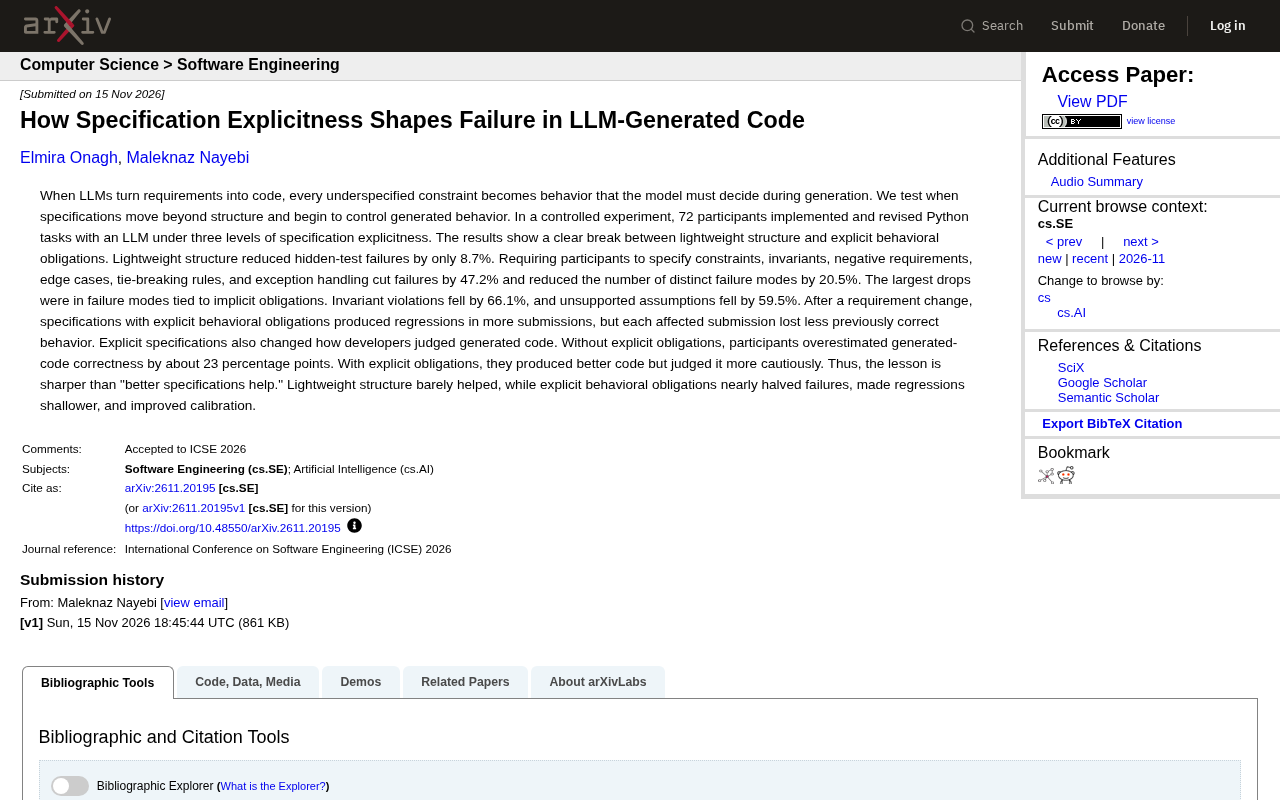
When large language models turn requirements into code, every constraint that is not explicitly specified becomes implicit behavior that the model must decide on its own during generation. A controlled experiment with 72 participants revealed a key difference: lightweight structural specifications reduced hidden test failures by only 8.7%, whereas requiring explicit behavioral obligations—constraints, invariants, negative requirements, edge cases, tie-breaking rules, and exception handling—caused the failure rate to plummet by 47.2%.
The Gap Between Lightweight Structure and Explicit Behavior
The study divides specification explicitness into three levels, and the core finding is a clear break between "structure" and "behavior." Lightweight structure (such as function signatures and basic input/output types) yields only an 8.7% reduction in failure rate, meaning that simply telling the model "what to do" is far from enough.
When participants were asked to explicitly write behavioral obligations—including invariants, negative requirements, edge case handling, tie-breaking rules, and exception handling—the failure rate was cut by nearly half. More importantly, the number of distinct failure modes decreased by 20.5%, indicating that explicit specifications not only reduce errors but also narrow the diversity of errors.
Invariant refers to a condition that must always hold during program execution (or at a specific stage), such as "the account balance is never negative" or "the list length always equals the number of inserted elements." In the context of LLM code generation, invariants are a typical behavioral obligation: the model must understand which state transitions are legal, not just what parameters a function receives and what type it returns. When a specification provides only a signature, the model cannot infer these constraints and will choose its own set of rules in the implementation, while hidden tests verify from the opposite direction whether those rules hold. Explicitly writing invariants amounts to turning "what must never be broken" from a model guess into an explicit contract, which is why invariant-violation failure modes had the largest drop in the experiment.
Negative requirements refer to explicitly declaring what the system "should not do" or "under what circumstances it must refuse/raise an error." They complement positive functional descriptions: positive requirements describe the normal path, while negative requirements define prohibited paths and rejection conditions. Typical examples include "must throw an exception when the input is empty," "concurrent modification of the same record is not allowed," and "sensitive fields must not be cached." When given only positive descriptions, LLMs tend to complete a happy path that "runs successfully" while ignoring rejection, validation, and conflict handling. Explicitly writing negative requirements forces developers to enumerate failure branches that are easy to take for granted but are often covered by hidden tests.
Implicit Obligations Are the Main Source of Failures
The data points clearly to the root cause of failures: failure modes related to implicit obligations had the largest reductions. Invariant violations fell by 66.1%, and unsupported assumptions fell by 59.5%. This shows that when explicit constraints are lacking, the model "fills in" rules on its own, and human developers often assume these rules are obvious—until hidden tests break them.
According to the original experimental data, explicitly writing negative requirements (i.e., "what the system should not do") and exception handling paths is the key action for reducing such failures. Developers are accustomed to describing positive functionality but easily omit behavioral decision points such as "under what circumstances must we refuse" and "how to choose when there is a conflict."
Hidden tests are a common type of test when evaluating generated code: participants cannot see the specific content of the test cases and can only implement functionality based on the specification. Their role is to turn "whether the specification is sufficiently explicit" into a measurable variable—any behavior not clearly specified may be broken by a hidden test with a specific assertion. Compared with public tests, hidden tests are closer to real collaboration scenarios: code authors cannot reverse-engineer an implementation from the tests and can only rely on the completeness of the specification itself. Therefore, the failure-rate gap between lightweight structural specifications and explicit behavioral obligations essentially reflects how strongly hidden tests penalize "unspecified behavior."
Regression Characteristics After Specification Changes
A counterintuitive finding comes from the requirement-change scenario. After requirements changed, specifications with explicit behavioral obligations produced more commit-level regressions (i.e., more commits showed some kind of degradation), but each affected commit lost less of its original correct behavior.
This means explicit specifications make regressions "shallower": although the blast radius may be wider, the depth of each break is reduced. For continuously iterating codebases, this characteristic may be more conducive to locating and fixing problems, because degradation is no longer a catastrophic global collapse.
Commit-level regression refers to counting, after a requirement change, whether each code commit introduces a degradation of some original correct behavior. The same batch of changes may involve multiple commits, so it is possible to have both "more commits show regressions" and "each affected commit loses less correct behavior." The former measures the blast radius of regressions (how many commits are affected), while the latter measures their depth (how much behavior each commit breaks). Explicit behavioral obligations make contract boundaries clearer, so during changes the model is more likely to break only local contracts rather than the overall logic, resulting in a "broad but shallow" regression distribution. Understanding this metric definition helps correctly interpret the counterintuitive conclusion that "explicit specifications lead to more regressions"—it does not mean explicit specifications are worse, but that they change the shape of regressions.
Improved Developer Judgment Calibration
The experiment also measured developers' subjective judgments of the correctness of generated code. Without explicit obligations, participants overestimated the correctness of generated code by about 23 percentage points—a fairly serious calibration bias. When specifications included explicit behavioral obligations, participants produced better-quality code and their judgments became more cautious.
This finding elevates "writing better specifications" to a cognitive level: explicit specifications constrain not only the model but also developers' own verification mindset. When developers are forced to write edge cases and exception handling, they have a clearer idea of where the code may go wrong, thereby reducing blind trust.
Practical Implications
The study's conclusion is sharper than "better specifications help": lightweight structure is almost useless, and explicit behavioral obligations are the key lever. For teams using LLMs to generate code, investing in writing constraints, invariants, and negative requirements yields higher returns than pursuing prettier interface definitions.
At the same time, when requirements change, teams should expect more commits to be affected, but each impact to be shallower—this requires corresponding adjustments to code review processes, shifting the focus from "whether all tests pass" to "which behavioral contracts have been broken." The improvement in calibration data also suggests that explicit specifications can serve as a developer training tool, helping teams establish reasonable trust boundaries for generated code.
One-line Summary
Experiments show that lightweight structural specifications reduce failure rates by only 8.7%, while explicit behavioral obligations reduce them by 47.2% and are the key lever.
Paragraph Summary
A controlled experiment with 72 participants compared the impact of different levels of specification explicitness on the quality of code generated by large language models. The study found that providing only lightweight structural specifications such as function signatures reduced hidden test failure rates by just 8.7%; whereas requiring explicit behavioral obligations such as invariants, negative requirements, edge cases, tie-breaking rules, and exception handling caused the failure rate to plummet by 47.2% and reduced the number of failure modes by 20.5%. The root causes of failures were concentrated in implicit obligations: invariant violations fell by 66.1%, and unsupported assumptions fell by 59.5%. In requirement-change scenarios, explicit specifications led to more commits showing regressions, but each affected commit lost less correct behavior, making regressions "shallower." In addition, without explicit obligations, developers overestimated the correctness of generated code by about 23 percentage points, and explicit specifications improved judgment calibration. The conclusion is that explicit behavioral obligations, rather than beautiful interface definitions, are the key to improving the reliability of LLM-generated code.
Related articles

The ARTEX Alert: How AI Agents Do Hackers' Work
FBI issues a 13-page alert on the AI agent tool ARTEX: attackers use it to automate penetration testing, with some cases achieving privileged access in under three hours. This article analyzes ARTEX's architecture, real attack cases, the authorization paradox, and AI agent security boundaries.

FBI Warns: Open-Source AI Pentesting Framework ARTEX Weaponized — From Competition Winner to Threat Dossier in Three Weeks
FBI threat bulletin warns that open-source AI pentesting framework ARTEX was weaponized — just three weeks from GitHub release to first weaponization, linked to South Korean financial breaches, supply chain attacks, and large-scale operations. Timeline, attack evidence, and defense recommendations.

Tokendoctor: The Money-Saving Solution That Cuts Claude Code Costs by 38%
Tokendoctor claims it can reduce Claude Code usage costs by 38% through token efficiency optimization. This article analyzes its principles, community reactions, and practical implications for developers.