How Far Can Computers Verify a Proof of the Riemann Hypothesis?

The video uses a number-guessing game and a changed-passing-line analogy to clarify the zero locations of the Riemann Hypothesis and the boundaries of formal verification.
Using a science video, the article reviews the Riemann Hypothesis: non-trivial zeros lie on the critical line with real coordinate 1/2 on the complex plane, the first zero has an imaginary coordinate of about 14.13, and "all on 1/2" directly affects prime distribution. It then shifts focus to "computer verification," using the "two exam papers with altered passing lines" analogy to show that the primary risk of formal verification is whether the verified object is faithful to the original problem; it further notes that the trending "generalized version" covers specific function classes such as Dirichlet functions, not all L functions. The conclusion: a computer verifying it does not mean the mathematical community accepts it—statement fidelity and scope of applicability are the keys to judging such progress.
The video opens with a "number-guessing game": put in 0 and out comes -1; only when you put in -2 does 0 come out. This pulls the abstract concept of a "zero" back down to a function's input and output. So-called "trivial zeros" are negative even numbers like -2, while "non-trivial zeros" appear on the complex plane—go right by 1/2, then up about 14.13, and that point sitting horizontally is the first non-trivial zero. The core question of the Riemann Hypothesis then surfaces: do all non-trivial zeros lie on the line whose real coordinate is 1/2?

What a Non-Trivial Zero Looks Like
The point drawn in the video has a real coordinate of 1/2 and an imaginary coordinate of about 14.13—this is the location of the first non-trivial zero. The Riemann Hypothesis doesn't ask "are there zeros?" but "are they all on the line 1/2?" This seemingly simple geometric constraint is tied to the core law governing the distribution of primes. The video describes positions on the complex plane as "this number sitting horizontally," lowering the barrier of complex analysis to a level ordinary people can follow.

The Riemann ζ function is initially defined by the infinite series $\zeta(s)=\sum_{n=1}^{\infty} n^{-s}$, but this series only converges when the real part of $s$ is greater than 1. For "zeros" to be meaningful across the entire complex plane, the domain must be extended through analytic continuation: mathematicians find an expression that satisfies the basic properties of the ζ function over a larger range, so that the function is also defined where the real part is less than or equal to 1 (except for a pole at $s=1$). It is precisely analytic continuation that makes the trivial zeros at $s=-2,-4,\dots$ and the non-trivial zeros with real part 1/2 legitimate objects. In other words, the premise behind the video's "place it on the complex plane" is that the function has already been extended to that plane—a standard technique in complex analysis and essential background for understanding the locations of zeros.
The reason "all non-trivial zeros lie on the line with real part 1/2" is tied to prime distribution is that the ζ function and the primes are connected by the Euler product: $\zeta(s)=\prod_{p}(1-p^{-s})^{-1}$, where the product runs over all primes. This identity links the additive structure of integers with the multiplicative structure of primes, making the locations of the ζ function's zeros directly control the error term in the prime-counting function $\pi(x)$. Riemann's 1859 paper gave an explicit formula connecting prime counting with the distribution of zeros; the closer the zeros are to the critical line at 1/2, the smaller the error in prime distribution. Thus "all on 1/2" is not merely a geometric conjecture but the strongest quantitative statement of the phenomenon that primes "look random yet follow a pattern."
Does the Computer Verify the "Program" or the "Problem"?
The video offers a key analogy: two exam papers both say 60 is the passing score; change the input to 55—on the original and the left one it fails, but on the right one it passes—because the right one changed the passing line to 50 while keeping the same name. In formal verification, this corresponds to "are you verifying the original problem, or a modified one?" In actual verification, the original problem was taken separately, and five conclusions in two files were checked line by line, showing that the verification process itself has an awareness of comparison—but the risk of "same name, altered standard" always exists.
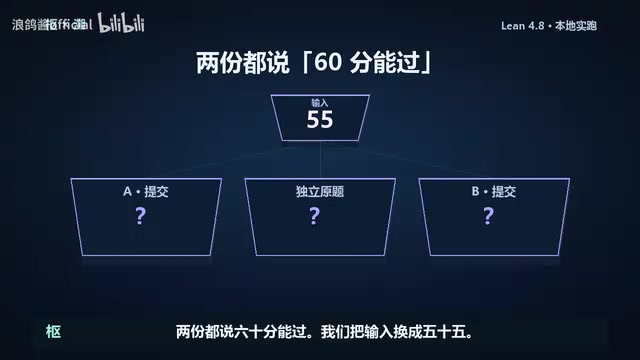
Formal verification means writing mathematical statements and proofs as machine-readable code using logical frameworks such as dependent type theory, then having a proof assistant (like Lean, Coq, or Isabelle) check step by step whether each inference is valid. Its reliability comes from a "small kernel": as long as the kernel is correct, a proof that passes verification will have no logical gaps. But this also means two things must be viewed separately: first, whether the formal statement faithfully translates the original problem (e.g., whether quantifier scope and function definitions are consistent); second, whether the proof code truly covers the objects it claims to cover. The video's "passing line changed" analogy corresponds precisely to the first kind of risk—the machine only guarantees that "from axioms to conclusion" the reasoning is correct, not that "the problem you wrote is the problem everyone is talking about."
How Broad Is the Generalized Version That "Passed"?
Trending topics say the generalized version passed too, but the video reminds us: the ordinary version concerns the Riemann ζ function, while the generalized version concerns Dirichlet functions. When the function returns to the last three lines of the paper, they are all checking this one group, and several other classes of functions were not checked in this report. In other words, formal verification covers a specific class of functions, not a universal conclusion about "all L functions." Equating "the generalized version has been verified" directly with "the Riemann Hypothesis has been proven" still leaves the hurdle of scope of applicability in between.

The Riemann ζ function is a member of the more general family of L functions; Dirichlet L functions are constructed from Dirichlet characters $\chi$, in the form $L(s,\chi)=\sum_{n=1}^{\infty}\chi(n)n^{-s}$, and can likewise be analytically continued and discussed in terms of zeros. The Generalized Riemann Hypothesis (GRH) asserts that all non-trivial zeros of such L functions lie on the critical line with real part 1/2. The L-function family also includes L functions associated with modular forms, L functions of elliptic curves, and others; they share structures such as functional equations and Euler products with the ζ function, but their definitions and coefficients differ. Therefore, "verified a certain class of L functions" and "verified all L functions" stand in a set-inclusion relationship, and the scope of coverage must be stated class by class—it cannot be glossed over with a single "generalized version."
How Far Can Formal Verification Go?
What a computer can do is translate a "proof" into machine-checkable inference steps and verify line by line whether the logic holds. But formal verification has two prerequisites: first, the formal statement itself must be faithful to the original problem; second, the scope of coverage must be clearly stated. The video's "five conclusions checked line by line" demonstrates the rigor of verification, while "several other classes of functions were not checked" marks out the boundary. For ordinary viewers, seeing "a computer verified it" does not mean "the mathematical community accepts it"—peer review and confirmation of scope still lie in between.
Where Is the Barrier to Understanding This?
The video cuts in with the bullet comment "I don't understand but I still want to watch," which actually points to the communication dilemma of this kind of news: the conclusions of formal verification are technical, but when spread they are easily simplified into "the Riemann Hypothesis has been proven." Distinguishing "formal verification of a certain function class" from "the conjecture itself being proven" is the key to understanding such progress. The video's analogy of "changing the input and altering the passing line" is precisely meant to make people realize: the definition of the object being verified is more worth questioning than the act of verification itself.
Related articles

ChatGPT Plus Subscription Pitfall Guide: Go/Plus/Pro Tier Comparison and Quick Activation
A complete ChatGPT Plus subscription guide based on a Bilibili tutorial: from registering an account, comparing Go/Plus/Pro tiers, to the practical steps for quickly completing your subscription.

GPT-6.2 Sol/Astra Released! A Step-by-Step ChatGPT Plus Subscription Guide and Tier Comparison
GPT-6.2 Sol/Astra is out—here's a ChatGPT Plus subscription guide: register an account, compare Go/Plus/Pro tiers, and subscribe in a minute.

Comparing Three Channels for Subscribing to GPT Plus in China: Is Website Top-Up the Easiest?
How to subscribe to GPT Plus in China? This article compares website top-up, credit card, and mobile top-up channels—process, cost, and risk—with steps and tips to help you choose wisely.