How Founders Can Manage Hourly Employee and Contractor Timekeeping

How founders can balance accurate hourly billing with avoiding micromanagement in contractor relationships.
For startups relying on hourly employees or contractors, timekeeping is both a cost-control and team-relations challenge. This article explores a real founder dilemma — how to track and verify hours before payment — covering everything from pure trust to dedicated time-tracking tools. It focuses on two high-complexity scenarios (multi-project workers and varying contractor rates) and concludes that the right approach depends on role type, upfront agreements, and treating trust as a strategic asset rather than a liability.
For startups that pay employees or contractors by the hour, tracking and verifying work hours is an unavoidable challenge. A founder sparked a discussion on Reddit around a real and widely shared pain point: How do you actually track and verify hours before processing payment?
The question may seem mundane, but it directly affects cost control, team trust, and management culture. The complexity compounds when team members are working across multiple projects simultaneously or when different contractors are billed at different rates.
Common Approaches to Tracking Work Hours
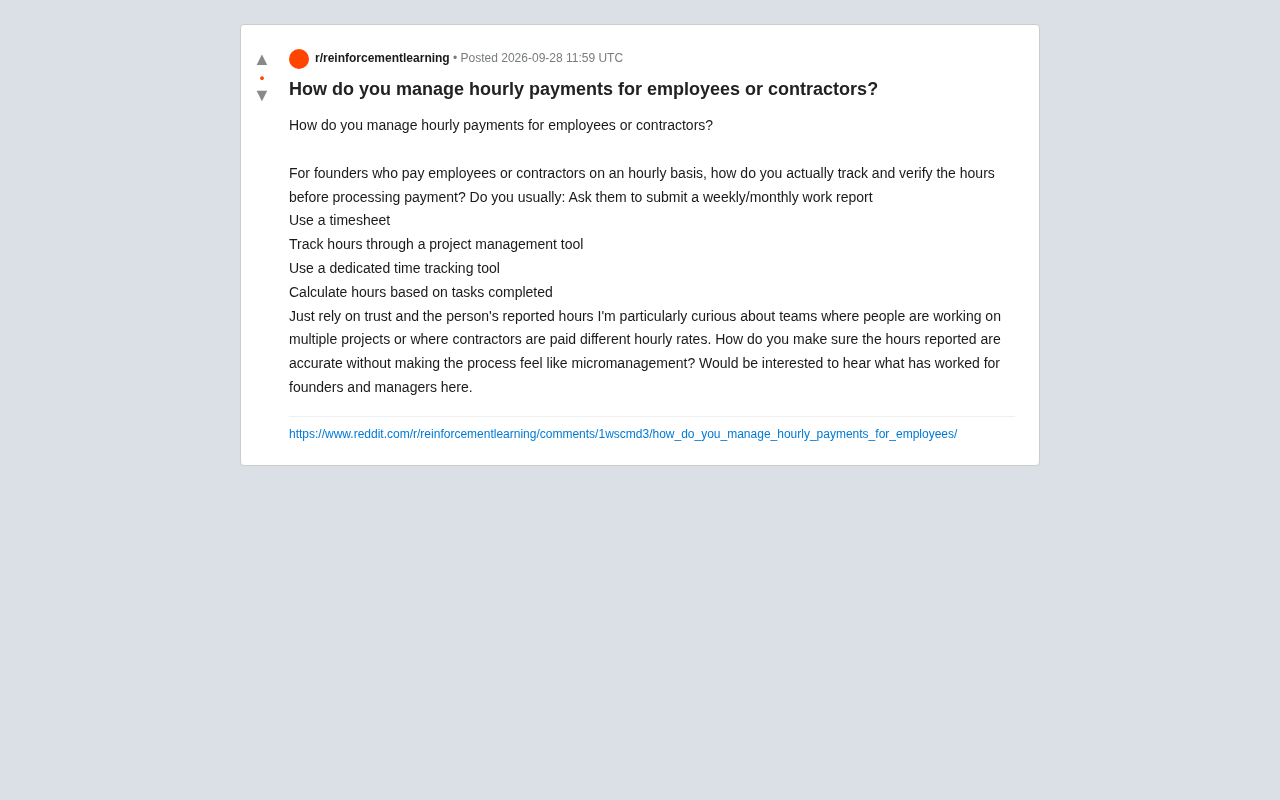
Drawing from the original thread's discussion, founders in practice typically rely on one or more of the following methods to track and verify hours:
- Weekly or monthly reports: Members regularly summarize what they worked on and how long it took, reconstructing workload through written records.
- Timesheets: Detailed daily or weekly hour logs that create a verifiable paper trail.
- Project management tools: Using task assignments and progress tracking to indirectly estimate time invested.
- Dedicated time-tracking software: Purpose-built tools that record actual working hours in real time.
- Output-based estimation: Skipping time measurement entirely and back-calculating hours from deliverables.
- Pure trust: Simply accepting whatever hours the contractor self-reports.
Each approach reflects a different management philosophy and carries a different trust cost. The original poster's dilemma is precisely this: how do you strike the right balance between accuracy and avoiding micromanagement?
Why Verifying Hours Is So Tricky
The core tension in hourly billing is this — you can't directly observe every minute a remote worker or contractor actually puts in. This creates risk in two directions.
On one hand, relying entirely on trust opens the door to inflated hour reports. For members working across multiple projects, it becomes difficult to determine exactly how much time went to which client or project. On the other hand, introducing overly strict monitoring — such as mandatory screenshots or mouse activity tracking — can quickly erode team trust, damage morale, and drive away skilled freelancers.
The original post highlighted two particularly complex scenarios:
Members Working Across Multiple Projects
When someone is serving multiple projects simultaneously, attributing hours becomes a real puzzle. A basic timer can't automatically tell you "which project does this hour belong to" — members need to manually tag entries or switch project timers as they context-switch, which adds operational friction and increases the chance of errors.
The leading time-tracking tools on the market (such as Toggl, Clockify, and Harvest) generally support a "project tags" feature, letting members select the relevant project or client when starting a timer so hours are automatically tallied per project. Some tools also offer browser extensions or integrations with project management platforms like Jira or Trello, which can trigger automatic timer switches when tasks change, reducing manual input. In practice, however, team members frequently jump between tasks and forget to switch timers — meaning reports still require manual review. For small teams, establishing an operational norm at project kickoff — "always update the timer when switching tasks" — often proves more effective than relying on tooling alone.
Contractors at Different Hourly Rates
When different contractors are billed at different rates, payment calculations get considerably more complex. Simply logging total hours isn't enough — you need precision at the level of "who, on which project, for how many hours, at what rate." Any error in that chain directly affects the final payment and the working relationship.
A Framework for Balancing Trust and Verification
The value of this kind of discussion isn't in finding a single right answer — it's in revealing a management spectrum. Between "pure trust" and "total surveillance," there's a wide range of adjustable middle ground.
For roles with clearly measurable outputs, billing by task or deliverable often makes more sense than counting every hour — what an employer actually cares about is results, not seat time. For ongoing work that's harder to quantify, a combination of timesheets and project management tools is a pragmatic middle ground: it creates auditable records without making team members feel they're being watched at every moment.
The key is establishing transparent rules that both sides agree on. When the logic of time tracking, rates, and reporting frequency are clearly defined from the start of a working relationship, hour verification shifts from "surveillance" to "collaboration" — and the negative connotations of micromanagement fade along with it.
What is micromanagement? Micromanagement refers to a manager excessively intervening in the details of a subordinate's work — not just monitoring hours, but continuously overriding decisions and policing every step. Research and practical experience both show that micromanagement significantly reduces employees' sense of autonomy and job satisfaction, and this effect is especially pronounced in remote and freelance contexts, where people choose flexible work arrangements precisely because they value independence. Tactics like mandatory screenshots and mouse-activity tracking may provide surface-level "evidence," but they tend to drive away high-quality collaborators and attract more compliance-oriented, lower-quality resources — a classic case of adverse selection. Management theory uses the concept of a "radius of trust" to describe how much control a manager is willing to cede. In contractor settings, widening that radius and focusing on deliverables tends to produce better long-term collaboration quality.
Practical Takeaways for Founders
Drawing from the discussion, a few useful principles emerge:
- Match your tool to the role: For output-measurable roles, focus on results; for process-oriented roles, focus on records.
- Agree upfront rather than chase accountability later: Bake timekeeping rules, rates, and reporting methods into the working agreement.
- Be aware of the hidden costs of over-monitoring: Trust itself is an asset that retains great talent.
- Multi-project scenarios require project-level granularity: Make sure hours can be accurately attributed to specific projects and rates.
There's no universal optimal solution for time management. At its core, it's a dynamic tradeoff between the cost of trust and the cost of verification. For early-stage teams, finding the balance that keeps billing accurate while preserving working relationships matters far more than chasing any "perfect tool."
Related articles

macOS Is No Longer UNIX: Apple Didn't Renew Certification, But the Technology Is Unchanged
Apple did not renew macOS's UNIX certification, and the Open Group has removed Apple's entry. This article analyzes the technical reality behind the expiration, Apple's possible intentions, and the practical impact on developers.

Building Stateful Multi-Agent Systems with Azure Cosmos DB
Based on the official Azure Cosmos DB tutorial, this article explains how to use the Agent Memory Toolkit to add shared persistent memory to a multi-agent travel planner, covering short-term, long-term, episodic, and semantic memory plus cross-session state continuity.

Production AI Agent Operations: A Three-Step Framework for Observing, Evaluating, and Optimizing
Azure Cosmos DB team proposes a three-step framework for production AI Agent operations: observe trace tracking, evaluate with LLM as a judge and regression testing, optimize cost across RU, retrieval, memory, and LLM layers.