How Graph Structures Reshape LLM Agent Systems: Five Facets of a Survey

The survey proposes a "role–locus" taxonomy to clarify where graphs take effect in LLM systems and who performs the computation.
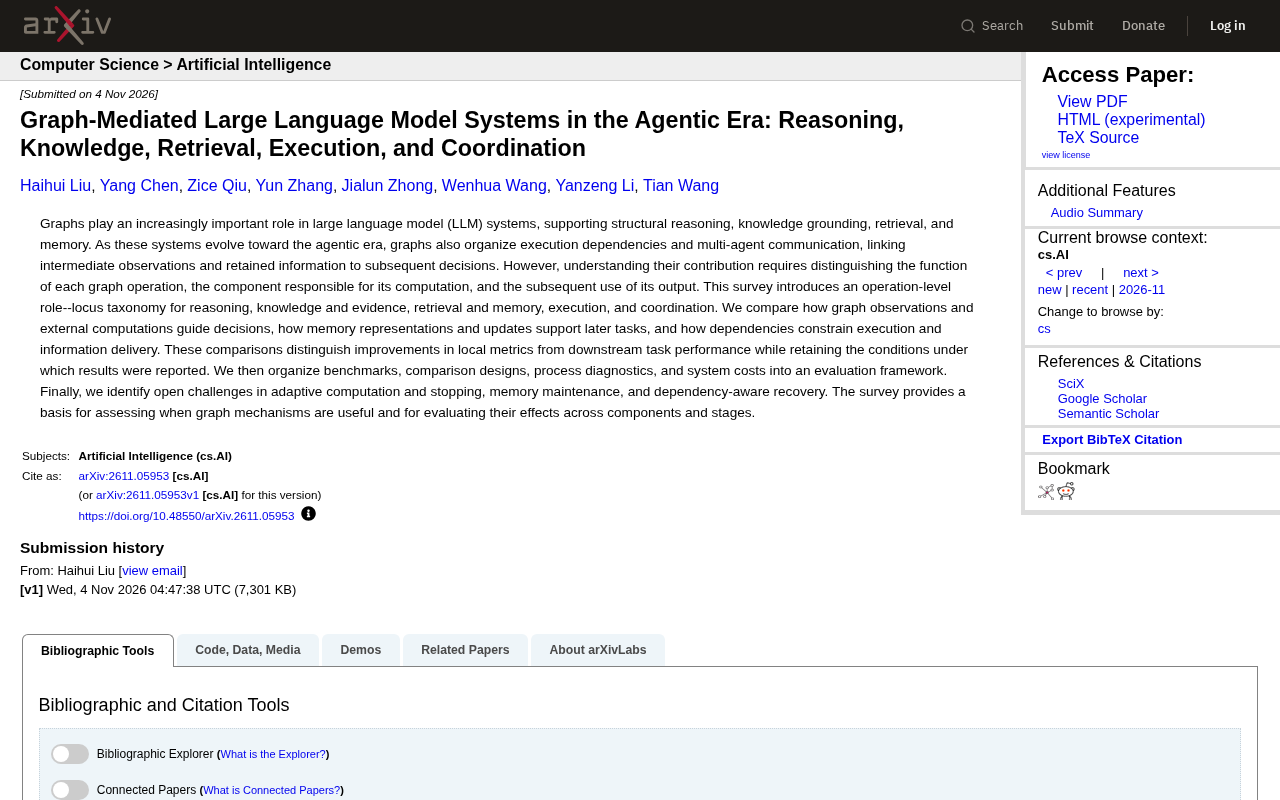
This survey systematically reviews the role of graph structures in large language model systems across reasoning, knowledge grounding, retrieval and memory, execution dependencies, and multi-agent coordination. Its core contribution is an operational-level "role–locus" taxonomy that distinguishes the function of each graph operation, the computing subject (implicit within the model vs. explicit external graph algorithms), and how outputs are used. It stresses that evaluation must combine downstream performance, process diagnostics, and system costs, and lists three open challenges: adaptive stopping, memory maintenance, and dependency-aware recovery.
Graph structures are becoming the infrastructure of large language model systems—from structured reasoning and knowledge grounding to retrieval and memory, and further to execution dependencies and communication coordination among multiple agents. A survey covering these directions proposes an operational-level "role–locus" taxonomy, attempting to answer a key question: when a graph is introduced into an LLM system, where exactly does it take effect, and who bears the computation?
Why an "Operational-Level" Perspective Is Needed
The survey points out that understanding the contribution of graphs in LLM systems requires distinguishing three things: what the function of each graph operation is, which component is responsible for the computation, and how the output is used afterward. This distinction may seem basic, yet it determines whether we can evaluate "local metric improvements" and "downstream task performance" separately.
In the agent context, the role of graphs further expands: they not only carry knowledge but also organize execution dependencies, linking intermediate observations and retained information to subsequent decisions. In other words, graphs shift from being a "representation tool" to a "scheduling skeleton."
In the "role–locus" taxonomy, "role" refers to the function that a graph operation assumes in the system, such as structural constraints, knowledge indexing, execution scheduling, or communication topology; "locus" refers to where the computation of that operation takes place—whether it is completed implicitly inside the LLM, or explicitly executed by external graph algorithms, graph databases, or an orchestration layer. This distinction is critical because the same graph computed at different loci brings completely different interpretability, reproducibility, and system overhead: implicit computation is hard to audit, while explicit computation is easier to trace but introduces extra latency and maintenance costs. Therefore, the role–locus taxonomy is essentially an attribution tool, helping researchers locate whether an improvement comes from the graph representation itself or from a switch in the computing subject.
Graphs Across Five Stages: A Taxonomy of Roles and Loci
The "role–locus" taxonomy proposed by the survey covers five directions, each corresponding to different combinations of graph operations and computing subjects.
Reasoning: Structural Constraints or Prompt Scaffolding
In the reasoning stage, graphs can serve as structural constraints or merely as scaffolding for organizing reasoning steps. The survey focuses on how graph observations and external computation jointly guide decision-making—this determines whether the graph truly participates in the reasoning process or merely organizes results after the fact.
Knowledge and Evidence: The Computational Attribution of Grounding
Knowledge grounding is the most traditional application of graphs. But the taxonomy demands asking: who completes the computation on the graph? Is it done implicitly inside the model, or explicitly executed by external graph algorithms? This distinction directly affects interpretability and reproducibility.
Knowledge grounding refers to establishing a verifiable correspondence between the generated content of language models and external knowledge sources, in order to reduce hallucination and improve factual consistency. In graph-enhanced LLM systems, grounding is usually implemented by organizing entities and relations into a knowledge graph and then retrieving relevant subgraphs during inference. The key divergence lies in computational attribution: one approach serializes subgraphs into the model context and lets the model implicitly perform multi-hop reasoning; the other explicitly computes evidence chains externally using graph algorithms (such as path queries, subgraph matching, or graph neural networks) and then hands them to the model for articulation. The former is flexible but difficult to trace reasoning paths; the latter is interpretable and reproducible, yet depends on the completeness of the graph structure and query design. The survey emphasizes this distinction precisely because it determines whether grounding results can be audited and reused.
Retrieval and Memory: Dual Perspectives of Representation and Updating
In the retrieval and memory stage, the survey compares how memory representation and update mechanisms support subsequent tasks. Here the graph is both an index structure and a carrier of memory evolution—static graph indices and dynamic graph updates support different types of subsequent tasks.
In graph-enhanced retrieval and memory systems, graph indices typically assume semantic organization functions beyond approximate nearest neighbor search: nodes can represent entities, document chunks, or dialogue segments, and edges represent co-occurrence, causal, or temporal relations, so retrieval can expand multi-hop along the graph structure rather than merely performing vector similarity matching. In contrast, graph memory emphasizes dynamic updating—as a dialogue or task progresses, new nodes and edges are written in, and old edges may be decayed or pruned. Static graph indices suit knowledge-intensive retrieval, with low update costs but difficulty reflecting the latest state; dynamic graph memory can evolve continuously, yet requires maintaining consistency, controlling graph size expansion, and deciding when to merge or forget. The survey juxtaposes representation and updating to show that the two support different types of subsequent tasks and cannot be conflated during evaluation.
Execution: How Dependencies Constrain Information Flow
The core of the execution stage is dependency constraints. Graphs decompose tasks into nodes with dependencies, thereby constraining execution order and information transfer paths. The survey emphasizes that such constraints may improve reliability but may also introduce new scheduling overhead.
Dependency-aware execution graphs typically organize task nodes as directed acyclic graphs (DAGs), with edges representing data dependencies or precedence constraints. This structure enables the system to identify parallelizable branches, determine critical paths, and decide rollback scope or replanning strategies based on dependencies when a node fails. Compared with pure chain-style prompting, DAG-based orchestration improves reliability and debuggability because the input-output boundaries of each node are clear. But the costs are equally obvious: graph construction and maintenance require extra overhead, the scheduler must handle concurrency and state synchronization, and overly fine-grained dependencies can increase communication and coordination costs. The survey treats such constraints as both a source of reliability and a source of overhead, reminding us that scheduling costs must be included in the total account during evaluation.
Coordination: How Multi-Agent Communication Is Organized
In multi-agent systems, graphs assume the role of communication topology. Who communicates with whom and along which paths information flows are determined by the graph structure. This partially turns coordination from a "prompt engineering" problem into a "graph design" problem.
Evaluation Framework: Bringing Process Diagnostics and System Costs Back to the Table
A major contribution of the survey is integrating benchmarks, comparison designs, process diagnostics, and system costs into a unified evaluation framework. Its core stance is: whether the introduction of graphs is effective cannot be judged solely by local metrics, but must consider downstream task performance while preserving the conditions under which results are reported.
The significance of process diagnostics lies in revealing at which step the graph mechanism takes effect; the inclusion of system costs reminds us that graph computation is not free—additional structure maintenance, dependency scheduling, and communication overhead all need to be accounted for.
Three Unresolved Questions
The survey concludes by listing open challenges: adaptive computation and stopping (when to continue expanding graph computation and when to stop), memory maintenance (how graph memory can remain effective over the long term), and dependency-aware recovery (how to roll back or replan based on dependencies after execution failures). All three point to the same reality: the value of graph mechanisms is highly context-dependent, and there is currently a lack of systematic basis for judging "when it is useful."
What this survey provides is not conclusions but a vocabulary for evaluation—enabling researchers and engineers to articulate clearly which component and which stage an improvement occurs in when discussing graph-enhanced LLM systems.
One-line Summary
The survey proposes a "role–locus" taxonomy to clarify where graphs take effect in LLM systems and who performs the computation.
Paragraph Summary
This survey systematically reviews the role of graph structures in large language model systems, covering five directions: reasoning, knowledge grounding, retrieval and memory, execution dependencies, and multi-agent coordination. Its core contribution is an operational-level "role–locus" taxonomy that requires distinguishing the function of each graph operation, the computing subject (implicit completion inside the model vs. explicit execution by external graph algorithms), and how the output is used. The survey emphasizes that evaluating graph-enhanced systems cannot rely solely on local metric improvements but should combine downstream task performance, process diagnostics, and system costs. Finally, it lists three open challenges: adaptive computation and stopping, memory maintenance, and dependency-aware recovery, pointing out that the value of graph mechanisms is highly context-dependent and that there is still a lack of systematic basis for judging "when it is useful."
Related articles
 Tech Frontiers
Google Omni 1.2 Flash: 15-Second AI Video at Just $0.07 per Second
Google DeepMind releases Gemini Omni 1.2 Flash: 15-second video, 720p at $0.07/sec (30% cheaper), multi-turn editing without regeneration, draft upscaling to 4K.
 Tech Frontiers
No AI Ghostwriting: Writer's Quarter Reinvents Novel Writing with a Visual Workbench
The Writer's Quarter is an AI-free novel writing and planning tool that unifies character building, story planning, and manuscript writing in one visual workbench. This article analyzes its positioning, target users, and differentiated value amid the rise of AI writing tools.
 Tech Frontiers
Fleeep: A Unified Inspiration Collection Notes App for Creatives
Fleeep is a notes app for creatives that unifies screenshots, bookmarks, saved posts, and inspiration into one calm, cross-device, offline-capable space. This article analyzes its positioning, differentiation, and target users.