How Is Anthropic Weakening Distillation Attacks Against Claude?

Anthropic says it has significantly reduced the effectiveness of distillation attacks on Claude, making model capability protection a priority for frontier labs.
In a tweet, Anthropic revealed that over the past few months it has made significant progress in reducing the effectiveness of distillation attacks targeting Claude. Distillation attacks involve a third party collecting input-output pairs through large volumes of API calls and then training a smaller model, thereby replicating the original model's core capabilities at low cost without authorization. This statement means model providers are beginning to treat "capability theft" as an issue of equal importance to safety alignment. Because the tweet does not elaborate on technical details, the specific principles of the defenses, their scope, and their impact on legitimate developers remain unclear. The article notes that defenses need to balance security and usability, and that the offense-defense dynamic may become a long-term "cat-and-mouse game."
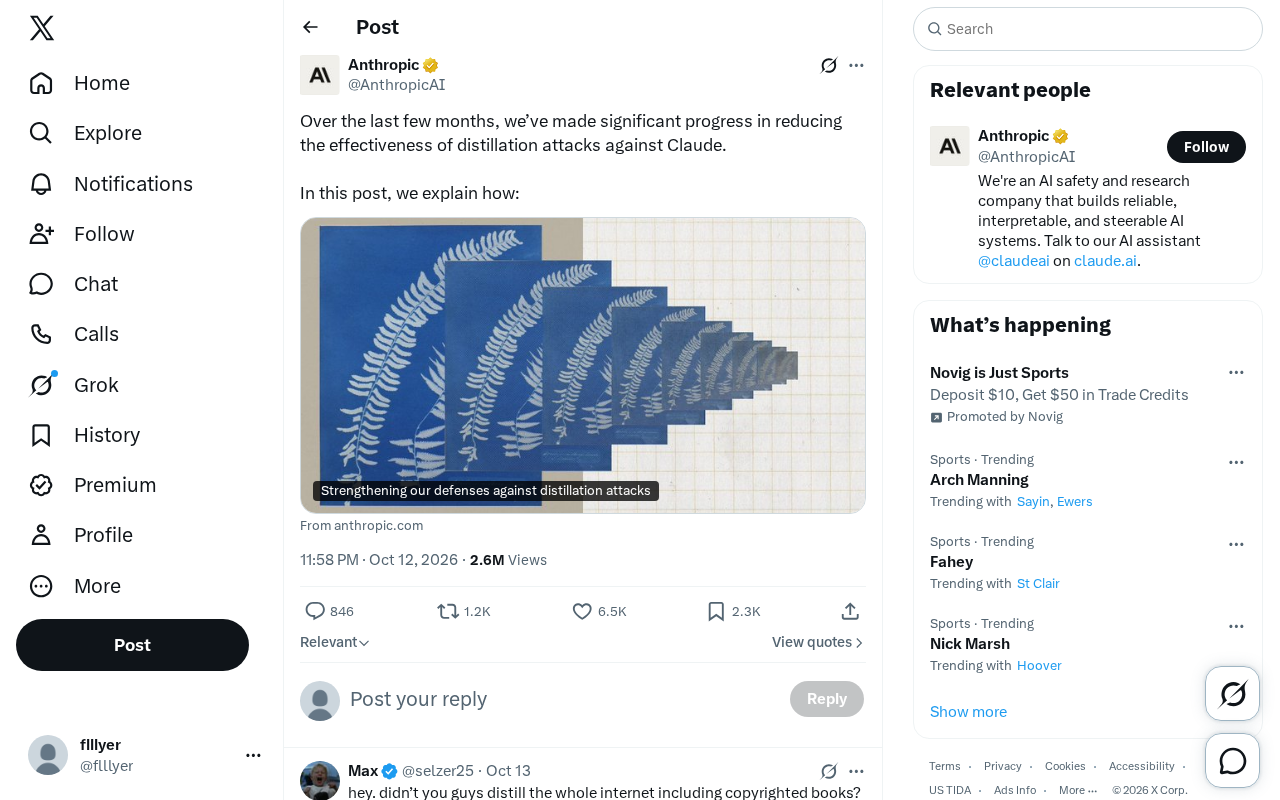
In a tweet, Anthropic revealed that over the past few months they have made significant progress in reducing the effectiveness of distillation attacks targeting Claude. Behind this brief message lies a growing challenge for the large model industry: how to prevent model capabilities from being systematically replicated.
What Is a Distillation Attack?
A distillation attack refers to a third party making large volumes of calls to a target model's API, collecting input-output pairs, and then using that data to train a smaller model—thereby replicating the original model's core capabilities without authorization. This approach allows attackers to obtain a model with approximate performance at a fraction of the training cost.
Anthropic attached a link to a detailed explanation in its tweet, indicating that it has taken specific defensive measures against this type of attack. Although the tweet itself does not elaborate on technical details, the statement itself is noteworthy—it means model providers are beginning to treat "capability theft" as an issue of equal importance to safety alignment.
Knowledge distillation is itself a legitimate model compression technique: first train a large and expensive "teacher model," then have a small "student model" learn the teacher model's output distribution (soft labels), thereby achieving comparable performance at lower cost. Hinton et al. systematized this method in 2015. The controversy of distillation attacks lies not in the technique itself but in authorization and data provenance: when a third party uses a commercial model's API outputs as training signals to replicate its capabilities without permission, it constitutes an expropriation of the model's intellectual property. Unlike traditional model theft (directly downloading weights), distillation attacks require only black-box access, have an extremely low barrier to entry, and are difficult to distinguish from normal application calls based on traffic alone.
Why This Problem Is Becoming More Urgent
As large models' capabilities continue to improve, the intellectual property value of the models themselves rises accordingly. A frontier model trained on massive compute and data—its behavioral patterns and reasoning abilities constitute core competitiveness. Distillation attacks precisely bypass this competitive barrier.
According to Anthropic's tweet, defensive measures have achieved notable results "over the past few months." This timeframe indicates that this is not a one-time patch but a continuous, iterative adversarial process. Attackers adapt to defenses, and defenders observe changes in attack patterns.
Model capability protection and model safety alignment are two issues at different levels. Alignment focuses on whether model outputs are harmful and whether they follow human intent; capability protection focuses on the value of the model's behavioral characteristics and reasoning patterns themselves as assets. Training a frontier model can cost tens of millions to hundreds of millions of dollars, and once its API outputs are harvested at scale, competitors can train comparable alternatives at a fraction of the training cost, directly eroding the original model vendor's commercial moat. This is also why leading labs are beginning to incorporate output watermarking, fingerprinting, and anomalous call pattern detection into routine operations—they protect not only alignment safety but also the model's commercial scarcity.
The Tension Between Defense and Openness
Interestingly, overly aggressive defenses may affect the experience of legitimate developers. Measures such as API call rate limits, output perturbation, and watermark detection may all be incorporated into distillation defense mechanisms. Anthropic did not specify in its tweet which methods it has adopted, but based on industry practice, such defenses typically need to find a balance between security and usability.
For developers who rely on Claude to build applications, understanding this context helps explain certain changes in API behavior. For observers concerned about AI safety, Anthropic's disclosure provides a signal: model capability protection is becoming one of the priorities of frontier labs.
Unanswered Questions
The technical explanation linked in Anthropic's tweet is not fully presented in the source material, so we cannot confirm the specific principles of its defense mechanisms, their scope, or their potential impact on legitimate users. Whether the offense-defense dynamic of distillation attacks will evolve into a long-term "cat-and-mouse game" also requires more information from official sources and independent researchers to verify.
One-line Summary
Anthropic says it has significantly reduced the effectiveness of distillation attacks on Claude, with model capability protection becoming a priority issue for frontier labs.
Paragraph Summary
In a tweet, Anthropic revealed that over the past few months it has made significant progress in reducing the effectiveness of distillation attacks targeting Claude. Distillation attacks refer to a third party collecting input-output pairs through large volumes of API calls and then training a smaller model, thereby replicating the original model's core capabilities at low cost without authorization. This statement means model providers are beginning to treat "capability theft" as an issue of equal importance to safety alignment. Because the tweet does not elaborate on technical details, the specific principles of the defense mechanisms, their scope, and their impact on legitimate developers remain unclear. The article notes that defenses need to find a balance between security and usability, and that the offense-defense dynamic may evolve into a long-term "cat-and-mouse game."
Related articles

Agent Skills Beginner's Guide: From Concepts to Multi-Agent Collaboration in Practice
A comprehensive guide to Agent Skills: core concepts, components, the importance of Description, standardization, beginner learning paths, and multi-agent collaboration.

One Neuron Detects Both Cats and Cars? We Reproduced It and Found a New Explanation
The cat-car neuron reinterpreted: researcher Cammarata argues it distinguishes pointy from round, not cats from cars. We reproduced the experiment and found the new explanation holds on most inputs—but cars are the exception. The interpretability debate continues on language models.

MCP Server + Python Assistant: A MicroStation Design Efficiency Revolution
Explore the early preview of the MCP Server and Python Assistant in MicroStation 2026: custom tools in five minutes, intelligent sheet index checks, and how AI is reshaping drawing workflows to unleash design creativity.