How Klaviyo Built an Internal App Platform on Vercel: 512 Employees, 356 Projects in Two Weeks

Klaviyo used Vercel to let 512 employees ship 356 full-stack internal apps in two weeks, going live in just 3 minutes.
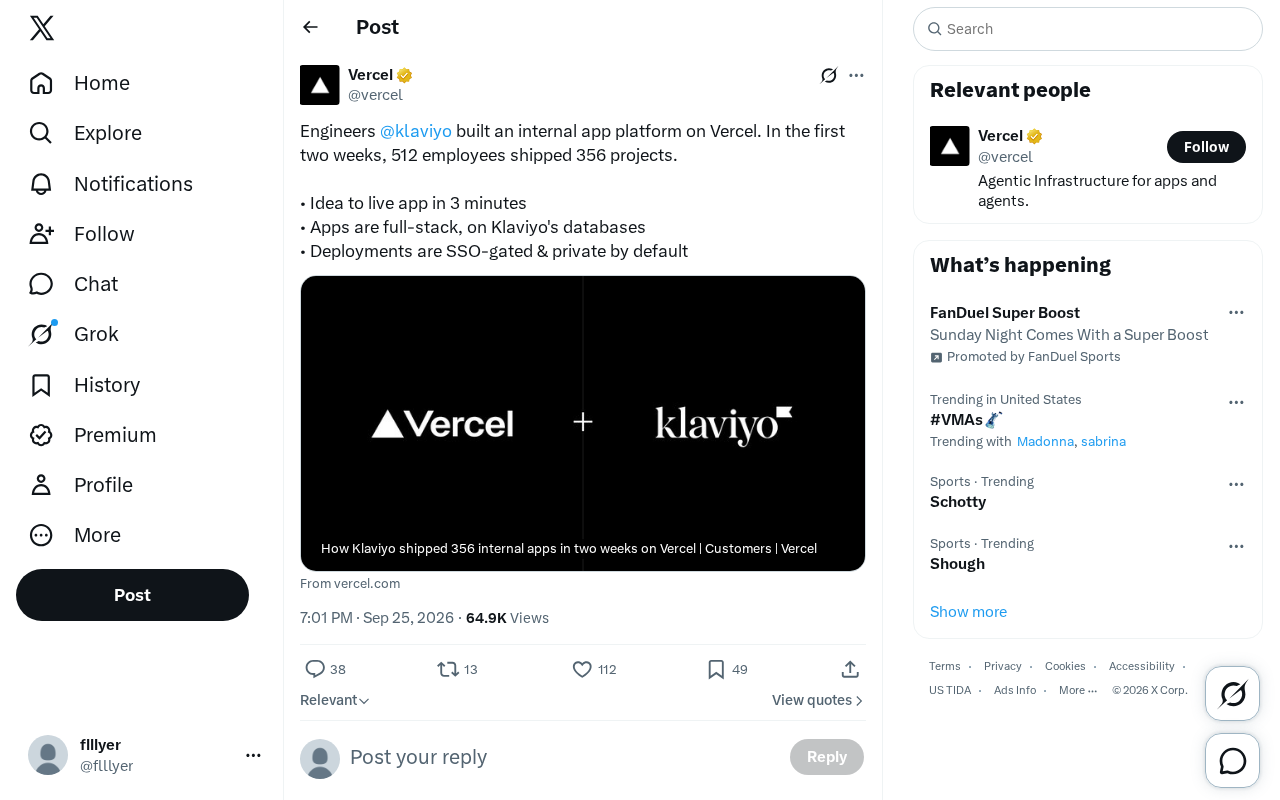
Marketing automation company Klaviyo built an internal application platform on Vercel, compressing the time from idea to live app down to just 3 minutes. In the first two weeks, 512 employees delivered 356 projects. The platform supports full-stack apps with direct access to company databases, and enforces security through SSO gating and private-by-default deployments. The case reflects the broader rise of Platform Engineering and Internal Developer Platforms (IDPs), where engineering teams package standardized capabilities for citizen developers — while maintaining consistent security and compliance.
How an Internal Platform Spawned 356 Apps in Two Weeks
Building internal tools has always been bottlenecked by engineering resources — business teams have needs, but ideas often die waiting in the engineering backlog. Klaviyo, the marketing automation company, set out to break that bottleneck: their engineering team built an internal application platform on Vercel, enabling employees across the entire company to quickly build and ship their own apps.
The results are compelling. According to data published by Vercel, in the first two weeks after launch, 512 employees delivered 356 projects. That means more than half of participants shipped something usable — dramatically lowering the barrier to internal tool development.
From Idea to Live in Three Minutes
The platform's most striking metric is speed: just 3 minutes from idea to live app. This is powered by Vercel's integrated deployment capabilities — developers don't need to worry about infrastructure configuration, server management, or setting up CI/CD pipelines. Write the code, ship the app.
For internal tooling, this speed is especially critical. Many internal needs are lightweight, temporary, or highly customized. Running them through a full traditional software engineering cycle — development, testing, deployment — often doesn't justify the effort. But when the cost of going live drops to the three-minute range, employees become far more willing to turn everyday pain points into actual tools.
Full-Stack Capabilities with Direct Database Access
Unlike many low-code platforms that only handle static pages or simple forms, Klaviyo's platform supports full-stack applications with direct access to the company's own databases.
This is what determines the platform's practical ceiling. Being able to read and write real business data means employees aren't building toy demos — they're building functional tools that embed into actual workflows: internal data dashboards, visual interfaces for operational scripts, cross-system data query tools, and more. The full-stack architecture enables complete front-end interaction and back-end logic, covering more complex use cases.
Security and Privacy: SSO Gating, Private by Default
When you hand application development capabilities to all employees, security governance is often the biggest concern. Klaviyo's design addresses this with two layers of protection:
- SSO-gated access: All application access is authenticated through Single Sign-On (SSO), ensuring only verified internal users can access apps.
- Private by default: Apps are deployed in a private state by default — not publicly accessible — reducing the risk of data exposure at the source.
This "secure by default" design philosophy matters. It makes security the foundation of the platform rather than an afterthought, so employees can build quickly without manually configuring permissions each time, and without the risk of accidentally exposing sensitive internal tools.
Single Sign-On (SSO) is an authentication mechanism that lets users log in once and access multiple systems within an organization without entering credentials for each individual application. Common SSO protocols in enterprise environments include SAML 2.0 and OIDC (OpenID Connect), typically managed by identity providers (IdPs) like Okta, Azure AD, or Google Workspace. In internal tooling contexts, routing all apps through SSO isn't just about convenience — it's about auditability. Admins can see from a central location who accessed which apps, and when an employee leaves, revoking their account in the IdP cuts off access to all internal systems at once, without needing to clean up dozens of individual tools.
Implications for the Enterprise Internal Tooling Ecosystem
Klaviyo's approach reflects a trend that's taking shape: the rise of Platform Engineering and Internal Developer Platforms (IDPs). Rather than having every team build their own infrastructure from scratch, engineering teams build a unified underlying platform that packages standardized deployment, security, and data access capabilities — and hands it to a much broader set of users.
This delivers value in two directions. On one side, "citizen developers" on the business side can self-serve their needs, relieving pressure on core engineering teams' backlogs. On the other, the unified platform ensures consistent security, compliance, and technical standards — avoiding the governance headaches that come with ungoverned sprawl.
It's worth noting that the data in this article comes from a single promotional post by Vercel on Twitter — this is a vendor-perspective showcase of results. The headline numbers (356 projects from 512 people in two weeks) are impressive, but the actual depth of usage, long-term maintenance, and real business impact still need independent validation. For teams considering a similar approach, this case is better treated as a proof-of-concept reference than a directly replicable success guarantee.
Platform Engineering is an engineering organizational practice that has gained traction in recent years. The core idea is to abstract cross-cutting concerns — infrastructure, deployment pipelines, security and compliance — into internal products, maintained by a dedicated platform team and consumed by other development teams. An Internal Developer Platform (IDP) is the concrete implementation of this practice, typically offering self-service capabilities like service catalogs, environment management, and configuration distribution. The relationship between the two is analogous to a cloud provider and its cloud services: the platform team is the internal "cloud provider," and the IDP is the "cloud services" they expose. Gartner predicts that by 2026, 80% of large software engineering organizations will have established internal developer platform teams. Compared to low-code/no-code platforms, IDPs are aimed at developers with some coding ability and emphasize standardization over visual drag-and-drop — giving them an edge in flexibility and depth of integration with existing engineering systems.
Summary
Klaviyo's case of building an internal application platform on Vercel demonstrates the potential of modern deployment platforms to lower the barrier to internal development — three-minute deploys, full-stack capabilities, direct database access, layered with SSO gating and private-by-default security. Together, these turn "everyone can build tools" from a slogan into an operational reality. For technical teams looking to improve organizational efficiency, this is a direction worth paying attention to.
Related articles

Amphibious Transforming Drone: Beyond 100x Power Savings, What Are the Real Needs?
Is the amphibious transforming drone just a gimmick? Starting from the 100x power difference of the M4 Morphobot, explore real application scenarios and thesis topic ideas, analyzing boundary conditions where pure drones and pure ground robots both fail.

Warhound Raises $200 Million: Genetically Engineered "War Dogs" Paired with Anduril Gear
Warhound raises $200M, backed by Ben Lamm and Palmer Luckey, to genetically engineer dogs for military and law enforcement use and equip them with Anduril gear. This article analyzes its technology direction, funding logic, and ethical controversy.

Claude API Comes to Google Cloud: IAM Integration and SDK Access Guide
Anthropic hosts the full Claude API on Google Cloud with IAM-controlled permissions and unified billing. This guide covers the Vertex AI and Anthropic-hosted entry points, IAM role configuration, and SDK access.