How Many Papers Should a PhD Student Publish in the LLM Era? Reddit Debates Publication Standards
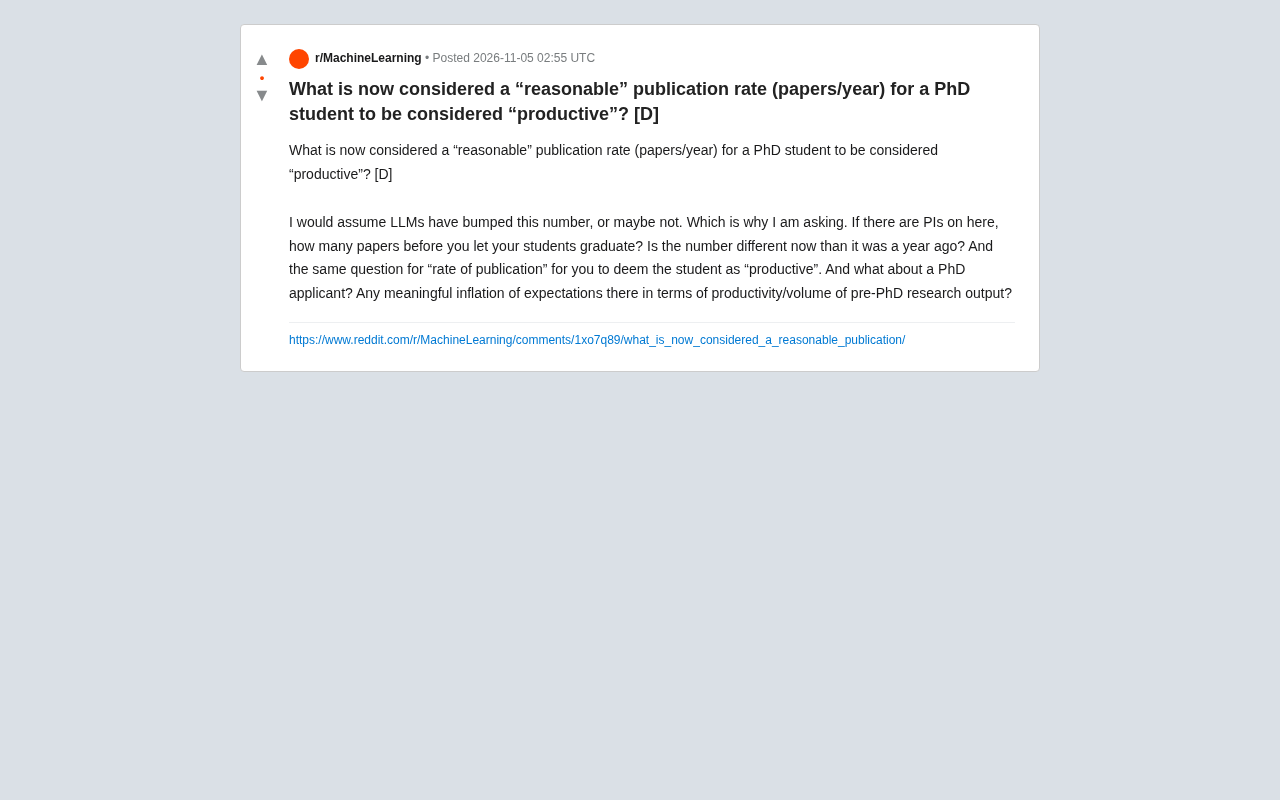
Reddit debate: no unified PhD publication standard in the LLM era; quality and storytelling beat quantity.
A Reddit question about PhD publication rates sparked debate on what counts as reasonable output and whether LLMs have inflated expectations. Advisors say quality, student contribution, and research completeness matter more than count. LLMs speed up drafting and analysis, but top-venue standards haven't loosened—quantity inflation shows mainly in low-barrier journals and preprints. Applicant evaluation is shifting from paper count to research storytelling.
A question that gives PhD students collective anxiety
A Reddit user posed a question that hits a raw nerve: what publication rate is considered "reasonable" and "productive" for PhD students today? He specifically raised one variable—whether the spread of large language models (LLMs) has pushed this number higher. The question quickly sparked discussion because it touches on a long-standing anxiety in academia that lacks a clear answer: how are quantitative output standards changing?
The poster broke the question into several layers: How many papers do advisors expect students to publish before graduating? Has this number changed compared to a year ago? For PhD applicants, are research output expectations at the undergraduate or master's level also inflating? These questions have no unified answer, yet they reflect the subtle tremors the academic evaluation system is undergoing.
The advisor's perspective: fuzzy numbers, but shifting expectations
The original post invited people with PI (Principal Investigator) experience to share their standards, but the discussion did not reach a consensus. One recurring view was that paper count has never been the only metric, or even the most important one. The quality of the papers, the student's contribution to them, and the completeness of the research itself often determine graduation more than sheer quantity.
However, multiple participants acknowledged that LLM tools have indeed changed the pace of output. Efficiency gains in literature review, coding, and drafting manuscripts are forcing a re-examination of the traditional "one paper a year" rhythm. Some comments noted that if tools make writing and experimental design faster, expectations for output speed will naturally rise—but this does not mean the quality bar rises in tandem.
PI (Principal Investigator) is the core role in an academic organization responsible for leading a research team, securing research funding, and mentoring PhD students and postdocs. In North American and European doctoral training systems, the PI is usually also the student's direct advisor, with substantive decision-making power over graduation standards and publication requirements. Expectations for publication quantity vary enormously between PIs: some require at least two first-author papers before graduation, while others value one high-quality representative work more. This individualized variance is precisely an important reason why it is difficult to form a unified numerical standard in the Reddit discussion.
Has LLM inflated publication counts?
This was the most contentious part of the original post. The poster assumed LLMs may have already pushed up publication counts, but the discussion diverged.
One side argued that LLMs lower the barrier to writing and data analysis, enabling more papers to be completed and submitted—especially in fields requiring substantial text output, where the pace of production has visibly accelerated. The other side emphasized that review standards at top journals and conferences have not been relaxed because of better tools; if anything, they may have become stricter due to increased submission volume. Therefore, "quantity inflation" is more evident in low-barrier journals or preprint platforms.
This divergence itself shows that LLM's impact on academic output is not evenly distributed. It may accelerate the production of "publishable" papers, but its contribution to "high-quality" papers is limited—and homogenized writing may even raise reviewers' suspicions.
A preprint server is an online repository where researchers publicly share draft papers before formal peer review, such as arXiv, bioRxiv, and SSRN. Preprints have greatly shortened the time from research completion to public disclosure, but they also mean that content without rigorous review can accumulate rapidly. After LLMs lowered the barrier to paper writing, submission volume on preprint platforms grew particularly noticeably—this is the technical context behind the discussion's judgment that "quantity inflation is more evident on low-barrier platforms." It is worth noting that preprints themselves are not equivalent to formal publication, and their academic recognition varies by discipline.
Output expectations for PhD applicants are also inflating
The original post also asked about research output expectations at the PhD application stage. Some in the discussion mentioned that it is increasingly common for applicants to have preprints or conference papers, but this is more a result of intensified competition than a direct effect of LLMs. One notable view was that evaluation of applicants' "research potential" is shifting from quantity to storytelling—the ability to clearly articulate research questions, methods, and contributions impresses admissions committees more than piling up a list of papers.
However, some comments cautioned that differences across disciplines and regions are enormous. Experimental sciences and humanities/social sciences have inherently different publication rhythms, and measuring everyone by a unified quantitative standard is itself a simplification.
In the context of academic evaluation, "storytelling" refers to whether a researcher can organize research questions, methodological choices, experimental design, and core contributions into a logically coherent and persuasive narrative thread. When admissions committees face large numbers of applicants with similar paper counts, they often pay more attention to whether the applicant can clearly explain "why this research was done," "what problem it solved," and "where the contribution lies." This evaluative shift reflects a deeper trend: when quantitative metrics lose their discriminating power due to the spread of tools, qualitative judgment—research taste, problem awareness, and communication ability—once again becomes the core basis for selection.
No standard answer, only dynamic balance
Returning to the original question: what is a reasonable publication rate? The implicit answer from the Reddit discussion is that there is no universally applicable number. Advisors' expectations, disciplinary conventions, journal cycles, and even a student's specific research topic all influence this standard. LLMs are indeed changing the efficiency curve of academic production, but they have not yet (and perhaps will not) give rise to a brand-new unified quantitative standard.
For PhD students, a more meaningful strategy may be to focus on the completeness and communicability of their research rather than chasing a constantly fluctuating number. For advisors and institutions, clearly communicating expectations and acknowledging the changes brought by tools is more important than clinging to old metrics. The value of this discussion lies not in providing an answer, but in revealing an academic evaluation reality that is being redefined by technology.
One-line Summary
Reddit discussion reveals no unified standard for PhD publication rates in the LLM era; quality and storytelling matter more than quantity.
Paragraph Summary
A Reddit question about PhD publication rates sparked heated debate, with the core issues being what constitutes reasonable paper output and whether LLMs have pushed the number higher. The discussion showed that advisors generally believe paper count is not the most important metric—quality, student contribution, and research completeness are more critical. LLMs do accelerate literature review, coding, and drafting, speeding up output, but top-journal review standards have not loosened, and quantity inflation is more evident in low-barrier journals and preprint platforms. Output expectations for PhD applicants are also inflating, but evaluation is shifting from quantity to research storytelling. The ultimate conclusion: there is no unified standard—disciplinary differences and advisor expectations make publication requirements highly individualized, and focusing on research completeness and communicability is more meaningful than chasing numbers.
Related articles
 Tech Frontiers
Stylome Bot Slammed as Useless Junk: Why Do AI Detection Tools Keep Failing?
Reddit users test the Stylome AI detection bot: Gemini-rewritten text judged human-written, consistently low confidence. An analysis of AI text detection's technical dilemmas, privacy concerns, and credibility crisis in community governance.
 Tech Frontiers
When AI Becomes a Productivity Divide: Clarity or "AI Psychosis"?
A civil engineer's deep use of agentic AI boosted efficiency but bred contempt for peers who refuse to learn. Is this clarity or AI psychosis? An analysis of the cognitive and psychological challenges behind the AI productivity divide.
 Tech Frontiers
Opus 5.5 Benchmark Scores Climb, Community Says Its "Weights Are Blessed"
Reddit community discusses Opus 5.5's rising scores on the Benchmaxxing Bench, with users describing its performance as "weights are blessed." This article interprets the community reaction and cautions against conflating benchmark scores with real capability.