How Much Access Should an Independent AI Agent Verifier Have? Where Do Developers Draw the Line?

AI Agent verification must move from outputs to execution paths, balancing verification depth against permission exposure.
As AI Agents enter production, checking only final responses no longer proves correct behavior. The article argues verifiers must inspect execution paths such as tool calls, database changes, and authorization compliance. Four permission tiers emerge, each trading verification capability against exposure, while independent Agent verification remains an early-stage practice.
AI Agents are moving from demos into production environments, but a thorny question has surfaced: when an Agent autonomously calls tools, modifies databases, and executes multi-step tasks, checking only the final response is no longer enough to determine whether it actually did the right thing. A developer on Reddit who is building an independent verification MCP raised a pointed question: if you were to introduce an independent AI Agent verifier, how much access would you be willing to give it?
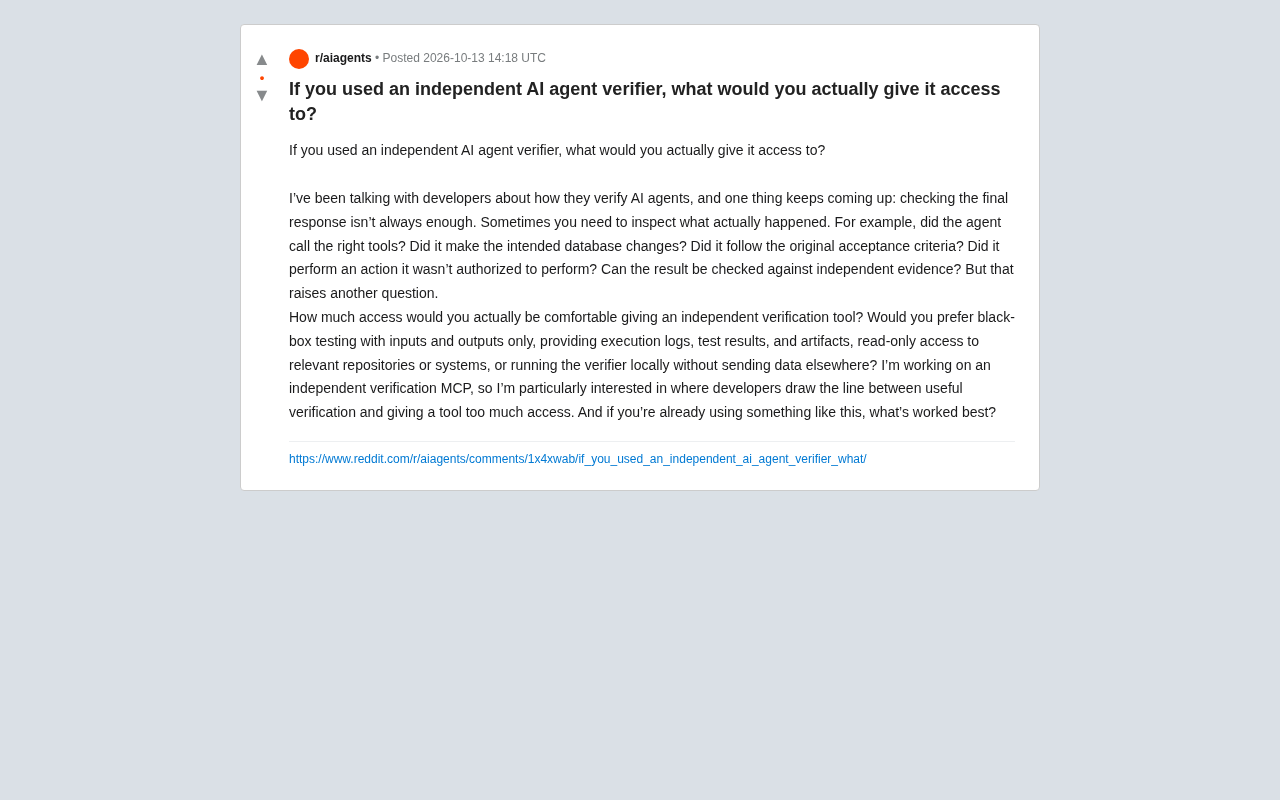
The reason this question matters is that it touches on the core tension in Agent deployment—the trade-off between verification depth and permission exposure.
Why Final Output Verification Isn't Enough
After talking with multiple developers, a consensus gradually emerged: an Agent's final response is just the tip of the iceberg. What really needs to be checked is the execution process itself.
Specifically, a verifier may need to answer these questions:
- Did the Agent call the correct tools?
- Did it make the expected modifications to the database?
- Did it satisfy the originally defined acceptance criteria?
- Did it perform any unauthorized operations?
- Can the results be cross-checked against independent evidence?
These questions cannot be answered simply by looking at input-output pairs. An Agent may return a seemingly correct answer, but during the process it called an API it shouldn't have, or caused unexpected changes to production data. Black-box testing misses a great deal of risk in these scenarios.
This also explains why verifiers need deeper visibility than traditional testing tools.
MCP (Model Context Protocol) is a protocol proposed and open-sourced by Anthropic to standardize how AI models interact with external tools and data sources. In Agent scenarios, MCP acts as a standardized "tool socket": Agents call capabilities such as database queries, file read/write, and API requests through interfaces exposed by MCP Servers, while MCP Clients initiate these calls. Since all tool calls pass through the MCP layer, this layer naturally records the complete call chain—who called which tool at what time, what parameters were passed in, and what results were returned. This is precisely the most valuable data source for independent verifiers: they don't need to intrude into the Agent's internal logic; they only need to tap into MCP's call records to reconstruct the complete execution path. For this reason, the design space for tools like "verification MCP" essentially depends on how much information at the MCP layer developers are willing to expose to the verifier.
Four Permission Tiers, and Widely Differing Developer Tolerance
Several typical ways of granting permissions emerged in the discussion, roughly divisible into four tiers from conservative to open:
Pure black box: Only inputs and outputs are provided, and the verifier cannot see any internal execution details. This approach is the safest, but its verification capability is also the most limited.
Providing execution logs and test results: Including logs, test results, build artifacts, etc. Developers are willing to let the verifier see "what happened," but not directly touch the runtime environment. This is currently the more widely accepted option in the discussion.
Read-only access to relevant repositories or systems: The verifier can directly read code repositories, databases, etc., but cannot write. This approach can verify "whether the Agent modified the correct code according to acceptance criteria," but it requires developers to trust that the verifier will not leak sensitive information.
Running the verifier locally: Data does not leave the developer's environment. This resolves compliance concerns for many teams, but sacrifices part of the verifier's value as an independent third party.
Behind each choice is a different judgment about where to draw the line between "useful verification" and "excessive permissions."
Black-box testing is a classic concept in software engineering, referring to situations where testers can only observe system behavior through inputs and outputs and cannot inspect internal implementation or execution processes. Its counterpart, white-box testing, allows testers to examine code structure, branch coverage, and internal state. In traditional software, black-box testing is sufficient because program logic is deterministic: the same input necessarily produces the same output. But AI Agent behavior is probabilistic and path-dependent—for the same task, an Agent may take completely different execution paths, some safe and some dangerous, yet ultimately give similar or even identical responses. Therefore, black-box testing systematically misses risks in Agent verification, which is the fundamental reason the article emphasizes "execution paths" rather than "output results." White-box or gray-box verification is becoming an inevitable direction for Agent quality assurance.
The Core Value of Independent Verifiers: Execution Paths, Not Outputs
One noteworthy point of view is that what verifiers really need to check is the execution path, not merely the execution result.
This means the verifier needs a certain ability to perceive the process. For example, it needs to know which tools the Agent called, the order of calls, the parameters of each call, and whether these calls were within the authorized scope. This information usually exists in execution logs, not in the final response text.
For developers building verification MCPs, this means the tool design needs to support multiple data ingestion modes—handling pure black-box scenarios while also being able to deeply inspect execution traces when authorization is granted. Fine-grained permission control will become a core competitive advantage for such tools.
What Developers Are Actually Using
The original poster also asked another question: is anyone already using similar verification solutions, and how well do they work?
Judging from the tone of the discussion, this field is still in an early exploratory stage. Most teams are still using traditional testing frameworks and manual spot checks to verify Agent behavior, and independent verification tools specifically for Agents have yet to form standard practices. This is both a gap and an opportunity.
A reasonable expectation is that as Agents take on increasingly critical tasks, the permission model for verifiers will gradually form layered, configurable best practices, much like the permission model for CI/CD. And the hesitation and discussion among developers today are precisely what is defining the boundaries for that set of practices.
CI/CD (Continuous Integration/Continuous Deployment) is the standard pipeline for modern software delivery, in which code automatically goes through build, test, and deployment stages after being committed. After years of evolution, the CI/CD permission model has formed a widely accepted set of layered practices: pipelines by default can only read code, deployment to production requires additional credential authorization, and sensitive operations require manual approval or dual review. When the article mentions that the verifier's permission model will move toward CI/CD, it refers precisely to this idea of "on-demand authorization, escalation by level, and auditable operations." For Agent verifiers, this means similar standards may emerge in the future: by default, only read execution logs; when deeper inspection is needed, request temporary read-only repository access; and when production data is involved, approval processes must be followed. Developers' current hesitation is, in effect, accumulating consensus for this yet-to-be-standardized norm.
One-line Summary
AI Agent verification needs to shift from checking outputs to checking execution paths, and the core tension is the trade-off between verification depth and permission exposure.
Paragraph Summary
As AI Agents enter production environments, checking only the final response is no longer enough to determine whether their behavior is correct. The article points out that what verifiers really need to examine is the execution path—process information such as tool calls, database changes, and authorization compliance. Developers' tolerance for verifier permissions falls into four tiers: pure black box, providing execution logs and test results, read-only access to repositories or systems, and running the verifier locally. Each tier involves a trade-off between verification capability and permission exposure. The core value of independent verifiers lies in process awareness rather than result comparison, which requires tools to support multiple data ingestion modes and fine-grained permission control. At present, independent Agent verification tools are still in an early exploratory stage and have yet to form standard practices, but as Agents take on increasingly critical tasks, their permission model is expected to evolve into layered, configurable best practices, much like CI/CD.
Related articles

How Big Can Stars Really Get? The Physical Limits of the Largest Stars
Red supergiants are the largest stars by volume, with radii up to 2,000 times the Sun, engulfing the inner solar system. But there is no precise upper limit on stellar size—models predict up to 15,000 solar radii. The most massive blue stars are far smaller than red supergiants—biggest and heaviest are two different things.

Apple HomeView Smart Display Full Feature Breakdown: Wall-Mount or Desktop, $299
Apple launches HomeView, a $299 smart display with wall-mount and desktop options, 12MP camera for facial recognition, smart home control, music playback, and recipe step-by-step cooking. Full breakdown of watch faces, apps, privacy, and cooking integration.

Where Did the Promised New Studio Go? Craft Computing Answers After Five Years
Craft Computing's host responds to viewer questions: the new studio promised five years ago was shelved as construction costs soared from $30,000 to $75,000, and was replaced by a 168-square-foot garage conversion.