How Much Does CPU Performance Actually Matter for Pure GPU Inference?
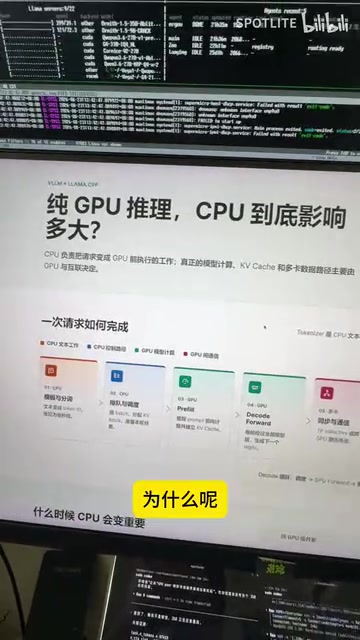
In pure GPU inference, CPU performance barely affects speed — invest in your GPU instead.
This article analyzes the CPU's actual role during pure GPU inference, breaking down the full pipeline from tokenization and scheduling (CPU) through prefill and decode (GPU) to sampling and detokenization (CPU). In low-concurrency local deployments, CPU preprocessing takes mere milliseconds compared to seconds of GPU generation time, making CPU upgrades nearly pointless. Only high-concurrency production environments benefit from stronger multi-core CPUs. The clear takeaway: prioritize GPU and VRAM for local AI setups.
Prerequisites for Pure GPU Inference
When deploying large models locally, many people struggle with a common question: how much does CPU performance actually affect AI inference? Before diving in, we need to establish a key premise — this article only discusses pure GPU inference scenarios, meaning cases where all model weights can be fully loaded into VRAM.
VRAM (Video RAM) is the high-speed memory on your graphics card, used to store data needed for GPU computation. Large language model weights are typically stored in FP16 (half-precision floating point) or lower precision formats. A 70B parameter model in FP16 requires approximately 140GB of VRAM. If VRAM is insufficient, the system enables an offload mechanism: some model layers are offloaded to the CPU's system memory (RAM), and data is frequently transferred between VRAM and RAM via the PCIe bus during inference. PCIe 4.0 x16 has a theoretical bandwidth of about 32GB/s — far below GPU memory bandwidth (e.g., the RTX 4090's 1TB/s). This causes a massive drop in inference speed, and at that point, the CPU's memory controller performance and PCIe lane count become critical bottlenecks.
This premise is crucial. If model weights can't fully fit into VRAM and need to be offloaded through CPU memory, the importance of CPU and memory bandwidth skyrockets — that's an entirely different topic. But when the entire model fits in the GPU, the situation is quite different.
Many users observe something during inference: even though the GPU is running the model, one or two CPU cores are constantly pinned at 100% utilization. This naturally raises the question: does higher IPC and clock speed on the CPU mean better inference performance?
The answer is: not really. In pure GPU inference, especially in low-concurrency scenarios, the CPU's impact on performance is quite limited. To understand why, we need to break down exactly how an inference request is processed.

The Complete Processing Pipeline for GPU Inference Requests
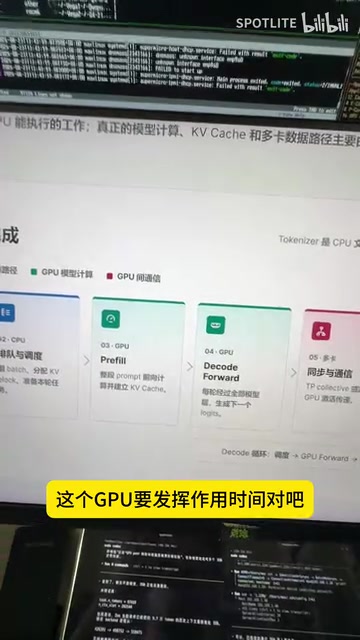
To understand the CPU's role, we need to dissect the entire request pipeline. If we strip away the outermost HTTP Server (which handles receiving and sending network requests), the internal processing within the inference framework can be roughly divided into the following stages:
CPU-Handled Preprocessing Stage
The first step is tokenization: converting the user's input text into Token IDs by referencing a vocabulary. Tokenization is the process of converting natural language text into numerical sequences that models can process. Mainstream large models use algorithms like BPE (Byte Pair Encoding) or SentencePiece to split text into subword units using a pretrained vocabulary. For example, "tokenization" might be split into ["token", "ization"] — two tokens, each mapped to an integer ID. Chinese models typically use character-level or word-level tokenization. This process involves string matching, hash lookups, and other CPU-intensive operations. However, since modern tokenizers are highly optimized (e.g., using Rust-based tokenizers libraries), a single tokenization operation typically takes on the order of 10–50ms. This step is purely CPU work.
The second step is scheduling and queuing: the framework decides how to split data into chunks (Chunk / u-batch) — determining which tokens each batch should process, how to allocate KV Cache, and so on. KV Cache is a critical optimization technique in Transformer decoding. During autoregressive generation, computing each new token requires the Key and Value vectors of all preceding tokens. Without caching these intermediate results, attention over the entire sequence would need to be recomputed, resulting in O(n²) complexity. KV Cache stores each layer's K and V matrices in VRAM, so when generating a new token, the system simply reads the historical cache and appends to it, reducing complexity to O(n). For a 32-layer, 4096-dimension model, the KV Cache for 2048 tokens occupies roughly 1GB of VRAM. This is why long-context inference demands large VRAM — VRAM must hold not only model weights but also reserve KV Cache space for each concurrent request. This scheduling logic is also handled by the CPU.
These two preprocessing steps are where the CPU actually does meaningful work.
GPU-Handled Core Computation
Once the data is ready, the real heavy lifting begins — and this is the GPU's domain:
- Prefill: For each incoming chunk, the GPU performs parallel fill computation on the prompt tokens.
- Per-token Decode: This is followed by the autoregressive token-by-token generation phase — the "streaming output" you see on screen.
Prefill and Decode are the two core stages of Transformer inference, with fundamentally different computational characteristics. The Prefill stage processes input prompt tokens and can compute attention across all tokens in parallel — it's a compute-bound task with high GPU utilization. The Decode stage generates tokens one at a time, with each step only processing the interaction between one new token and the historical sequence — it's a memory bandwidth-bound task. It requires frequent reads of KV Cache and model weights from VRAM, but the actual computation is relatively small, with GPU utilization typically only 20–40%. This is why the Decode stage's generation speed (tokens/s) is far lower than the Prefill stage's throughput, and why improving memory bandwidth (e.g., upgrading from GDDR6 to HBM3) significantly boosts Decode performance.
If you're using multiple GPUs with Pipeline Parallelism or Tensor Parallelism, there's additional multi-GPU communication overhead. Tensor Parallelism (TP) and Pipeline Parallelism (PP) are the two main strategies for multi-GPU inference. TP splits a single Transformer layer's weight matrices across different GPUs by columns or rows — for example, a 12288-dimension matrix split four ways, with each card handling 3072 dimensions. The advantage is load balancing and low latency; the downside is that every layer's forward pass requires All-Reduce communication, demanding high inter-card interconnect bandwidth (NVLink or Infinity Fabric). PP splits the model by layers — e.g., a 32-layer model across 4 cards, with each card handling 8 layers, and data flowing through cards like a pipeline. The advantage is minimal communication; the downside is pipeline bubbles that reduce utilization. In practice, both strategies are often combined — for example, an 8-GPU deployment might use TP=4 and PP=2 to balance communication overhead and load distribution.
Here's a detail worth noting: taking vLLM as an example, each additional GPU spawns an extra TP Worker responsible for scheduling coordination between cards, not actual computation. This explains why more GPUs means more active CPU cores — but these cores are mostly doing communication scheduling, not heavy computation.
Output Stage Returns to CPU
After computation, the model applies Softmax to the Decode output to produce a probability distribution over candidate tokens. For example: "Beijing" 70%, "Shanghai" 20%, "Tianjin" 3%.
The Softmax function converts the model's final layer logits (unnormalized scores) into a probability distribution: P(token_i) = exp(logits_i) / Σexp(logits_j). For a vocabulary of 50,000 tokens, each generation step produces 50,000 probability values. The Temperature parameter controls the smoothness of the distribution: T=0 degenerates to greedy sampling (selecting the highest probability item), T=1 preserves the original distribution, and T>1 flattens it (increasing randomness). In practice, Top-K sampling (selecting only from the K highest-probability candidates) and Top-P sampling (truncating when cumulative probability reaches P) are commonly used to avoid selecting low-probability meaningless tokens. These sampling operations execute on the CPU and involve sorting, accumulation, and similar operations — but since they only process a single probability vector (~200KB of data), they typically take <5ms.
If Temperature is set to 0 (greedy sampling), it simply outputs "Beijing" — the highest probability token. Finally, the framework performs detokenization to convert the Token ID back to text, which is then handed to the outer HTTP Server for delivery to the user.
At this point, one complete inference request is finished. As you can see, the CPU is mainly responsible for the head (tokenization, scheduling) and tail (sampling, detokenization) of the pipeline, while the most compute-intensive prefill and decode stages run entirely on the GPU.
CPU Processing Time as a Proportion of Total Inference
With the pipeline laid out, the key question becomes: how much time do these CPU-handled stages actually consume?
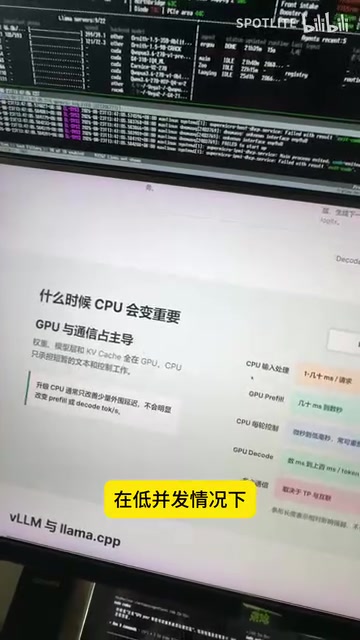
In a pure GPU inference + low concurrency scenario (personal use typically involves just one or two concurrent requests), CPU preprocessing time might only be a few tens of milliseconds, or even less. What does this mean?
Suppose you boost your CPU clock from 1.5GHz to 5GHz — a 3x+ performance improvement. The net effect is merely compressing a few tens of milliseconds of processing time down to a dozen milliseconds or so. Compared to the total generation time of several seconds per request, this difference is practically negligible.
In other words, for personal local deployment users, the inference gains from higher CPU single-core performance are minimal.
CPU Performance Considerations Under High Concurrency
Of course, there are exceptions. When the scenario shifts to high concurrency, things change.
Take vLLM as an example — a production-oriented, high-throughput inference framework. vLLM, developed at UC Berkeley, features the innovative PagedAttention mechanism, inspired by the operating system's virtual memory concept. Traditional inference frameworks pre-allocate a fixed-size KV Cache for each request, leading to memory fragmentation and waste (actual generation length is often much shorter than the pre-allocated size). PagedAttention divides KV Cache into fixed-size blocks (e.g., 64 tokens) and allocates them dynamically on demand, similar to how an OS allocates memory by pages. This improves vLLM's VRAM utilization by 2–4x, supporting larger batch sizes. In high-concurrency scenarios (e.g., processing 100 simultaneous requests), vLLM's Continuous Batching and preemptive scheduling can significantly boost throughput — and at that point, the CPU's scheduling capability (deciding which requests enter the batch, how to allocate KV blocks) becomes important. But for personal users with 1–2 concurrent requests, these advanced scheduling features are largely unused.
When handling large batches and numerous requests simultaneously, the preprocessing tokenization, scheduling, and batching logic multiplies accordingly, and the CPU can genuinely become a bottleneck. But note — what matters here is not single-core performance, but multi-core performance and multi-core scheduling capability.
IPC (Instructions Per Cycle) measures how many instructions a CPU can execute in a single clock cycle and is a core metric of CPU microarchitecture efficiency. Modern high-performance CPUs employ superscalar execution (issuing multiple instructions per cycle), out-of-order execution (dynamically reordering instructions to avoid stalls), and branch prediction (speculatively guessing if-else outcomes) to boost IPC. For example, Intel's Golden Cove architecture achieves an IPC of roughly 4–5, while the older Bulldozer architecture managed only 1–2. However, in the CPU-side processing for AI inference (tokenization, scheduling), the code logic is relatively simple, branch prediction accuracy is high, and data volumes are small (KB-level data per request). Even a CPU with lower IPC won't become a bottleneck. Only under extremely high concurrency — when hundreds of requests need simultaneous tokenization and scheduling — do differences in IPC and multi-core performance become noticeable.
More importantly, these CPU-sensitive scenarios typically arise in commercial production deployment environments. For the vast majority of hobbyists running local models at home in low-concurrency scenarios, this bottleneck is essentially never reached.
Budget Allocation Advice for Local AI Deployment
Based on the analysis above, we can draw a clear conclusion:
- Pure GPU inference + low concurrency: CPU impact is minimal — no need to over-invest.
- High concurrency / commercial deployment: Multi-core performance and scheduling capability become important.
For individuals planning to build a local AI inference setup, the most practical advice is: allocate the bulk of your budget to the GPU. VRAM capacity determines the size of models you can run, and GPU compute power determines generation speed — these two factors are the decisive elements of local inference experience. As for the CPU, as long as it's not an extremely outdated model, it will generally be sufficient for personal-level inference scheduling needs.
Instead of agonizing over CPU IPC and clock speeds, spend your money where it counts — a better GPU will improve your local AI experience far more than a top-tier CPU ever could.
Key Takeaways
- In pure GPU inference scenarios, the CPU handles tokenization, scheduling, and sampling — stages that consume a tiny fraction of total time
- For personal low-concurrency use, CPU single-core performance has negligible impact on inference speed
- Multi-core CPU performance and scheduling capability only matter for high-concurrency commercial deployments
- Local AI deployment budgets should prioritize the GPU — VRAM capacity and GPU compute power are what truly matter
Related articles

Meme Culture in Open-Source AI Communities: A Look at Self-Organization Through Reddit
Analyzing open-source AI community self-organization through Reddit's r/StableDiffusion meme culture: exploring formation mechanisms, distributed innovation, and governance challenges in tech communities.
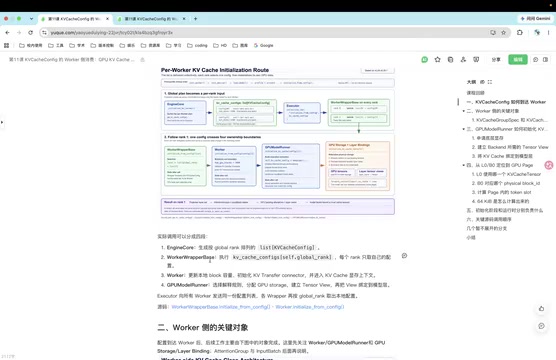
Deep Dive into vLLM Worker-Side GPU KV Cache Initialization
Deep dive into vLLM's Worker-side KV Cache GPU memory allocation, covering the full pipeline from KVCacheConfig generation to physical memory binding via ModelRunner.

Zepto Builds AI Customer Service with MLflow: An Evaluation-Driven Practice Guide
Deep dive into how Zepto built an evaluation-driven AI customer service system using MLflow and Databricks, achieving 60% faster responses and 40% less manual handling. From technical architecture to practical insights.