How Much Math Do AI Practitioners Really Need? A Deep Dive into Three Role Types

AI math needs vary by role: Users need none, Developers need basics, Researchers need deep mastery.
This article divides AI/ML practitioners into three roles — Users, Developers, and Researchers — and analyzes the math requirements for each. Users need zero math, just business acumen and tool proficiency. Developers primarily need strong programming skills, with math as a helpful bonus. Researchers absolutely require deep mathematical foundations across linear algebra, probability, calculus, optimization, and information theory. The core insight: the deeper you go, the more math you need.
Is Math a Prerequisite for Working in AI?
"How much math do I need to learn AI?" This is probably the one question everyone looking to enter the field of artificial intelligence can't avoid. The answer isn't a simple "yes" or "no" — it depends on what role you want to play in this field and how deep you want to go.
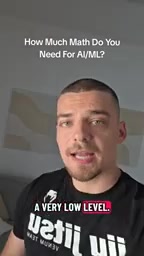
A YouTube tech creator recently shared his in-depth thoughts on this question, dividing AI/ML practitioners into three tiers with targeted advice for each. The framework is highly practical and worth serious consideration for anyone planning their AI career path.
Type 1: AI/ML Users — Zero Math Required
The first type is defined as AI/ML Users. These are people who know what AI tools are available on the market, understand how to leverage existing AI models, and can combine various tools to solve business problems — but they don't dive into the technical implementation layer.

The typical profile is a tech-savvy business professional — product managers, marketers, corporate executives, and the like. Their core competency lies in understanding business needs and matching them with the right AI solutions. In today's environment of explosive AI tool growth, the value of this role is the ability to quickly evaluate and integrate various AI products (such as ChatGPT, Midjourney, and various vertical SaaS tools), converting them into real business productivity rather than getting bogged down in technical implementation details.
Conclusion: This role requires absolutely no math skills. What you truly need is an understanding of AI's capability boundaries, business acumen, and proficiency with the tools themselves.
Type 2: AI/ML Developers — Coding Is King, Math Is a Bonus
The second type is AI/ML Developers. These are the people who actually build AI systems and agent systems, using various development frameworks to create complete applications.

A Developer's Typical Tech Stack
A common tech stack for an AI/ML developer includes:
- LangChain / LangGraph: Building LLM applications and agent workflows. LangChain is an open-source framework that provides modular components such as chain calls, memory management, and tool integration, enabling developers to seamlessly connect large language models with external data sources and APIs. LangGraph is an extension library within its ecosystem, focused on building stateful, multi-step agent workflows with support for cyclic graph structures — particularly well-suited for AI Agent applications requiring complex decision logic and multi-turn interactions.
- MLflow: Machine learning lifecycle management. This is an open-source platform from Databricks covering four core modules: experiment tracking, model packaging, model registry, and model deployment. It addresses the long-standing reproducibility problem in ML engineering, allowing teams to systematically log parameters, metrics, and artifacts from each experiment while managing model version iterations in production environments.
- N8n: Low-code/no-code automation tool
- Various backend engineering frameworks
For this role, programming ability and software engineering skills are absolute hard requirements. You need to know how to design system architecture, write maintainable code, and handle deployment and operations. "Software engineering skills" here means more than just writing code — it also encompasses version control, CI/CD pipelines, containerized deployment, API design, system monitoring, and a whole range of engineering practices.
Math at this level is a "nice-to-have" — having some mathematical foundation will help you better understand model behavior, but lacking advanced math knowledge won't prevent you from succeeding in this role. For example, you don't need to derive the attention mechanism formula in Transformers, but having an intuitive understanding of what "attention weights" mean will help you better debug and optimize your applications.
Type 3: AI/ML Researchers — Math Is a Survival Necessity
The third type is AI/ML Researchers, and here the answer is unambiguous: You absolutely need a solid mathematical foundation.

Why Researchers Can't Live Without Math
A researcher's daily work includes:
- Designing and improving model architectures
- Reading and reproducing academic papers
- Building models from scratch or enhancing existing ones
- Performing fine-tuning and architectural modifications
- Conducting experiments and system optimization at the foundational level
Mathematical Intuition Determines Research Quality
A critical question: if you don't understand the underlying math, how can you reasonably choose hyperparameters? How do you decide which activation function to use? How do you assess the risk of vanishing or exploding gradients?
Hyperparameters are parameters set manually before model training begins (such as learning rate, batch size, and number of network layers), fundamentally different from the weight parameters that models learn automatically during training. Poorly chosen hyperparameters can cause a model to fail to converge or severely overfit. Activation functions (such as ReLU, Sigmoid, Tanh) determine the nonlinear transformation of neuron outputs, and their mathematical properties directly affect gradient propagation stability — for example, the Sigmoid function's gradient approaches zero for very large or very small inputs, easily triggering vanishing gradients, while ReLU mitigates this through its piecewise linear nature but may cause "dead neuron" phenomena.
Vanishing and exploding gradients are classic challenges in deep neural network training. During backpropagation, gradients are multiplied layer by layer through the chain rule. If each layer's gradient value is less than 1, the gradient decays exponentially toward zero after many multiplications (vanishing gradients), leaving shallow-layer parameters virtually unable to update. Conversely, if gradient values exceed 1, they grow exponentially (exploding gradients), causing excessively large parameter updates and unstable training. Modern deep learning addresses these issues through techniques like residual connections (ResNet), Batch Normalization, and gradient clipping — and understanding why these techniques work itself requires a solid mathematical foundation.
This isn't just about "knowing the formulas" — it requires an intuitive understanding of mathematics. You need to sense how data flows through high-dimensional spaces, understand the geometric meaning of loss functions, and grasp the conditions under which optimization algorithms converge. Without this intuition, every decision you make could be a shot in the dark.
Mathematical Branches Researchers Need to Master
Specifically, AI/ML researchers typically need systematic study in the following mathematical areas:
- Linear Algebra: Matrix operations, eigendecomposition, Singular Value Decomposition (SVD). Linear algebra is the mathematical language of deep learning — forward propagation in neural networks is essentially a series of matrix multiplications combined with nonlinear transformations. Eigendecomposition and SVD are widely used in dimensionality reduction (e.g., PCA), recommendation systems, word embeddings, and more. The core of the attention mechanism in Transformer architectures is matrix dot-product operations, and understanding concepts like matrix rank, eigenvalues, and vector spaces is crucial for grasping a model's expressive capacity and information bottlenecks.
- Probability and Statistics: Bayesian inference, probability distribution theory. Probability theory provides the theoretical framework for modeling uncertainty in machine learning — from Naive Bayes classifiers to Gaussian processes, from variational inference to diffusion models, probabilistic thinking permeates every aspect of AI research.
- Calculus: Multivariable differentiation, the chain rule (the mathematical foundation of backpropagation). The backpropagation algorithm — the core of deep learning training — is essentially the systematic application of the chain rule for composite functions on a computational graph.
- Optimization Theory: Convex optimization, gradient descent and its variants. From basic Stochastic Gradient Descent (SGD) to adaptive optimizers like Adam and AdaGrad, understanding their convergence properties and applicable conditions is fundamental for researchers.
- Information Theory: Entropy, KL divergence, mutual information. Founded by Claude Shannon in 1948, information theory's influence in deep learning is direct — the cross-entropy loss function comes straight from information theory, measuring the difference between a model's predicted distribution and the true distribution. KL divergence quantifies the "distance" between two probability distributions and is a core component of the Variational Autoencoder (VAE) training objective. Mutual information is used in feature selection, representation learning, and information bottleneck theory, helping researchers understand how each layer of a neural network compresses and retains input information.
Core Takeaway: The Deeper You Go, the More Math You Need
The core insight of this framework is crystal clear: The deeper you want to go, the more math you need. It's a continuous spectrum, not a binary choice.
From user to developer to researcher, math requirements increase in a staircase pattern. Users need virtually no math, developers need basic mathematical literacy to support technical decisions, and researchers must internalize math as a thinking tool.
The creator also made a special point: for anyone who wants to call themselves an "engineer" rather than merely a "user," you should at least learn some foundational math. This isn't about becoming a mathematician — it's about having better judgment when making technical decisions. This judgment shows up in many details: Why does a certain model perform poorly on a specific dataset? Why doesn't increasing model parameters always lead to better performance? Why are certain data preprocessing steps necessary? The deeper answers to these questions almost always point back to math.
Practical Advice for Learners at Different Stages
Based on where you currently are, consider the following learning paths:
- If you're a career changer or beginner: Start by entering through the user role — familiarize yourself with AI tools and the ecosystem while building up your programming fundamentals (Python is the lingua franca of AI). Don't let math scare you off; just start getting hands-on. Many successful AI practitioners gradually filled in their theoretical knowledge through practice. The "use first, learn later" path is entirely viable.
- If you're a developer looking to level up: Gradually introduce mathematical thinking through project practice, starting with understanding the principles behind the models you're already using. When you encounter a formula you don't understand, look it up and learn it. The recommended approach is "demand-driven" — when you hit confusion while debugging a model, study the relevant math with that specific problem in mind. This is more efficient and easier to sustain than systematically working through textbooks from scratch.
- If your goal is research: Study math systematically, don't skip the fundamentals, and invest time in building bridges from formula derivation to intuitive understanding. Start by solidifying your foundation in linear algebra and calculus, then study probability theory and optimization theory in parallel. MIT's Gilbert Strang linear algebra course and 3Blue1Brown's visual math series are excellent starting resources. The key is not to settle for "knowing how to compute" — strive to "understand why it's computed that way."
Ultimately, math shouldn't be a source of fear when entering the AI field — it should be seen as a key. Which doors it opens depends on which room you want to walk into.
Related articles

Code with Claude Event: AI-Powered Creative Experiments on Tiny Computers
At Code with Claude, Anthropic gave participants tiny computers to build creative projects with AI assistance, showcasing how AI coding tools empower the maker community.

Claude Code Adds Agent View: A Research Preview for Unified Session Management
Claude Code's new Agent View feature (research preview) consolidates all coding sessions into a unified list, advancing AI tools toward multi-agent orchestration.
Open-Source Python SDK: Measuring AI Agent Reliability with SRE Principles
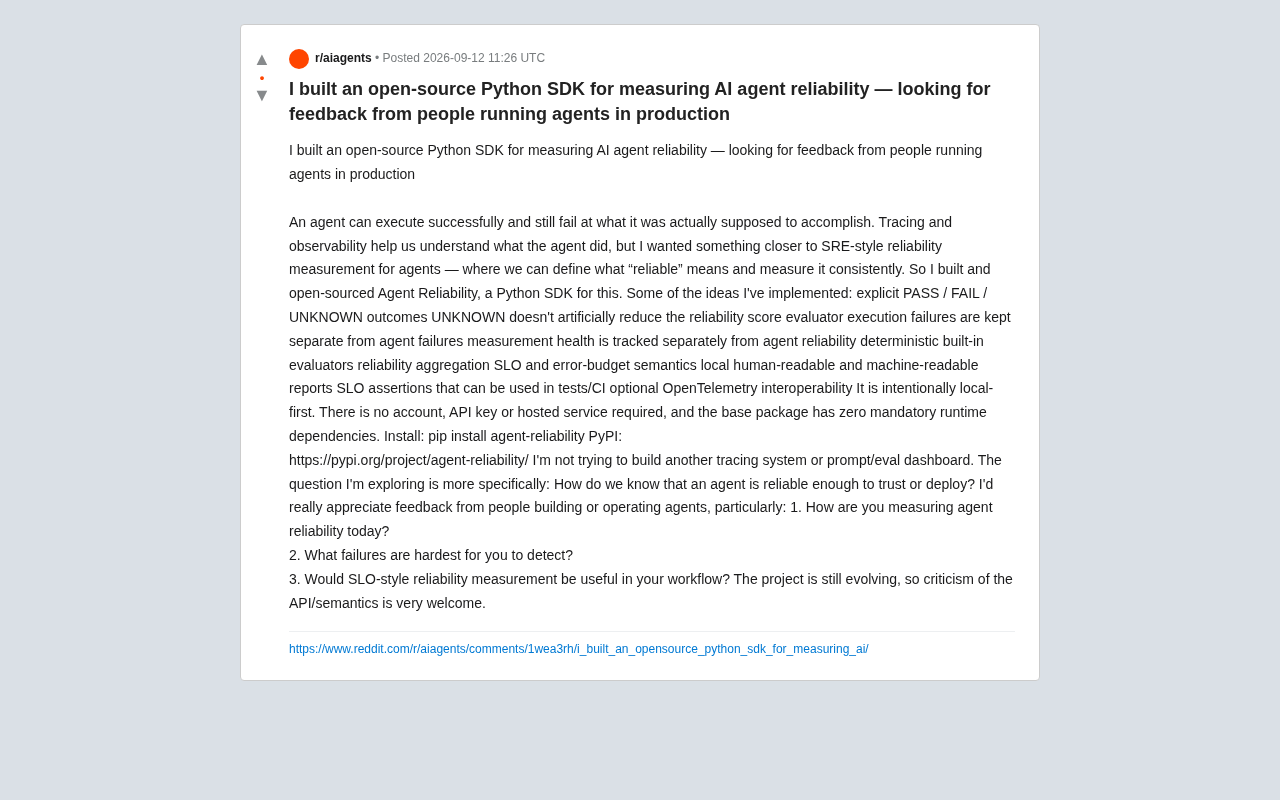
Agent Reliability is an open-source Python SDK that applies SRE's SLO and error budget concepts to AI Agent evaluation, with PASS/FAIL/UNKNOWN states, CI assertions, and zero forced dependencies.