How Much Math Do AI Professionals Really Need? A Detailed Breakdown by Role

A breakdown of math depth needed for different AI roles, from application engineering to frontier research.
This article addresses a common question among AI learners: how much math is truly needed in industry? It maps AI roles onto a spectrum from applied engineering (conceptual understanding suffices) to frontier research (derivation-level mastery required), covering linear algebra, probability, statistics, and optimization theory. The key insight: mathematical literacy and the ability to quickly rebuild knowledge matter more than memorizing formulas.
A Real Dilemma from a Soon-to-Be Master's Student
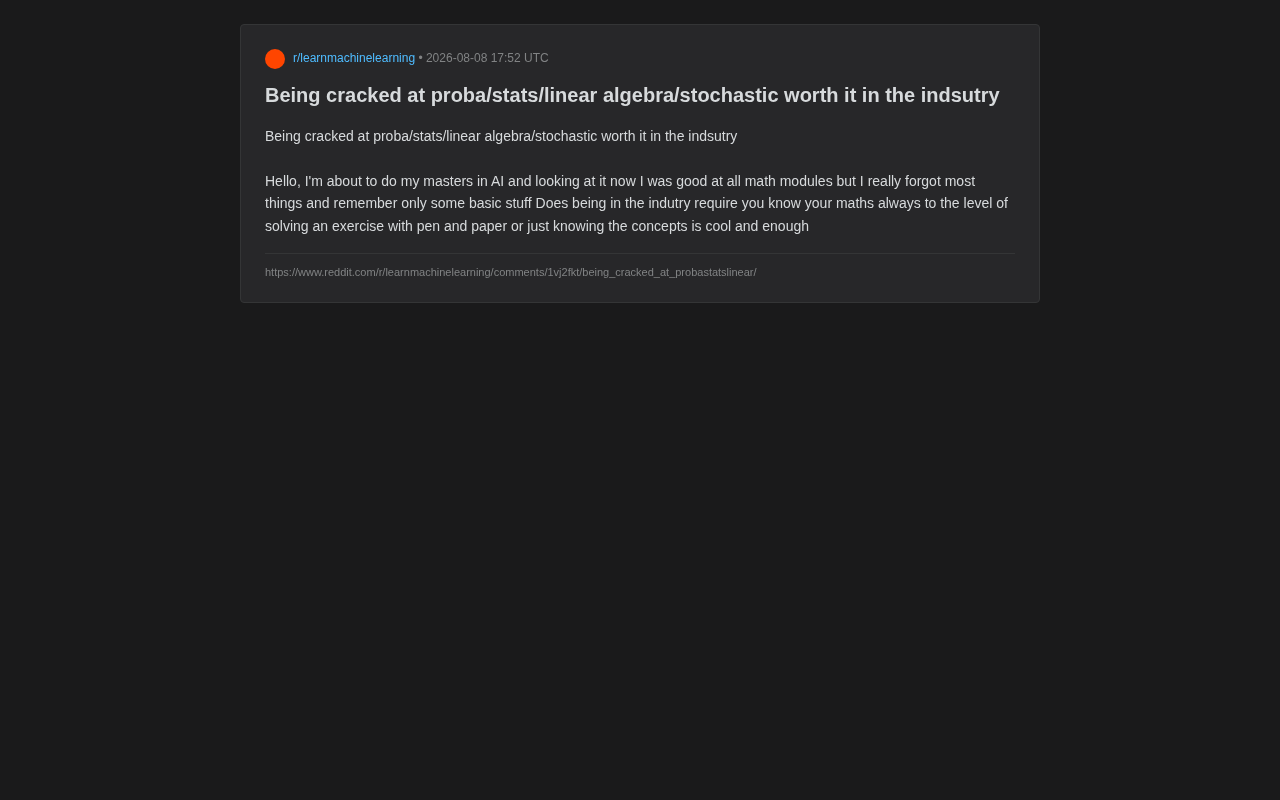
Recently on Reddit, a student about to pursue a master's degree in AI posed a question that resonated widely: In industry, do you really need to master probability theory, statistics, linear algebra, and stochastic processes to the level of deriving proofs by hand? Or is understanding the core concepts enough?
The poster admitted that while they once performed well in math courses, looking back now, most of the material has been forgotten — only some basics remain. This state of "learned it but forgot it" is precisely the shared predicament of the vast majority of AI learners and practitioners.
This question seems simple but actually touches on a core tension between AI education and industry practice: Where exactly is the balance point between theoretical depth and engineering practicality?
Two Roles Math Plays in AI Work
To answer this question, we first need to distinguish between the two fundamentally different roles math plays in the AI workflow.
Role One: Conceptual Math as an "Understanding Tool"
For the vast majority of applied AI positions (such as machine learning engineers, data scientists, AI application developers), the core value of math lies in helping you understand what the model is doing, why it's doing it, and how to troubleshoot when things go wrong.
Here are some specific scenarios:
-
When you encounter gradient descent, you need to understand what "gradient" means in terms of directional change, without manually differentiating the entire network. Gradient descent is the most fundamental optimization algorithm in deep learning — its mathematical essence is iteratively updating parameters in the direction of the negative gradient of the loss function. In modern deep learning frameworks (like PyTorch and TensorFlow), automatic differentiation has completely replaced the need for manual derivation — frameworks automatically complete chain rule computations during backpropagation through computational graphs. This means engineers almost never need to manually compute gradients in practice, but understanding the geometric meaning of gradients is crucial for diagnosing training issues (such as vanishing gradients, exploding gradients, or improper learning rate settings).
-
When you encounter model overfitting, you need to understand the bias-variance tradeoff behind regularization, without deriving the complete proof. The bias-variance tradeoff is one of the core concepts in statistical learning theory: a model's prediction error can be decomposed into bias (systematic error from overly simplistic model assumptions), variance (instability from the model being too sensitive to fluctuations in training data), and irreducible noise. Regularization methods (such as L1/L2 regularization, Dropout, early stopping) essentially introduce a small amount of bias to significantly reduce variance, thereby improving generalization. This framework remains the best theoretical lens for understanding overfitting and underfitting phenomena.
-
When debugging attention mechanisms, you need to know that those matrix multiplications geometrically represent projections and weightings, without computing element by element. The self-attention mechanism in the Transformer architecture can be mathematically understood as a series of linear transformations and weighted summations: the input sequence is projected through three weight matrices into Query, Key, and Value vectors (equivalent to mapping into different subspaces), then attention weights are computed via dot products and used to aggregate Values. Understanding the geometric meaning of these operations — projection, similarity measurement, information aggregation — helps explain why certain attention heads focus on specific patterns and how to diagnose abnormal attention distributions.
At this level, knowing the concepts, understanding the intuition, and being able to read formulas in papers is already sufficient for most work. You don't need to be able to derive the complete chain of Bayes' theorem from memory on a blank sheet of paper. It's worth noting that while Bayes' theorem has a concise formula (P(A|B)=P(B|A)·P(A)/P(B)), it has given rise to the entire Bayesian learning framework in machine learning, whose core advantage lies in quantifying prediction uncertainty — particularly critical in high-stakes scenarios like medical diagnosis and autonomous driving.
Role Two: Deep Math as a "Weapon for Innovation"
However, if your goal is to enter research positions, work as an algorithm researcher, or join teams that design entirely new model architectures, the story is completely different.
In these roles, math is no longer a tool for understanding but the raw material for innovation. You need to be able to:
- Derive new loss functions or optimization methods from mathematical first principles
- Analyze algorithm convergence, complexity, and theoretical bounds
- Prove the effectiveness of your methods using rigorous mathematical language in papers
At this point, math proficiency at the "can derive proofs by hand" level is no longer optional — it's a hard requirement. Stochastic processes, measure theory, convex optimization — knowledge that might seem "excessive" — becomes your core competitive advantage that distinguishes you from ordinary engineers.
Regarding convex optimization, it's worth adding: convex optimization theory studies methods for finding global optima over convex objective functions and convex constraint sets, with strong theoretical guarantees — any local optimum is a global optimum. However, loss functions in deep learning are almost always highly non-convex. Interestingly, recent theoretical research has shown that in over-parameterized deep networks, most local minima have quality close to the global optimum, and saddle points are the real obstacle to optimization. Understanding convex optimization provides precise tools for analyzing simple models and offers an important comparative benchmark for understanding the non-convex optimization landscape in deep learning.
Measure theory, as the mathematical foundation of modern probability theory (established by Kolmogorov in 1933 using an axiomatic approach), mainly appears in theoretical analysis of generative models (e.g., the Wasserstein distance in GANs is essentially an optimal transport problem), path analysis of stochastic processes, and mathematical derivations of diffusion models. For scholars engaged in theoretical research on probabilistic models, it is an indispensable foundational language.
The Math Requirements Spectrum Across AI Roles
Rather than agonizing over "whether to study to the extreme," it's better to view AI-related positions on a spectrum of math requirements:
As AI technology matures and industrializes, the industry has formed a clear hierarchical structure. According to data from major job platforms, approximately 70% of AI-related positions are in applied engineering, about 20% in modeling and analysis, and only about 10% in frontier research. The era of large models has further intensified this trend: as pretrained models and API services become widespread, more and more AI work involves "using AI" rather than "creating AI," causing a clear polarization in the demand for mathematical depth.
Applied Engineering Side (Math Requirement: Conceptual Level)
- AI Application Developers / LLM Application Engineers: Primarily calling APIs, doing prompt engineering, and building products. Math requirements are the lowest — understanding basic principles is sufficient.
- Machine Learning Engineers: Need to understand model principles, perform feature engineering, and tune hyperparameters. Requires "solid conceptual understanding" but rarely involves hand-deriving formulas.
Modeling & Analysis Side (Math Requirement: Proficiency Level)
- Data Scientists: Statistics is the foundation of the role. Hypothesis testing, probability distributions, and regression analysis must be truly mastered — not just known by name.
- Quantitative Researchers: Probability theory and stochastic processes are daily tools; math proficiency requirements approach academic levels.
Frontier Research Side (Math Requirement: Mastery Level)
- Algorithm Researchers / Research Scientists: Linear algebra, probability and statistics, and optimization theory all need to reach the "can derive and innovate" level. Advanced topics like stochastic processes are also standard weapons.
This spectrum clearly illustrates: The answer to "how much math should I learn" depends entirely on which end of the spectrum you want to be.
Forgetting Isn't Scary — The Ability to Rebuild Is What Matters
Returning to the poster's anxiety about having "learned but forgotten most of it," here's a truth many overlook: In industry, no one expects you to keep all mathematics in your head ready for instant recall.
What truly matters is that you once systematically studied these subjects, giving you two capabilities:
-
The ability to quickly rebuild: When work requires a specific concept, you can pick it back up within hours by consulting resources, because your brain already has the "hooks." Cognitive science research shows that previously systematically learned knowledge, even when forgotten, can be relearned significantly faster than starting from scratch — this is called the "savings effect." Your brain retains the structural framework of knowledge and the associative network between concepts; these implicit memories make reactivation efficient.
-
Intuition for recognizing the essence of problems: Even if you can't recall specific formulas, you can keenly recognize that "this calls for some kind of statistical test" or "this problem is fundamentally an optimization problem." This pattern recognition ability is the accumulated deposit of long-term mathematical training — it doesn't disappear along with forgotten formulas.
This kind of "mathematical literacy" is far more valuable than "mathematical memory." It means that when facing a new problem, you at least know which direction to look for answers.
Practical Advice for AI Learners
Taking everything into account, learners about to enter the AI field can adopt this strategy:
1. Prioritize Building Conceptual Intuition
Firmly grasp the core intuitions of linear algebra, probability and statistics, and calculus. The geometric meaning of matrix operations, the shapes of probability distributions, the directional meaning of gradients — these are fundamentals inseparable from any AI work. The recommended approach is to combine visualization tools (such as 3Blue1Brown's "Essence of Linear Algebra" series) to build geometric intuition, rather than diving into abstract symbolic manipulation from the start.
2. Determine Depth Based on Career Direction
If you're certain about pursuing an applied engineering path, invest more energy in engineering practice, system design, and product understanding — keeping math at a "good enough" level. If you want to do research, you must go back and retrain your math to the derivation level. It's worth noting that career directions may change over time, so building a solid mathematical foundation during your master's program is an "option investment" — even if not immediately needed, it preserves optionality for potential future direction changes.
3. Cultivate the Habit of "Being Able to Pick It Up When Needed"
Don't force yourself to memorize all formulas, but maintain familiarity with mathematical tools. Periodically implement algorithms by hand (such as building a simple neural network or gradient descent from scratch), read papers with formulas, and keep your math abilities in a "ready to activate" state. In practice, an effective method is to maintain a personal "math quick-reference notebook" recording core formulas and intuitive explanations, serving as anchor points for future rapid recall.
Conclusion
This Reddit user's confusion is essentially a positioning question that every AI practitioner must face.
In industry, the vast majority of roles don't require you to derive formulas by hand as if taking a closed-book exam, but they all require you to truly understand what mathematical concepts mean. Math isn't for showing off — it's a tool for understanding, troubleshooting, and innovation. How deep your math needs to be depends on what role you want to play in the vast landscape of AI.
Rather than worrying about how much you've forgotten, ask yourself a more fundamental question: When work truly requires a particular mathematical tool, can I quickly pick it up and use it correctly? If the answer is yes, then your mathematical preparation is already sufficient.
Related articles

RAG Getting Started in Practice: From Principles to Building an Enterprise Knowledge Base
Bilibili RAG course highlights: from retrieval-augmented generation principles, document chunking and vectorization, to five accuracy factors and enterprise knowledge base boundaries, with fine-tuning vs RAG selection advice.

AI Model Selection Guide: DeepSeek vs. Qwen3 in Practice
How should AI developers choose models? Based on a Bilibili tutorial, this article breaks down the Function Calling differences between DeepSeek V3 and R1, Qwen3's programmatic thinking mode switching and agent capabilities, and outlines a multi-model learning path and practical selection logic.

Anchoring, Loss Aversion, and Nudges: 5 Psychological Tactics Retailers Use to Make You Spend
Behavioral economics reveals how retailers use anchoring, framing, loss aversion, and nudge theory to manipulate your spending decisions. This article breaks down 5 common psychological tactics and offers counterstrategies like slowing down decisions and setting your own anchors to see through the pricing design behind discounts.