How Neural Networks Build Their Own Learning Mechanisms: Insights from Brain Science for Unsupervised Learning

Artificial neural networks can achieve self-organizing learning through local rules, offering new clues for understanding brain learning mechanisms.
The article explores whether artificial neural networks can learn autonomously like the brain without detailed design instructions. Traditional training relies on human-designed loss functions, optimizers, and architectures, while self-organizing learning emphasizes local rules and emergent behavior, closer to biological neuroplasticity. Researchers have explored Hebbian learning rules, dynamic structural adjustment, and other pathways. This direction may yield more efficient, robust AI models with less dependence on labeled data and manual tuning, while also serving as computational models to help neuroscience validate hypotheses about brain learning mechanisms, reflecting bidirectional feedback between AI and neuroscience.
Can artificial neural networks learn autonomously like the brain, without detailed design instructions? This question is not only a core challenge in deep learning but also bears on our understanding of how biological brains learn.
From Design to Self-Organization: A Paradigm Shift in Learning
Traditional artificial neural network training relies on carefully designed loss functions, optimizers, and network architectures. Researchers need to specify learning objectives for the network, define gradient update rules, and continuously tune hyperparameters. However, truly intelligent systems might need to possess the ability to self-organize their learning—just like biological brains—autonomously constructing the internal mechanisms needed for learning without detailed external instructions.
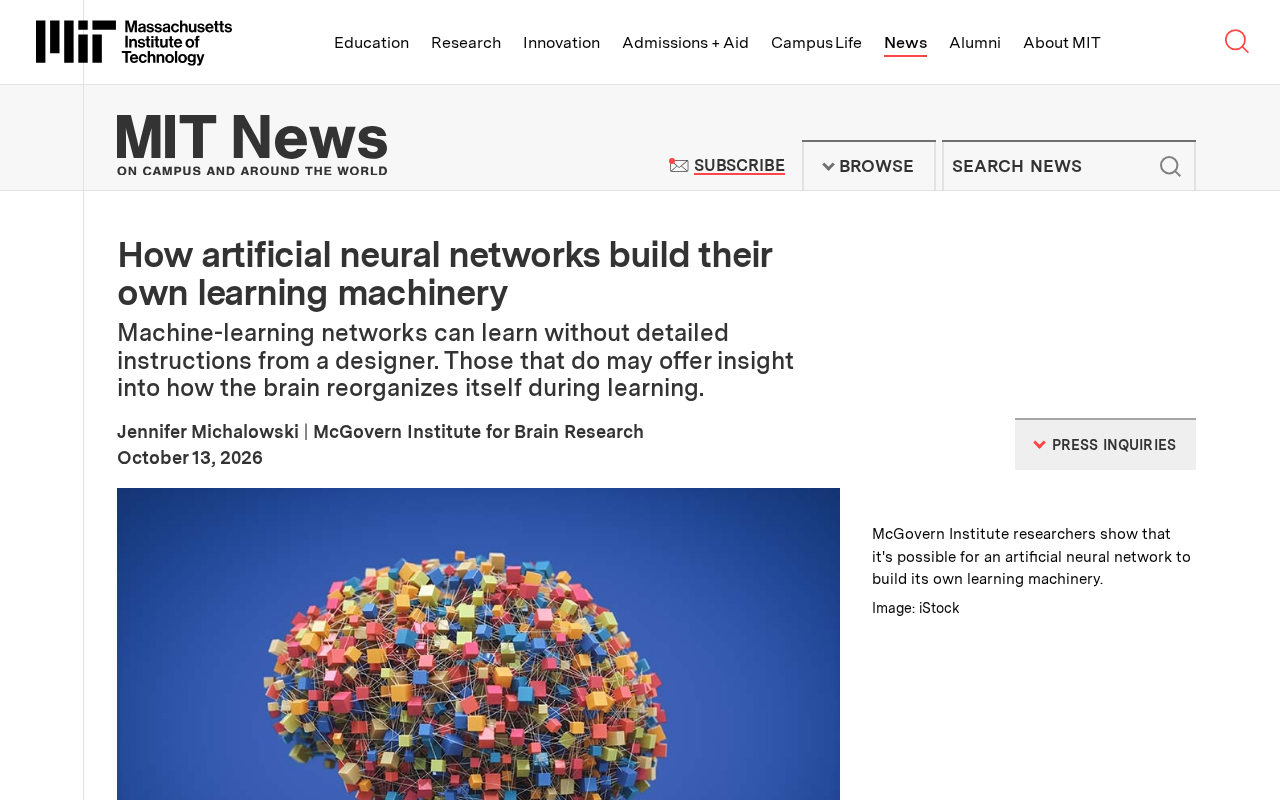
According to RSS sources, machine learning networks can learn without detailed instructions from designers, and those capable of doing so may provide important clues for understanding how the brain reorganizes itself during learning. This finding bridges artificial intelligence and neuroscience, suggesting that autonomous learning mechanisms may be a key feature of general intelligence.
The core of this self-organizing capability lies in the fact that the network does not passively accept human-designed learning rules, but actively adjusts its own internal structure and connectivity patterns to adapt to task requirements. This closely parallels the plasticity mechanisms of the brain during development and learning.
Brain Plasticity: The Underlying Logic of Biological Learning
The brain's remarkable ability to reorganize during learning is awe-inspiring. When a person learns a new skill, connections between neurons change—some are strengthened, others weakened, and new synapses may even form. This mechanism, known as "neuroplasticity," enables the brain to continuously optimize its information processing capabilities without an external engineer.
Self-organizing learning in artificial neural networks attempts to replicate this process. Unlike traditional backpropagation—which relies on a global error signal to adjust all weights—self-organizing learning emphasizes local rules and emergent behavior. Each unit in the network updates based on local information and simple interaction rules, while complex global learning behavior spontaneously emerges from these local interactions.
Backpropagation is the dominant training algorithm in current deep learning. Its core idea is: forward propagation computes the error between the network output and the target, then uses the chain rule to propagate this error signal back layer by layer from the output layer, calculating each weight's contribution to the total error (i.e., gradient), and updating weights accordingly. This process requires a global, explicit objective function to define "what is good," and demands that the entire network's computational graph be differentiable. Backpropagation's efficiency has made it the cornerstone of modern large-scale neural network training, but it differs significantly from how biological brains learn: no precise error back-propagation pathways have been found in the brain, and neurons cannot access global error information. It is precisely this discrepancy that drives researchers to explore self-organizing learning rules closer to biological mechanisms.
Implementation Pathways for Self-Organizing Learning
Currently, researchers have explored multiple pathways for implementing self-organizing learning. One class of methods draws on Hebbian learning rules—"neurons that fire together, wire together"—these purely local learning rules do not require a global error signal, yet can produce meaningful representations.
Another class of methods focuses on dynamic adjustment of network structure. Some networks can add or remove neurons during training, adjust connection topology, and even develop modular structures. These structural changes are not preset by external designers but arise spontaneously as the network strives to better accomplish its task.
Interestingly, this self-organizing capability forms an intriguing contrast with current popular large-scale pre-trained models. While the latter are massive in scale, their learning mechanisms still rely heavily on human-designed training objectives and architectures. Self-organizing learning points toward a development path closer to biological intelligence.
Hebbian learning rules originate from the theory proposed by neuropsychologist Donald Hebb in 1949: when two neurons are repeatedly activated simultaneously, the strength of the connection between them increases. In one sentence: "Cells that fire together, wire together." The mathematical form of this rule typically manifests as the weight change being proportional to the product of the activation values of the two neurons. The key advantage of Hebbian learning is its purely local nature—each synapse's update depends only on the states of the two neurons directly connected to it, without requiring any global error signal or external supervision. However, pure Hebbian rules also face instability issues: positive feedback can lead to unbounded weight growth. To address this, researchers have proposed various improvements, such as the Oja rule (introducing weight decay for normalization) and the BCM rule (introducing a sliding modification threshold), making Hebbian learning more stable and practical in real networks.
Emergence refers to the appearance at the system level of complex behaviors or properties that do not exist in individual components or local rules and cannot be directly anticipated. In self-organizing neural networks, emergence means: each neuron follows only simple local update rules, but after massive neuronal interactions, the network as a whole can form meaningful representations, classification boundaries, and even modular structures. This concept has deep connections to phase transitions in statistical physics and self-organized criticality in complex systems. Understanding emergence is crucial for answering the fundamental question of "how intelligence arises from simple rules" and serves as an important theoretical bridge connecting artificial neural networks and biological nervous systems.
Dual Significance for AI and Neuroscience
The significance of this research extends beyond purely engineering applications. For the AI field, self-organizing learning may lead to more efficient and robust models—ones that do not require large amounts of labeled data or repeated human hyperparameter tuning. For neuroscience, self-organizing phenomena in artificial networks can serve as computational models, helping researchers formulate and test hypotheses about brain learning mechanisms.
This bidirectional feedback between the two fields is accelerating our understanding of the phenomenon of "learning" itself. When artificial networks exhibit brain-like self-organizing capabilities, we are not only building more intelligent machines but also gaining deeper insight into how intelligence itself emerges from simple local rules.
One-line Summary
Artificial neural networks can achieve self-organizing learning through local rules, providing new clues for understanding brain learning mechanisms.
Paragraph Summary
The article explores whether artificial neural networks can learn autonomously like the brain without detailed design instructions. Traditional network training relies on human-designed loss functions, optimizers, and architectures, while self-organizing learning emphasizes local rules and emergent behavior, closer to the neuroplasticity mechanisms of biological brains. Researchers have explored multiple implementation pathways including Hebbian learning rules and dynamic structural adjustment. This direction may not only lead to more efficient and robust AI models with reduced dependence on labeled data and manual tuning, but also serve as computational models to help neuroscience validate hypotheses about brain learning mechanisms, embodying bidirectional feedback between AI and neuroscience.
Related articles

The Statistical Mechanics of Attention: Transformer Inference Phase Transitions Through the Lens of Hopfield Models
Research constructs a statistical mechanics framework for Transformer attention via modern Hopfield models, revealing first-order phase transitions between glassy and robust-inference phases in the free-energy landscape, extended to stochastic queries and keys.

MID: A New Paired-Free Distribution-Level Evaluation Metric for Medical Image Segmentation
MID is a distribution-level evaluation metric for medical image segmentation that compares image-mask joint distributions without per-sample pairing, validated on 13 CT/MRI/MRA datasets to track Dice, detect distribution shifts, and identify image-mask misalignment.

SA-CUA Dual-LLM Framework: Building a Trust Boundary for Computer Use Agents
SA-CUA is a dual-LLM security framework for Computer Use Agents that derives deterministic rules from the accessibility tree to establish trust boundaries, verifies untrusted information through an endorsement channel, and achieves zero attack success rate with higher usability.