How Peter Thiel's Religious Rhetoric Is Disrupting the AI Governance Debate

Peter Thiel hijacks the AI governance debate with "Antichrist" religious rhetoric, using moral judgment and apocalyptic fear to suppress rational policy discussion.
The article analyzes how Peter Thiel's labeling of AI regulation supporters as the "Antichrist" is not an offhand metaphor but a systematic narrative strategy: replacing policy debate with religious moral judgment, activating confirmation bias and emotional reasoning, and bypassing cost-benefit analysis. The rhetoric is doubly amplified through targeted speeches in religiously influential areas like Nashville and media sensationalism, and it uses technological singularity fear to frame regulation as an obstacle to humanity's response to existential threats. Polarization feedback loops, media sensationalism, and the emotional barriers of the religious framework feed each other, making this discourse system self-sustaining and difficult to reverse. The predicted costs include fear-driven policy, disappearing collaborative space, and eroded public trust. Rebuilding rational debate requires providing meaning frameworks that can compete with emotional narratives, not relying on fact-checking alone.
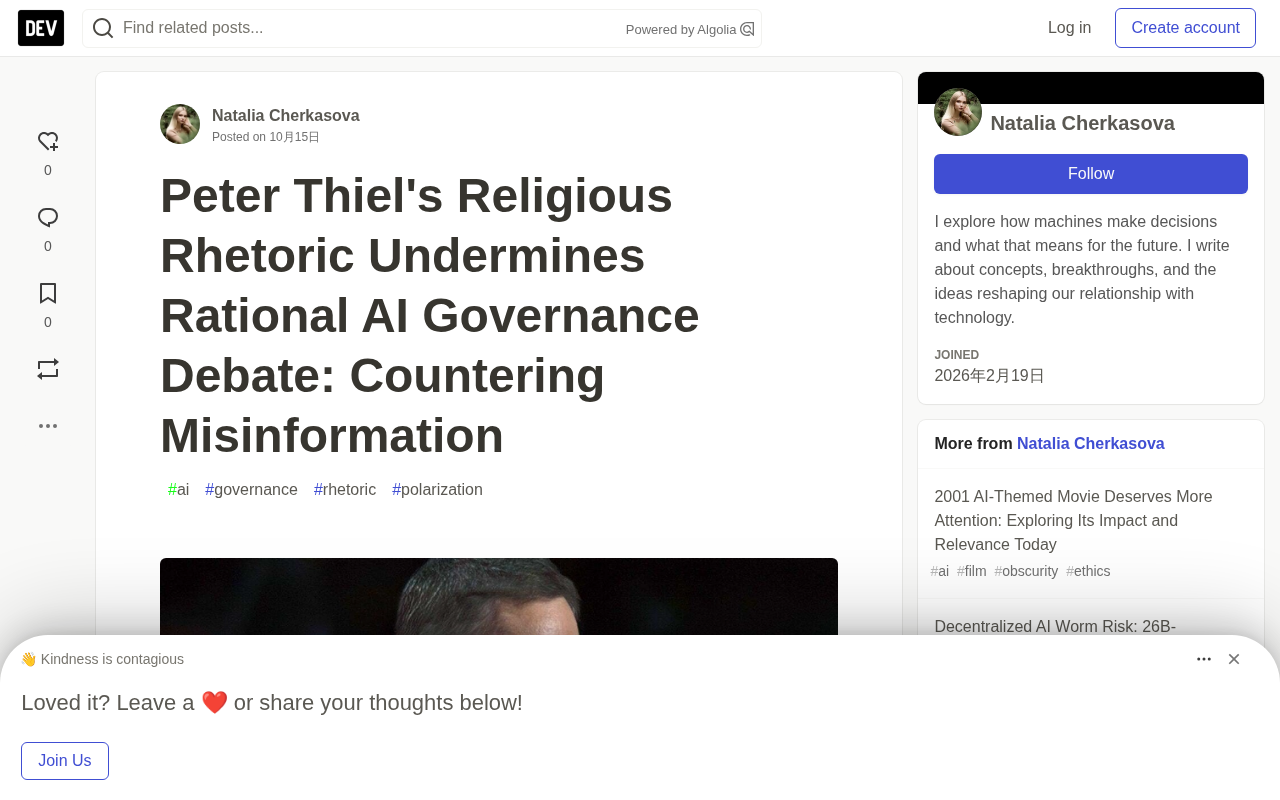
AI governance should be a meeting point for technical risk, ethical boundaries, and policy tools—but a set of religiously charged rhetoric from Peter Thiel is changing the language rules of this debate. A technical analysis article from a developer community points out that Thiel likens supporters of AI regulation to the "Antichrist." This is not an offhand metaphor, but a carefully designed narrative strategy—using moral judgment to replace policy debate, and apocalyptic fear to suppress risk discussion.
Why Religious Metaphors Are More "Useful" Than Data
Thiel equates AI regulation advocates with the "Antichrist," and the lethality of this move lies in how it redefines the nature of the debate. Regulators are no longer stakeholders with differing judgments, but rather "enemies" cast onto the moral opposite side.
From a cognitive perspective, this rhetoric directly bypasses rational analysis. It activates confirmation bias and emotional reasoning, not cost-benefit evaluation. When someone is labeled the "Antichrist," you don't need to refute their arguments—you only need to deny the legitimacy of their position. The analysis article characterizes this as an "exploitation of cognitive biases": the emotional weight of religious symbols makes evidence-based rebuttals very difficult to hear.
More troublesome is that this framework transforms policy disagreement into a moral holy war. Once compromise is equated with betrayal, the room for policy discussion disappears.
Confirmation bias refers to people's tendency to seek out, interpret, and remember information that supports their existing beliefs, while ignoring or dismissing evidence to the contrary. In experiments in the 1960s, psychologist Peter Wason found that subjects would systematically test only evidence consistent with their hypotheses rather than attempting to falsify them. In the AI governance debate, this mechanism means that a label like "Antichrist" instantly filters the audience: those already skeptical of regulation will view it as powerful corroboration, while neutral parties are pulled by the emotional impact, shifting their attention from the specific content of regulatory provisions to taking sides on moral grounds. Alongside confirmation bias is emotional reasoning—treating subjective emotions as factual evidence: "I feel that regulation threatens my existence, therefore regulation is a threat." The two combined make it nearly impossible for cited data and cost-benefit analysis to shake established positions in this discursive environment, because the starting point for rebuttal—a shared framework of rational assessment—has already been dissolved by religious rhetoric.
The Compounding Effect of Local Dissemination and Media Amplifiers
Thiel's rhetoric does not spread aimlessly. The analysis notes that he gives targeted speeches in areas with strong religious influence, such as Nashville, aligning the AI regulation issue with local religious values. This localization strategy creates an echo chamber effect—in specific regions, anti-regulation narratives gain cultural resonance, and the acceptability of opposing voices declines accordingly.
Media is the second amplifier. Algorithms and editorial preferences naturally favor conflictual content, and Thiel's polarized statements fit perfectly with the "engagement-driven" dissemination logic. The result: sensational claims receive wide distribution, while nuanced discussion is drowned out. The analysis article describes this mechanism as "media amplification"—it allows Thiel's narrative to reach a broader audience while compressing the space for alternative perspectives.
The echo chamber effect refers to a relatively closed information environment where homogenized views are repeatedly reinforced, and dissent gradually disappears due to a lack of circulation channels. Thiel's speeches in religiously rich areas like Nashville exploit existing local cultural identities: when AI regulation is framed as "secular elites interfering with faith life," the anti-regulation stance ceases to be merely a policy preference and becomes part of community identity. In such an environment, even residents who originally supported prudent regulation may remain silent for fear of being labeled as "betraying the faith," forming a spiral of silence. Media amplification then allows this localized discourse to break through geographical boundaries: algorithmic recommendation systems optimize for engagement metrics such as dwell time and click-through rates, naturally favoring content with high emotional intensity. Thiel's polarized statements far outperform technical white papers in dissemination efficiency, so platform distribution mechanisms inadvertently serve as free megaphones for this narrative, while alternative, prudent analysis is continuously marginalized in the competition for traffic.
Fear of the Technological Singularity Used as an Anti-Regulation Weapon
The most strategic element of Thiel's rhetoric is its exploitation of technological singularity fear. He frames AI regulation as "hindering humanity's ability to respond to existential threats," implying that regulation is not only useless but dangerous.
The structure of this argument is: AI may bring existential risk, so we need to accelerate at full speed, and regulation will slow our ability to respond to risk. The analysis article points out that this fear narrative pushes the discussion from "rational risk assessment" toward "emotional survivalism," eroding public trust in AI governance and making preventive policies harder to support.
The logical paradox here is: if AI truly constitutes an existential threat, prudent regulation is precisely the necessary risk buffer; but Thiel's narrative casts regulation itself as part of the threat.
The technological singularity concept was first proposed by mathematician I.J. Good in 1965 and later popularized by Ray Kurzweil and others. It refers to the critical point at which artificial intelligence surpasses human intelligence and technological development enters an unpredictable and irreversible phase. Discussions around the singularity generally divide into two camps: one believes humanity should accelerate at full speed to reach and control the singularity first, while the other argues that an international regulatory framework must be established to prevent loss of control. Thiel's rhetorical strategy swaps the premise of this debate: he equates any regulatory attempt with "voluntarily slowing down in a race," thereby portraying the prudent camp as enemies of human survival. The flaw in this argument is that it sets "speed" and "safety" as mutually exclusive options, but engineering history repeatedly shows that redundancy, testing, and braking mechanisms are precisely the conditions that allow high-speed systems to continue operating. What the analysis article calls "emotional survivalism" refers to this tendency to simplify complex risk governance into a binary narrative of "either full speed ahead or extinction," which creates instinctive public resistance to the precautionary principle and puts regulatory agencies at a moral disadvantage when seeking authorization.
Where Does Systemic Instability Come From?
The analysis article identifies three factors that allow this discourse system to "self-sustain."
Feedback loops: Polarization itself reinforces Thiel's narrative, forming a self-cycle of fear-driven discourse. The more intense the opposition, the more credible his victim narrative becomes.
Media sensationalism: Engagement takes priority over accuracy, misinformation spreads, public confusion intensifies, and institutional trust further erodes.
Emotional barriers of the religious framework: The "Antichrist" rhetoric carries its own moral weight, making it difficult for evidence-based rebuttals to reopen space for rational dialogue.
These three feed each other, pushing the AI governance debate toward an increasingly difficult-to-reverse state of division.
The Real Cost of This Rhetorical Battle
If this narrative is not effectively countered, the analysis article predicts several typical failures: policy driven by fear rather than evidence, often short-sighted and ill-equipped to address the complex challenges of AI governance; regulation supporters and opponents each becoming entrenched, with collaborative space disappearing; public trust in AI and its governance eroded by religious and existentialist associations, weakening the social foundation for technology adoption; media echo chambers further compressing viewpoint diversity.
These costs are not abstract. AI governance requires finding an operational balance among innovation incentives, risk prevention, and rights protection. When the debate is hijacked by religious rhetoric, this balance point becomes increasingly difficult for public discussion to reach.
Possible Paths to Rebuilding Rational Debate
What is being opposed is not Thiel himself, but a narrative model that moralizes policy disagreement. The core judgment of the analysis article is: Thiel's religious rhetoric is a strategic attack on the foundations of rational policymaking, exploiting cognitive biases, polarization dynamics, and media mechanisms to create a self-reinforcing cycle of fear and division.
Breaking this cycle requires efforts in several directions. Fact-checking and contextual supplementation are certainly necessary, but facts alone are not enough—it is essential to provide meaning frameworks that can compete with emotional narratives, rather than assuming data will speak for itself. Second, platforms and media need to reexamine the systemic distortion of public discussion quality caused by engagement metrics. Finally, advocates of AI governance need to learn to communicate within religious and cultural contexts, rather than ceding religious communities wholesale to anti-regulation narratives.
The language of the debate determines the outcome of the debate. When one side replaces risk assessment with apocalyptic rhetoric, if the other side remains at the level of technical white papers, what will be lost is not the argument, but the admission ticket to the entire public discussion.
Meaning framework originates from sociology and communication studies and refers to a set of narrative structures that help people understand events and imbue them with moral and emotional significance. Unlike scattered facts, a meaning framework answers "what does this mean" and "which side should I stand on." Thiel's religious rhetoric is effective precisely because it provides a highly complete meaning framework: AI regulation = Antichrist = betrayal of faith and humanity. Fact-checking often fails in similar situations because it only corrects details within the framework without providing an alternative framework capable of competing for emotional identification. Research shows that counter-narratives can compete on equal footing with religious narratives only when they not only clarify "what is right" but also "who we are and what we are protecting." For AI governance advocates, this means actively entering religious and cultural contexts and expressing prudent regulation in localized value language such as "protecting the order of creation" and "being responsible to future generations," rather than pushing religious communities wholesale into the anti-regulation camp and ceding this vast resource for meaning production.
Related articles

WorkBuddy Full Tutorial: Build an AI Office Automation Agent from Scratch
A complete WorkBuddy tutorial: installation, three working modes, multimodal picture book video practice, expert team agent building, and workflow configuration for low-cost AI office automation.

WorkBuddy Agent Complete Guide: From Beginner to Automation in 7 Days
Based on Bilibili's 256-episode WorkBuddy masterclass, this systematically breaks down Tencent's AI office workbench core capabilities: Agent principles, Skill encapsulation, cross-platform connectors, scheduled automation, knowledge bases, and zero-code development, with learning path recommendations.

8 AI Accounts, 7 Failed: An Honest Review of Using AI to Get Work Done
Only 1 of 8 AI-run Bilibili accounts succeeded. We break down the real difference between "performing AI" and "using AI to get work done."