How Quantum Generative Priors Are Revolutionizing World Models: Quantum-JEPA Has the Answer

Quantum-JEPA uses conditional quantum Born priors to generate diverse and correlated future representations for JEPA world models.
Quantum-JEPA addresses multimodal uncertainty in world models by using a conditional quantum Born prior to generate binary latent actions mapped to diverse future representations. The quantum prior avoids exponential class output layers, captures correlations between latent actions, supports coordinated multi-agent futures, and generates multiple obstacle-avoidance routes on D3IL. It outperforms variational baselines and validates finite-shot parameter-shift training, readout-noise robustness, and real QPU inference.
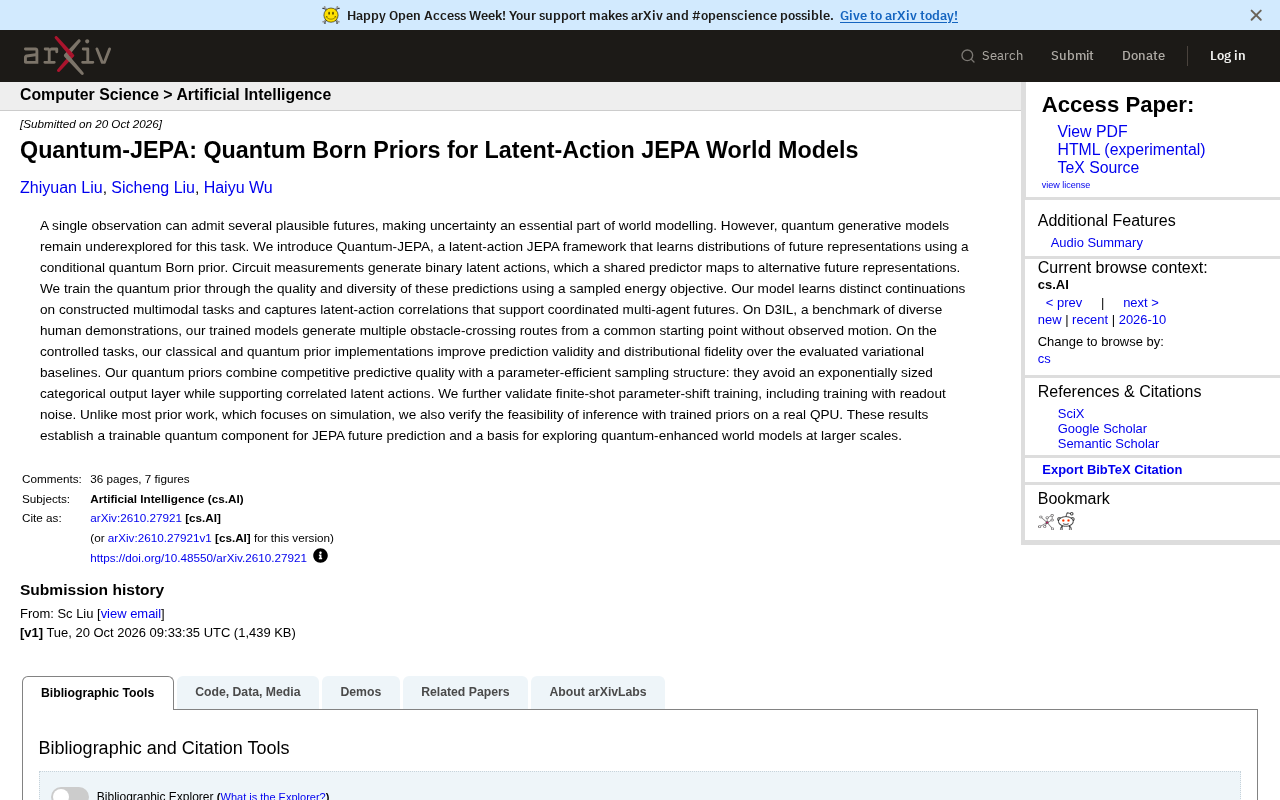
One of the core challenges of world models is that a single observation often corresponds to multiple plausible futures. Traditional generative models typically require enormous output layers or complex sampling mechanisms to handle this multimodal uncertainty. A paper titled "Quantum-JEPA: Quantum Born Priors for Latent-Action JEPA World Models" attempts to learn the distribution of future representations using a conditional quantum Born prior, introducing a trainable quantum component to JEPA (Joint Embedding Predictive Architecture).
Quantum Born Priors: From Circuit Measurements to Latent Actions
The core design of Quantum-JEPA is to use quantum circuits to generate binary latent actions. The circuit measurements output bitstrings, which are interpreted as latent actions and then mapped by a shared predictor to different future representations. Unlike classical classification output layers, the quantum prior's parameterization naturally supports correlation modeling and does not require an exponentially large class output layer.
The training signal comes from prediction quality and diversity: the researchers employ a sampled energy objective to optimize the quantum prior, so that the generated latent actions both produce valid future predictions and cover multiple possible continuations. This end-to-end training approach makes the quantum circuit a learnable module within the world model, rather than a standalone generator.
The Born rule is one of the fundamental postulates of quantum mechanics: when a quantum state is measured, the probability of obtaining a certain outcome equals the squared modulus of the inner product between that outcome's measurement operator and the quantum state. In quantum computing, this means that the measurement bitstrings at the end of a circuit are not deterministic outputs, but are sampled according to some probability distribution. Quantum-JEPA exploits exactly this: the measured bitstrings are treated as samples drawn from a "quantum Born prior," with each bit corresponding to a binary latent action. Because the amplitudes of a quantum state can encode correlations between variables, the distribution derived from the Born rule can naturally express correlations among latent actions, unlike classical softmax output layers that require explicitly modeling all joint classes.
JEPA (Joint Embedding Predictive Architecture) is a class of self-supervised learning frameworks whose core idea is to make predictions in representation space rather than in pixel or raw observation space. Given the embedding of the current observation, the model predicts the embedding of future observations instead of reconstructing every pixel of the future frame. This design focuses the model on semantically predictable structure, avoiding details that are hard to predict. The key problem JEPA faces is precisely the multimodality of future representations: the same current state may correspond to multiple plausible futures, and deterministic regression would yield a blurry average result. Quantum-JEPA uses a learnable quantum prior to sample different latent actions, thereby generating diverse future embeddings in representation space—an enhancement of JEPA's multimodal prediction capability.
Multimodal Tasks and Multi-Agent Coordination
On constructed multimodal tasks, the model learned distinctly different continuation trajectories. More strikingly, it captured correlations between latent actions, thereby supporting coordinated multi-agent futures. This means the quantum prior can not only express single-agent multimodal uncertainty but also encode behavioral coupling between agents.
On D3IL, a benchmark containing diverse human demonstrations, the trained model can generate multiple obstacle-avoidance routes from the same initial point without observing motion information. This indicates that the model learns an abstract understanding of task structure rather than simple trajectory copying.
Comparison with Variational Baselines: Both Quality and Efficiency
On controlled tasks, both classical and quantum prior implementations outperform the evaluated variational baselines in prediction validity and distribution fidelity. The unique advantage of the quantum prior lies in parameter efficiency: it avoids an exponentially large class output layer while supporting correlated latent action sampling.
The study also validated finite-shot parameter-shift training, including training scenarios with readout noise. This provides evidence for the practical trainability of the quantum component, rather than remaining at the level of theoretical simulation alone.
The parameter-shift rule is a commonly used gradient estimation method when training variational quantum circuits. For expectation values of the form cos(θ), the derivative with respect to the parameter can be obtained exactly by evaluating the circuit at θ+π/2 and θ−π/2, without needing finite-difference approximations. This gives parameter updates for quantum circuits analytical gradients, at the cost of requiring multiple circuit executions per gradient computation. The "finite-shot parameter-shift training" mentioned in the paper refers to gradient estimation where each circuit evaluation uses only a finite number of measurement shots, in which case the gradient carries sampling noise; the study verified that training remains feasible under such conditions and further tested robustness in the presence of readout noise. These experiments show that the quantum prior is not merely an idealized module in simulation but has a realistic basis for end-to-end training under noisy, finite-shot conditions.
Inference Validation on Real Quantum Processors
Most quantum machine learning work focuses on simulation, but this study further validates the inference feasibility of the trained prior on a real QPU. Although the scale is limited, this step is crucial for assessing the real-world potential of quantum-enhanced world models. The authors position this result as a foundation for trainable quantum components and point toward exploring larger-scale quantum-enhanced world models.
A QPU (Quantum Processing Unit) refers to the hardware device that actually runs quantum circuits, as opposed to classical simulators. Current noisy intermediate-scale quantum (NISQ) devices are limited by qubit count, gate fidelity, and coherence time, making it difficult to run large-scale circuits. Deploying a trained quantum prior to a QPU for inference means testing whether the latent action distribution it generates remains valid under real noise and finite sampling conditions. Despite the limited scale, the significance of this step lies in distinguishing "valid only in simulation" from "runnable on real hardware," providing preliminary evidence for the real-world feasibility of quantum-enhanced world models.
Limitations and Outlook
Current validation focuses on controlled tasks and limited-scale QPU inference, and the performance of the quantum prior on larger-scale, higher-dimensional problems remains to be tested. In addition, the impact of the quantum circuit's sampling overhead and noise robustness in real applications requires more systematic evaluation. Nevertheless, Quantum-JEPA demonstrates a viable path for embedding quantum generative priors into JEPA world models, offering a new modeling tool for multimodal future prediction.
One-line Summary
Quantum-JEPA uses conditional quantum Born priors to generate diverse and correlated future representations for JEPA world models.
Paragraph Summary
To address the multimodal uncertainty in world models where a single observation corresponds to multiple futures, Quantum-JEPA proposes using a conditional quantum Born prior to generate binary latent actions, which are then mapped by a shared predictor to different future representations. The bitstrings obtained from quantum circuit measurements naturally support correlation modeling and avoid an exponentially large class output layer. The study employs a sampled energy objective to train the quantum prior end-to-end, capturing correlations between latent actions on constructed multimodal tasks and supporting coordinated multi-agent futures; on the D3IL benchmark, it can generate multiple obstacle-avoidance routes from the same initial point without observing motion information. The quantum prior outperforms the evaluated variational baselines in prediction validity and distribution fidelity, and the study validates finite-shot parameter-shift training, training under readout noise, and inference on a real QPU. The authors position it as a foundation for trainable quantum components, with limitations being that validation is at controlled scale and larger-scale and noise robustness remain to be tested.
Related articles

macOS Is No Longer UNIX: Apple Didn't Renew Certification, But the Technology Is Unchanged
Apple did not renew macOS's UNIX certification, and the Open Group has removed Apple's entry. This article analyzes the technical reality behind the expiration, Apple's possible intentions, and the practical impact on developers.

Building Stateful Multi-Agent Systems with Azure Cosmos DB
Based on the official Azure Cosmos DB tutorial, this article explains how to use the Agent Memory Toolkit to add shared persistent memory to a multi-agent travel planner, covering short-term, long-term, episodic, and semantic memory plus cross-session state continuity.

Production AI Agent Operations: A Three-Step Framework for Observing, Evaluating, and Optimizing
Azure Cosmos DB team proposes a three-step framework for production AI Agent operations: observe trace tracking, evaluate with LLM as a judge and regression testing, optimize cost across RU, retrieval, memory, and LLM layers.