How Self-Aware Are Vision-Language Models? A Capability-Level Metacognition Probe

VLMs can solve problems but cannot accurately state their visual weaknesses; answer probabilities harbor a signal of self-knowledge.
A new study probes open and proprietary VLMs' capability-level metacognition, finding they cannot accurately foresee which tasks or image conditions will cause errors. Training accuracy prediction fails to teach weakness recognition, but answer probabilities during problem-solving reveal model-specific shortcomings, offering a supervision signal for improving self-awareness.
Vision-language models (VLMs) can accurately describe image content, but do they know which visual tasks they tend to fail on? A new study systematically tested open and proprietary models' ability to anticipate their own weaknesses through a "capability-level metacognition" probe, and the conclusions are not encouraging.
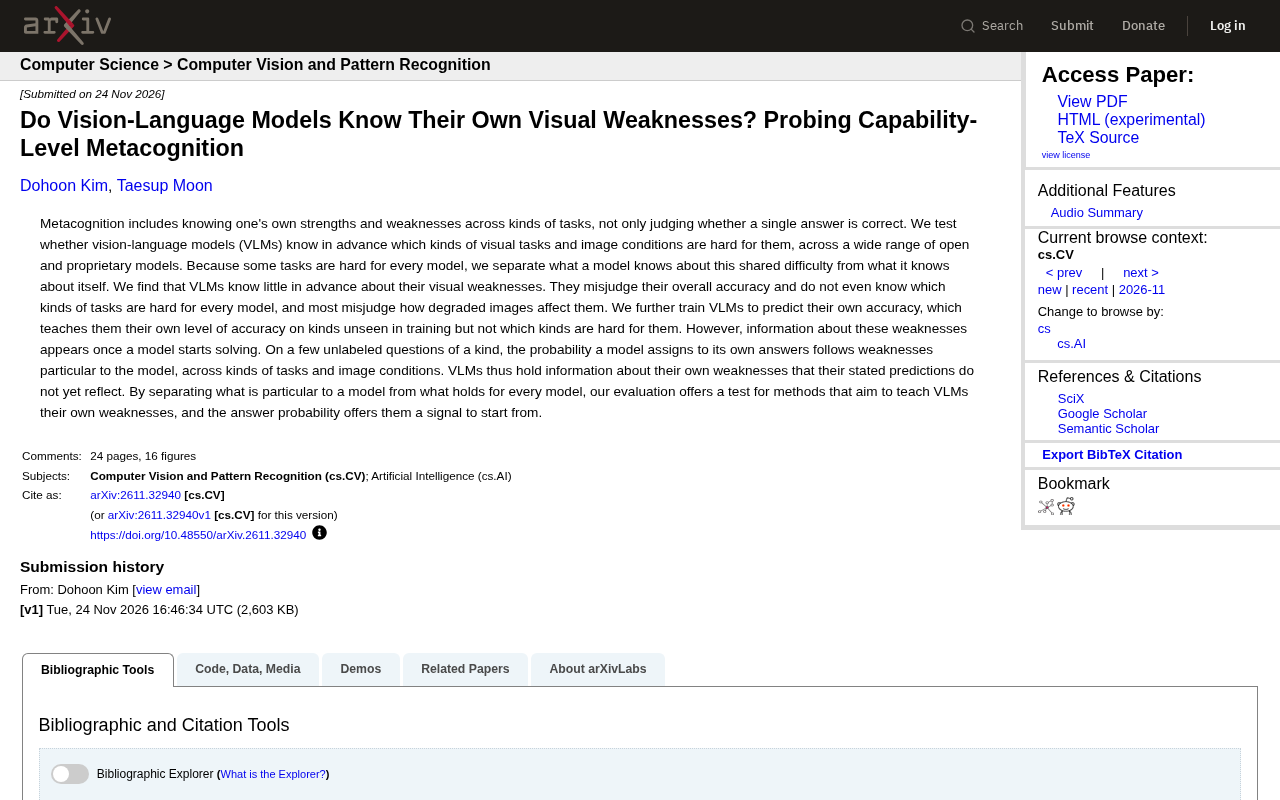
Metacognition goes beyond judging right or wrong
Metacognition is commonly understood as "thinking about thinking." In AI evaluation, a common approach is to have the model judge whether a specific answer is correct, but this only touches the surface of metacognition. A stricter requirement is: can the model foresee, before a task begins, which types of tasks and which image conditions pose a challenge to it?
The research team calls this ability "capability-level metacognition" and tested it across a wide range of open and proprietary VLMs. The core finding is: VLMs have very limited ability to anticipate their own visual weaknesses. They not only misjudge their overall accuracy, but even fail to identify universally difficult problems that challenge all models.
Vision-language models (VLMs) are a class of multimodal models that process both image and text inputs, typically represented by open-source series such as LLaVA and Qwen-VL, as well as proprietary models like GPT-4V and Gemini. They usually use a visual encoder (such as CLIP ViT) to map images into feature sequences, which are then passed through a projection layer into a large language model for reasoning. VLMs perform outstandingly on tasks such as image captioning, visual question answering, and document understanding, but their capability boundaries are not transparent.
Capability-level metacognition differs from common "answer-level" metacognition (judging whether a specific output is correct) in that it requires the model to form an anticipation, before a task begins, of "which types of tasks and which input conditions will cause it to fail." This requires the model not only to know its average accuracy, but also to distinguish performance differences across task types and image degradation conditions. The study probes this ability by having models predict their own accuracy before solving problems.
Distinguishing "shared difficulty" from "one's own weakness"
A key insight in the evaluation design is that some tasks are difficult for all models. If a model merely says in general terms "this type of task is hard," it does not prove that it understands itself. The researchers therefore separated two kinds of information—which difficulties are universal, and which weaknesses are specific to individual models.
This separation makes the evaluation more diagnostic. The results show that when predicting their own performance, models neither accurately captured universal difficulty nor reflected individual-specific shortcomings. Most models also misjudged the impact of image degradation (such as blur and noise) on their own accuracy.
Image degradation refers to the quality loss introduced during image acquisition, transmission, or compression, commonly including Gaussian blur, motion blur, sensor noise, JPEG compression artifacts, low resolution, and so on. In visual benchmarks, researchers often test model robustness by artificially applying these degradations. Different models vary greatly in sensitivity to various degradations: for example, some models are insensitive to noise but sensitive to blur, and vice versa. Therefore, image degradation is an ideal condition for probing "model-specific weaknesses"—if a model can accurately anticipate its performance decline under a certain degradation, it demonstrates fine-grained self-awareness.
Training to predict accuracy does not teach "self-knowledge"
A natural improvement idea is to train VLMs to predict their own accuracy. The researchers did exactly this. The effect showed a clear split: the model learned to give its accuracy level on new task types unseen during training, but did not learn to judge which task types are difficult for itself.
In other words, the model can learn to say "I probably have a certain level of accuracy on this new task," but cannot say "this task type is exactly my weak spot." Predicting accuracy and identifying weaknesses are two different abilities.
Weakness information only emerges during problem-solving
The most intriguing finding of the study appeared after the model began solving problems. On a small number of unlabeled questions within a certain task type, the probability the model assigned to its own answers varied with that model's specific weaknesses—and this tracking held across different task types and image conditions.
This means: VLMs internally hold information about their own weaknesses; it is just that their explicit predictions do not yet reflect it. The model "doing" exposes weaknesses, but "saying" cannot accurately express them. This mismatch provides a signal for improvement methods: answer probabilities can serve as a starting point to help models gradually learn to express their weaknesses.
Answer probability (i.e., the softmax probability or log-probability the model outputs for each candidate answer) is a direct reflection of the model's internal confidence. Unlike the "accuracy prediction" the model gives in natural language after the fact, answer probability is naturally produced during forward computation and does not depend on an additional metacognitive module. The study found that when a model encounters its own specific weakness on a certain task type, the probability it assigns to the correct answer systematically decreases, and this decrease pattern is highly correlated with the model's specific weaknesses. This suggests that answer probability encodes the model's implicit perception of its own difficulties and can serve as a training signal to align the model's explicit self-assessment.
Implications for evaluation and alignment
The value of this work goes beyond revealing flaws. By separating "model-specific" difficulty from difficulty "shared by all models," it provides a reusable testing framework for examining methods aimed at teaching VLMs to recognize their own weaknesses. At the same time, the existence of answer probability as an internal signal suggests a pragmatic path: rather than only training models to output predictions, use the probability distribution during problem-solving as a supervision signal.
For applications that rely on VLMs for high-stakes visual judgments, this finding is a cause for caution—models may give overconfident outputs without being aware of it. Teaching models to "know what they don't know" remains an unresolved frontier problem.
Alignment in the AI field generally refers to making model behavior consistent with human intent, values, or safety requirements. Metacognitive alignment is a subdirection within it: enabling models not only to output answers but also to reliably assess the reliability of their own answers. For high-stakes visual applications (such as medical image analysis and autonomous driving perception), if a model cannot identify its own weak points, it may give overconfident erroneous judgments in scenarios where it is not skilled. Therefore, incorporating metacognitive ability into alignment objectives—for example, using answer probability as a supervision signal to train models to express uncertainty—is regarded as an important way to improve the deployment safety of VLMs.
One-line Summary
VLMs can solve problems but cannot accurately state their own visual weaknesses; answer probabilities harbor a signal of self-knowledge.
Paragraph Summary
A new study tested open and proprietary VLMs' ability to anticipate their own visual weaknesses through a "capability-level metacognition" probe, finding that although models can describe images, they struggle to accurately foresee before a task begins which types of tasks or image conditions will cause them to err. The study separated "difficulty shared by all models" from "model-specific weaknesses" and found that models neither captured universal difficulty nor reflected individual shortcomings, even misjudging the impact of image degradation on accuracy. Training models to predict accuracy only lets them estimate their level on new tasks, but cannot teach them to identify their own weak spots. However, the probability models assign to their own answers during problem-solving tracks their specific weaknesses, indicating that weakness information is held internally but not reflected in explicit predictions. Answer probability can serve as a supervision signal, offering a pragmatic path to improving VLMs' self-awareness and carrying cautionary significance for high-stakes visual applications.
Related articles
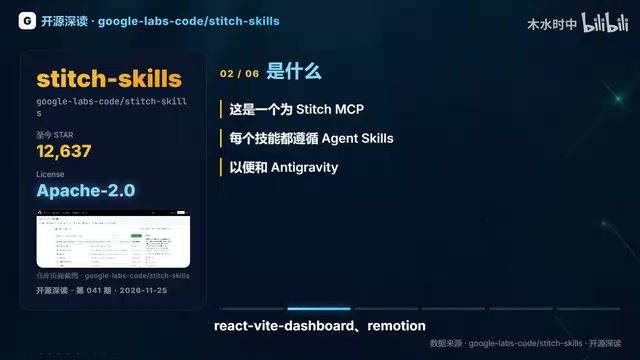
Google Stitch Skills: Connecting Coding Agents to the Design Workflow
Google Stitch Skills is an Agent Skills library following the open standard, adding a design-to-code workflow to the Stitch MCP Server. This article breaks down its three skill groups, SKILL.md directory structure, installation paths, and dependency pitfalls.

40.5-Inch Color E-Paper Art Frame: An Art Display You Charge Once a Year
The Ink Poster Tella 40.5-inch color e-paper art frame uses the E Ink Spectra 6 full-color solution: A1 format, no backlight, no noise, about one charge a year, 2,000+ licensed artworks built in, and automatic adaptation of phone photos.

Jingle Jam Memories: RT's Awkward First Encounter with Lewis
RT shares his awkward first Jingle Jam experience: unexpectedly pushed into the studio, meeting Lewis and Yogg's cast, and Toddy appearing in armor.