How to Become an Agentic AI Engineer: A Hands-On Roadmap from Practitioners

A growth framework for Agentic AI engineers: a four-stage path from LLM fundamentals to evaluation and observability.
Based on a Reddit discussion, this article outlines an actionable roadmap for aspiring Agentic AI engineers. It distinguishes agentic engineering from traditional AI/ML work, then presents four stages: LLM application fundamentals, the agent core loop (planning, memory, tools, error handling), project-driven learning that exposes real difficulties, and evaluation/observability skills that separate juniors from seniors.
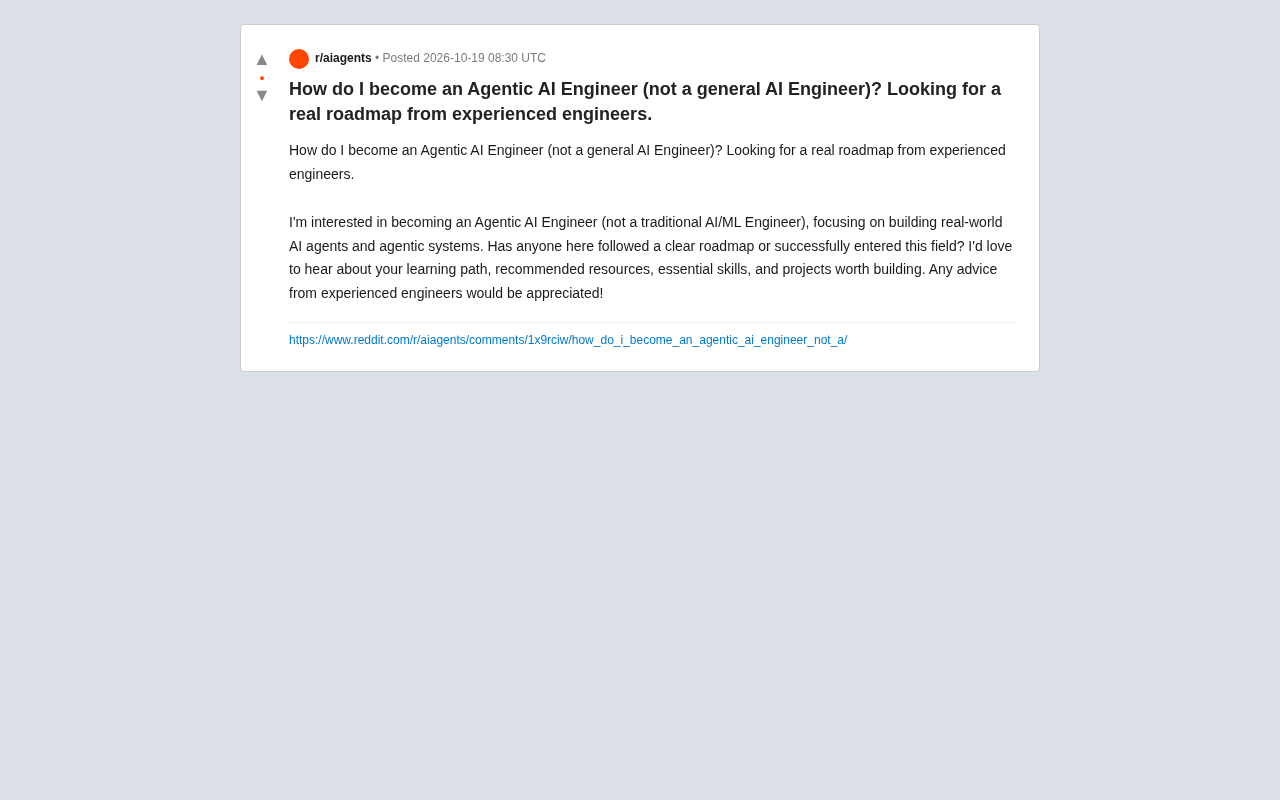
The term "Agentic AI Engineer" has been appearing more and more frequently in the job market and developer communities over the past year. Yet the vast majority of tutorials and courses still stay within the framework of "AI engineer" or "ML engineer": tuning models, doing fine-tuning, building RAG. Almost no one clearly explains a growth path truly oriented toward "agentic systems."
A question from a developer on Reddit is typical: what he wants to become is not a traditional AI/ML engineer, but someone focused on building real-world AI agents and agentic systems. He wants a clear roadmap, learning resources, required skills, and worthwhile hands-on projects. The thread gathered discussions from quite a few frontline engineers, and this article distills the parts with consensus into an actionable growth framework.
First, Clarify: What Exactly Does an Agentic AI Engineer Do?
The core work of a traditional AI engineer is "getting the model to output correct results"—training, fine-tuning, evaluation, deployment. The core work of an Agentic AI engineer is "getting the model to autonomously complete multi-step tasks within an environment"—planning, tool calling, memory management, error recovery, multi-agent collaboration.
This distinction determines that the two have completely different skill stacks. The former relies more on mathematics and internal knowledge of models, while the latter relies more on system design and an understanding of the behavioral boundaries of LLMs. Multiple engineers participating in the discussion made the same point: agentic engineering is more of an intersection of "distributed systems + human-computer interaction + prompt engineering" than an extension of deep learning research.
In other words, you don't have to first become an excellent ML engineer to enter this direction. But you do need a very pragmatic understanding of the capability boundaries of LLMs.
Stage One: Build a Solid Foundation in the LLM Application Layer
Almost all replies point to the same starting point: first treat the LLM as an unstable external service, not as a black-box magic trick.
Specifically, what you need to master at this stage is:
- API calls and parameter control: the actual impact of parameters like temperature, max tokens, and stop sequences under different tasks—you must build intuition through extensive experimentation.
- Structured approaches to prompt engineering: not writing "spells," but designing reusable prompt templates, ways to organize few-shot examples, and output format constraints.
- Function Calling / Tool Use mechanisms: understanding how the model decides which tool to call, how parameters are parsed, and how errors are passed back on failure. This is the most fundamental capability of agentic systems.
One engineer emphasized in a reply that this stage is the easiest to skip, yet precisely the one you should least skip. Many people jump straight into LangChain or AutoGen, and when problems arise they have no idea whether it's the framework's fault or the model's.
Function Calling / Tool Use is a structured output capability offered by current mainstream large models (such as GPT-4 and Claude 3): developers use JSON Schema to describe the names, parameters, and purposes of available tools. When generating a response, if the model determines that a tool needs to be called, it returns a call request conforming to the Schema (including the tool name and parameters) rather than directly outputting natural language. The runtime system parses the request, executes the actual function, and then passes the result back to the model to continue generating. This mechanism turns the LLM from a "text generator" into a "programmable decision-making hub" and is the cornerstone of building agents. Understanding its boundaries is crucial: the model may call non-existent tools, use incorrect parameter formats, or call when it shouldn't, so robust parameter validation and error-passing design are essential.
Stage Two: Understand the Core Loop of an Agent
The essence of an agent is a loop: observe the environment → plan the next step → execute an action → evaluate the result → decide whether to continue. This loop sounds simple, but every step involves a large amount of engineering detail.
Engineers participating in the discussion generally agree that at this stage the three sub-problems most worth diving into are:
Planning and Task Decomposition
When facing multi-step tasks, LLMs tend to lose the goal midway. Patterns such as ReAct, Plan-and-Execute, and Tree of Thoughts each have their applicable scenarios. Understanding their differences is more important than memorizing the API of a particular framework.
ReAct (Reasoning + Acting) is a prompting paradigm that has the LLM alternately generate reasoning traces (Thought) and actions (Action). At each step the model thinks before acting and adjusts subsequent steps based on environment observations (Observation), thereby interleaving reasoning with tool calling. Plan-and-Execute, by contrast, first has the model generate a complete multi-step plan and then executes it step by step; it suits scenarios with clear task structure that require global optimization, but the plan may become invalid due to environmental changes. Tree of Thoughts (ToT) models problem solving as tree search: at each node it generates multiple candidate thoughts, scores them with an evaluation function, and prunes; it suits complex reasoning tasks that require exploration and backtracking. The core difference among the three lies in "when planning happens and at what granularity," and understanding these patterns helps you choose or combine strategies based on task characteristics rather than blindly applying a framework.
Memory and Context Management
An agent needs to remember what it has done before, which attempts failed, and what the current state is. How to design short-term memory (conversation history), long-term memory (vector stores or structured storage), and working memory (intermediate results of the current task) in layers is where problems most easily arise in real projects.
A vector store (Vector Database) is a common implementation of long-term memory: text fragments are converted into high-dimensional vectors via an embedding model and stored, and at retrieval time similarity search is used to recall relevant fragments. But an agent's memory management goes far beyond vector retrieval—short-term memory is limited by the model's context window, and once exceeded it needs summarization, truncation, or selective retention; working memory requires structured storage of the current task state (such as completed sub-goals and to-do lists). In practice, layered strategies are often used: conversation history uses a sliding window plus summarization, long-term knowledge uses a vector store plus metadata filtering, and task state is explicitly maintained with JSON or a database. Poor design causes the agent to "forget" key constraints or repeat ineffective attempts.
Tool Design and Error Handling
The way a tool is described directly affects whether the model can call it correctly. The format of the error messages a tool returns also directly affects whether the agent can recover from failure. One engineer mentioned that he spent more time on "getting the agent to correctly understand tool errors" than on prompt engineering.
Stage Three: Force Out Real Capabilities Through Projects
A piece of advice that repeatedly appeared in the discussion: don't wait until you've "finished learning" to start—let projects drive learning. But project selection matters—projects like todo lists and chatbots cannot expose the core difficulties of agentic systems.
Several engineers recommended project directions including:
- A research assistant with tool calling: given a question, the agent autonomously decides to search, read web pages, cross-validate, and produce a report with citations. This project forces you to handle real problems such as tool failures, conflicting information, and overly long contexts.
- A multi-step code-fixing agent: read the codebase, locate the problem, propose changes, run tests, and iterate based on test results. The value of this project lies in the "evaluation loop"—how the agent knows it has fixed things correctly.
- Multi-agent collaborative tasks: have two or more agents divide a task, for example one responsible for generation and one for review. This exposes distributed-system problems such as communication protocols, role boundaries, and conflict resolution.
One respondent specifically pointed out that the "retrospective" after finishing a project is more valuable than the project itself: record where the agent failed, why it failed, and how you fixed it. This record is more persuasive in interviews than any certificate.
Stage Four: Build Evaluation and Observability Capabilities
This is the least mentioned but most emphasized capability in the discussion, described as "what separates juniors from seniors." The behavior of agentic systems is non-deterministic, and traditional unit tests are almost useless. You need to be able to answer: how many times did this agent fail out of 100 runs? What were the failure modes? Did performance get better or worse after changing the prompt?
Related engineering practices include: trace recording (trace), step-by-step evaluation, failure classification, and regression test set construction. Some engineers mentioned that people who can build an agent evaluation pipeline are extremely scarce on a team.
Trace recording (Trace) means completely recording each step of a single agent run: input, model output, tool calls and returns, latency, token consumption, etc., forming a replayable sequence of events. Step-by-step evaluation defines checkpoints at each key node of the trace (such as "was the correct tool selected" and "were the parameters reasonable") rather than looking only at the final result. Failure classification requires categorizing failure cases into predefined types (such as planning errors, tool misuse, and context loss) so improvements can be targeted. Regression test sets involve collecting a batch of representative tasks and expected behaviors, re-running them after each change to prompts or the framework, and quantitatively comparing changes in pass rates. Together, these practices form the "observability" infrastructure of an agent and are the prerequisite for stable iteration.
Learning Resources and Realistic Advice on the Path
Regarding resources, the consensus in the discussion is: no single course can cover this field, because the field itself is still evolving rapidly. A more effective approach is to combine:
- Official documentation first: OpenAI's and Anthropic's documentation on function calling and agents is updated fastest, with examples closest to practice.
- Go deep on one open-source framework: LangGraph, AutoGen, and CrewAI each have their own design philosophy; reading the source code of one is more valuable than dabbling in five.
- Selective paper reading: ReAct, Reflexion, and Toolformer are foundational for understanding agent design patterns.
- Follow the community: a large amount of practical knowledge in this field lives in Discord, GitHub issues, and developer blogs, not in textbooks.
One engineer's summary was direct: this direction doesn't lack tutorials; what it lacks is experience in "building something and making it run stably." A roadmap can give you direction, but capability can only grow while debugging agents.
Final Thoughts
Agentic AI Engineer is not a title that can be proven by course certificates. From this discussion, the capabilities that are truly recognized center on three things: a pragmatic understanding of the behavioral boundaries of LLMs, engineering control over every part of the agent loop, and the habit of letting evaluation data speak. If your goal is to enter this direction, the most effective starting point is not learning another framework, but choosing a real task, turning it into an agent that runs stably, and recording every one of its failures.
One-line Summary
A growth framework for Agentic AI engineers: a four-stage path from LLM fundamentals to evaluation and observability.
Paragraph Summary
Based on a Reddit community discussion, this article lays out an actionable growth framework for developers who want to become Agentic AI engineers. It first clarifies the essential difference between Agentic AI engineers and traditional AI/ML engineers: the former focuses on system design, tool calling, and autonomous completion of multi-step tasks, while the latter emphasizes model training and tuning. It then proposes a four-stage path: stage one builds LLM application fundamentals (API parameters, structured prompting, function calling); stage two covers understanding the agent core loop (planning and decomposition, memory management, tool design and error handling); stage three uses projects such as research assistants, code fixing, and multi-agent collaboration to expose real difficulties; stage four builds evaluation and observability capabilities, the key to distinguishing juniors from seniors. The article also offers resource combination advice and emphasizes that practice and retrospectives are more valuable than course certificates.
Related articles

FastAPI: A High-Performance Python Framework and a Production-Ready API Development Powerhouse
FastAPI is a high-performance web framework based on Python type hints, supporting async and automatic OpenAPI docs. With over 100k GitHub stars, this article analyzes its core strengths, production readiness, and selection advice.

Tesla Optimus Begins Mass Production: Can the Goal of 20,000 Units Per Week Be Achieved?
Tesla Optimus officially begins mass production as Musk sets a target of 20,000 units per week. This article analyzes the supply chain challenges behind mass production, the real gap in capacity ramp-up, and the competitive landscape for humanoid robots.

PCL: A Minecraft Launcher with 8.5k Stars — Why Was It Written in VB.NET?
An in-depth analysis of PCL, the GitHub Minecraft launcher with 8,500+ stars: why it chose VB.NET, its features and China network advantages, and the limits of Windows-only.