How to Become an AI Developer? A Systematic Beginner's Roadmap

A systematic roadmap for beginners to become AI developers, from Python basics to LLM application development.
This article provides a clear, actionable roadmap for aspiring AI developers. It covers essential foundations including Python programming and math, core ML/DL concepts from traditional algorithms to Transformers, modern LLM-era skills like prompt engineering, RAG, and LoRA fine-tuning, plus practical advice on building experience through projects and open-source contributions.
From Confusion to Clarity: The Path to Becoming an AI Developer
On tech communities like Reddit, you'll frequently see posts like "How do I become an AI developer? I'm so confused." This confusion is understandable—AI is a multidisciplinary field spanning mathematics, programming, engineering, and business understanding, and the entry path can seem overwhelmingly complex. This article lays out a clear, actionable growth roadmap for beginners, helping you move from "not knowing where to start" to "making progress with clear goals."
Becoming an AI developer doesn't require you to first become a PhD-level researcher. Today's AI ecosystem is highly engineering-oriented—with the right toolchain and mindset, ordinary programmers can quickly get started and deliver real value.
Building the Foundation: Python Programming and Mathematics
Choosing a Programming Language
Python is the dominant language in AI, with virtually all major frameworks (PyTorch, TensorFlow, scikit-learn) using Python as their core interface. Python holds this position not just because of its clean and easy-to-learn syntax, but because of the massive scientific computing ecosystem behind it. NumPy provides efficient multi-dimensional array operations, calling C/Fortran-implemented BLAS/LAPACK libraries under the hood for near-native performance. Pandas builds on top of NumPy, offering SQL-like data manipulation capabilities. While PyTorch and TensorFlow have their core computation engines written in C++ with GPU acceleration support (via NVIDIA's CUDA platform), both chose Python as their user interface because Python's dynamic nature is ideal for rapid experimentation and prototyping. This "Python frontend + high-performance backend" architecture lets developers enjoy development efficiency without sacrificing runtime performance.
Beginners should prioritize mastering Python, covering the following:
- Basic syntax and data structures (lists, dictionaries, sets)
- Object-oriented programming and modular thinking
- Common scientific computing libraries: NumPy, Pandas, Matplotlib
If your goal leans toward production deployment, you should also learn some engineering fundamentals like Git version control, virtual environment management (venv/conda), and basic command-line operations.
Essential Math Foundations
Many beginners are intimidated by mathematics, but in reality, as an "AI developer" rather than an "AI researcher," you don't need to derive every formula from scratch. The core concepts you need to understand include:
- Linear Algebra: Vectors and matrix operations are the building blocks of neural networks. Neural networks are essentially a series of matrix multiplications plus nonlinear transformations—input data is represented as vectors, transformed through weight matrices to generate outputs. Understanding the geometric meaning of matrix multiplication (spatial transformation) helps you intuitively grasp what a model is doing.
- Probability and Statistics: Understanding model uncertainty and evaluation metrics. Bayesian thinking is ubiquitous in machine learning—from Naive Bayes classifiers to variational inference, probability theory provides the mathematical framework for making decisions under uncertainty.
- Basic Calculus: Building intuition for optimization processes like gradient descent. The core idea of gradient descent is like finding the lowest point on a mountain while blindfolded—you feel the slope beneath your feet (the gradient), then take a step in the downhill direction. The learning rate determines step size: too large and you might overshoot the minimum, too small and convergence is painfully slow. Backpropagation uses the chain rule to propagate error signals layer by layer from the output back to the input, making it possible to compute gradients in reasonable time even for networks with hundreds of layers.
The key principle is "just enough"—build intuition first, then dive deeper when you encounter specific problems.
Mastering Core Machine Learning and Deep Learning
After building your foundation, the next step is systematically learning core machine learning concepts. At this stage, it's recommended to start with traditional machine learning before transitioning to deep learning. Understanding the logic of this pathway is important: traditional ML algorithms (like Random Forests, SVM) typically require manual feature engineering—domain experts deciding which input variables are useful for prediction. Deep learning's revolution lies in "representation learning"—the model automatically learns useful feature representations from raw data. For example, in image recognition, CNNs automatically learn edge detection at lower layers, texture patterns at middle layers, and semantic concepts at higher layers. This end-to-end learning eliminates dependence on manual feature engineering, but the tradeoff is requiring more data and computational resources. Understanding this paradigm shift helps you judge when to use traditional methods (small data, high interpretability requirements) versus deep learning (big data, complex patterns).
Traditional Machine Learning Algorithms
Practicing classic algorithms through scikit-learn helps you build understanding of the complete "model training → evaluation → tuning" workflow:
- Supervised learning: linear regression, logistic regression, decision trees, random forests
- Unsupervised learning: clustering, dimensionality reduction (PCA)
- Model evaluation: cross-validation, overfitting vs. underfitting, confusion matrices
Deep Learning Frameworks and Models
Deep learning powers the majority of today's AI applications. Choose either PyTorch or TensorFlow to study in depth (PyTorch is more popular in research and the community, with its dynamic computation graph design making debugging more intuitive):
- Neural network fundamentals: fully connected layers, activation functions, backpropagation
- Convolutional Neural Networks (CNN): image processing
- Recurrent networks and Transformers: sequence and language processing
- Basic principles of Large Language Models (LLMs)
The Transformer architecture was introduced by Google in their 2017 paper "Attention Is All You Need." Its core innovation is the self-attention mechanism, which allows the model to directly attend to information at any position when processing sequences, solving the information decay problem that plagued earlier RNN/LSTM architectures on long sequences. The GPT series uses the decoder portion of the Transformer, learning statistical patterns of language and world knowledge through pretraining on massive text corpora via next token prediction. Model parameters grew from GPT-1's 117 million to GPT-4's estimated trillion-plus, and this scaling brought "emergent abilities"—models suddenly exhibiting reasoning, coding, and other capabilities at sufficient scale that smaller models lack. Understanding this context helps you grasp the core trajectory of current AI development.
Embracing AI Application Development in the LLM Era
With the rise of large language models, the definition of "AI developer" is evolving. Today, an increasing number of AI applications are built on top of mature large models rather than training from scratch. This provides beginners with a faster path to tangible results.
Key Skills
-
API Calls and Prompt Engineering: Proficiently using APIs from providers like OpenAI and Anthropic. Prompt engineering is a discipline of guiding model outputs through carefully designed input text, including strategies like zero-shot prompting, few-shot prompting, and Chain-of-Thought reasoning, which can significantly improve output quality without modifying model parameters.
-
Retrieval-Augmented Generation (RAG): Building knowledge Q&A systems with vector databases. RAG addresses two core problems of LLMs: knowledge cutoff dates and hallucination (generating plausible but incorrect information). The workflow is: first split knowledge base documents into passages, convert each text segment into high-dimensional vectors using embedding models (like OpenAI's text-embedding-ada-002), and store them in vector databases (like Pinecone, Weaviate, Milvus). When a user asks a question, the query is similarly converted to a vector, approximate nearest neighbor (ANN) search finds the most semantically relevant document passages, these are injected as context into the prompt, and the LLM generates answers based on this real information. This enables AI applications to provide precise answers grounded in up-to-date, domain-specific knowledge.
-
AI Application Frameworks: Using tools like LangChain and LlamaIndex. These frameworks encapsulate common operations like LLM calls, document processing, vector retrieval, and memory management into composable modules, dramatically reducing the engineering complexity of building sophisticated AI applications.
-
Model Fine-tuning: Understanding lightweight fine-tuning techniques like LoRA. LoRA (Low-Rank Adaptation), proposed by Microsoft in 2021, is a parameter-efficient fine-tuning method based on the insight that weight change matrices during fine-tuning are typically low-rank, meaning you don't need to update all parameters. The approach adds two small matrices (with rank much smaller than the original dimensions) alongside the original weight matrix, training only these small matrices. For example, with a 7B parameter model, LoRA might only train a few million parameters (less than 1% of the original), reducing VRAM requirements from tens of GB to just a few GB, making model customization possible on consumer-grade GPUs. QLoRA further combines 4-bit quantization, making it possible to fine-tune 70B models on a single 24GB GPU. This technology has dramatically lowered the barrier for AI developers to customize models.
For developers who want to produce results quickly, this "application layer" path often offers better ROI than starting from low-level algorithms.
Building AI Development Experience Through Projects
No matter how solid your theoretical knowledge, what truly makes you a developer is hands-on practice. A project-driven learning approach is recommended:
-
Reproduce Classic Projects: Start with beginner projects like image classification and sentiment analysis. For example, train a CNN on MNIST or CIFAR-10 datasets with PyTorch, or do text sentiment classification with a pretrained BERT model. While classic, these projects help you run through the complete pipeline from data processing to model training.
-
Participate in Open Source Communities: Contribute code on GitHub, or use open-source models on Hugging Face. Hugging Face has become the "GitHub" of AI, hosting hundreds of thousands of pretrained models and datasets, with its Transformers library providing a unified interface for loading and using various models.
-
Join Competitions: Platforms like Kaggle provide real datasets and problem scenarios. However, be aware of the differences between competitions and real-world business: in competitions, data is already cleaned, objectives are clear, and evaluation metrics are fixed; in real business, you need to define problems yourself, collect and clean data (typically consuming 70%+ of project time), handle data distribution drift, consider model inference latency and cost, and design monitoring and rollback mechanisms. Ensemble learning that works well in competitions may be infeasible in production due to inference costs. Therefore, use Kaggle as a starting point for learning data analysis and modeling, while developing complete engineering capabilities through end-to-end projects.
-
Build a Personal Portfolio: Deploy projects online to create demonstrable results. Use Streamlit or Gradio to quickly build demo interfaces, or containerize with Docker and deploy to cloud platforms, so your projects don't just live in Jupyter Notebooks.
A complete, runnable project is worth more than ten examples that never leave a tutorial. It not only consolidates knowledge but serves as your strongest proof when job hunting.
Practical Advice for AI Beginners
Facing an ocean of learning resources, the most common mistake is "endlessly bookmarking, never starting." Here are some practical tips:
-
Define your direction: AI has many subfields (NLP, CV, recommendation systems, AI applications, etc.)—pick one direction to go deep first. NLP (Natural Language Processing) currently has strong demand due to the LLM boom; CV (Computer Vision) is widely applied in autonomous driving, medical imaging, and more; recommendation systems are core revenue engines for internet companies. Choose based on your interests combined with job market demand.
-
Avoid perfectionism: Don't wait until you've mastered all the math before starting to code—learning by doing is more efficient.
-
Maintain continuous learning: Follow arXiv papers, tech blogs, and community updates—the AI field evolves extremely fast. arXiv is a preprint server for physics and computer science where virtually all important AI research results are first published, months before formal journal publication. Following the Papers With Code website helps you track the latest SOTA (State-of-the-Art) results.
-
Join communities: Whether it's Reddit, Discord, or other tech forums, exchanging ideas with others helps you avoid detours.
Becoming an AI developer is a gradual process. Rather than agonizing over "where to start," just write your first line of code today. A clear roadmap plus consistent action will dissolve confusion naturally.
Key Takeaways
Related articles
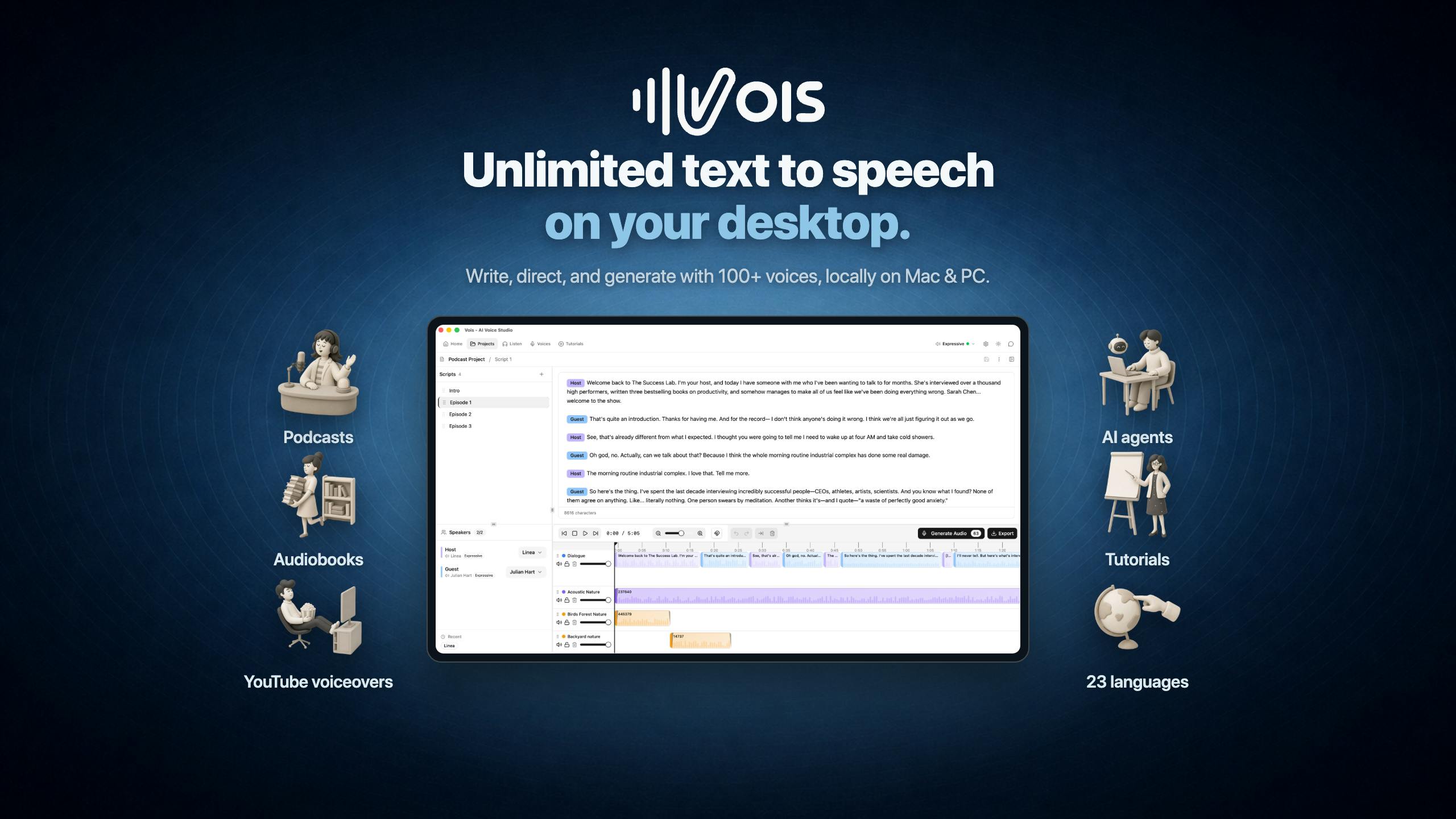
Vois 2.0 Review: Unlimited Voice Synthesis for $10/Month — Can It Replace ElevenLabs?
Vois 2.0 is a desktop AI voice synthesis tool offering unlimited generation with no per-character fees, 100+ voices, voice cloning, multi-speaker timeline, and 600+ languages for $10/month.
The Fascinating Real-World Counterparts of OpenAI Gym Reinforcement Learning Environments
Exploring how OpenAI Gym RL environments map to real-world scenarios, from CartPole to MountainCar, covering design principles and the sim-to-real transfer challenge.

A Practical Guide for Students to Deploy Multi-Container MLOps Projects on a Budget
A detailed guide on how student developers can deploy multi-container MLOps projects (Prometheus, Grafana, MLflow) to the cloud on a budget, covering Azure on-demand, Oracle free tier, and Fly.io.