How to Become an ML Engineer After Completing Andrew Ng's ML Course: A Job Search Roadmap

A practical 6-9 month roadmap for transitioning from ML course graduate to job-ready ML engineer.
After completing Andrew Ng's ML Specialization, many learners face a gap between course knowledge and job readiness. This article provides a detailed action plan covering deep learning with PyTorch, MLOps engineering skills (Docker, FastAPI, MLflow), GenAI/RAG projects as differentiators, and a tiered approach to algorithm interview prep, helping ML course graduates become competitive candidates within 6-9 months.
A Common Dilemma: Finishing an ML Course but Not Knowing Where to Start
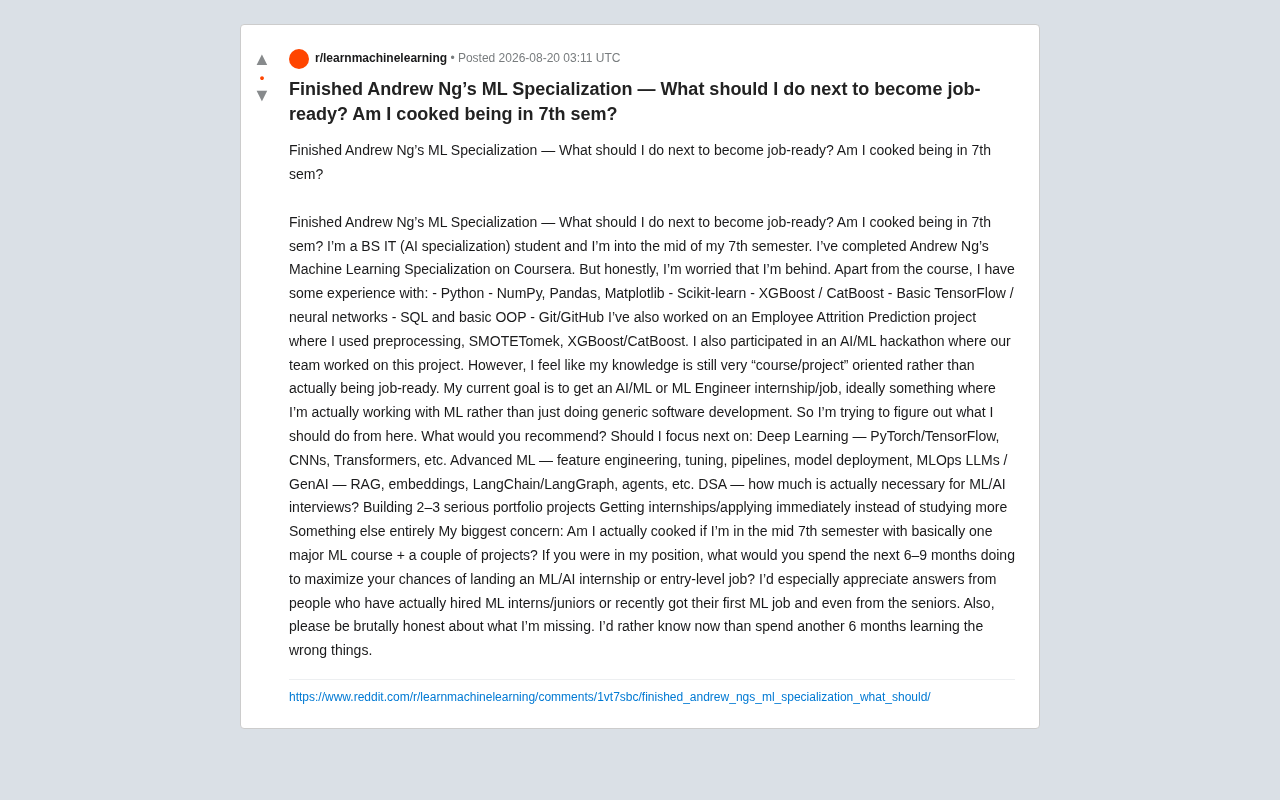
On Reddit, an IT undergraduate majoring in AI (currently in their senior year's first semester) posted a question that resonated widely: having just completed Andrew Ng's Machine Learning Specialization on Coursera, they found themselves deeply anxious — "Am I already behind?"
Andrew Ng's course was completely revamped in 2022, replacing his classic 2011 version. The new course covers three major modules: supervised learning (linear regression, logistic regression, neural networks), advanced learning algorithms (decision trees, ensemble methods), and unsupervised learning (clustering, anomaly detection, recommender systems). The course's design philosophy is "intuition first" — emphasizing understanding the mathematical intuition behind algorithms rather than engineering implementation details. This means that after completing the course, learners typically have a solid theoretical framework but obvious gaps in engineering capabilities like model deployment, data pipeline construction, and production environment debugging — which is precisely the root of this student's anxiety.
This student's skill set is actually quite decent:
- Python fundamentals
- NumPy, Pandas, Matplotlib data processing toolkit
- Scikit-learn, XGBoost / CatBoost and other mainstream modeling libraries
- Basic TensorFlow and neural networks
- SQL and basic Object-Oriented Programming (OOP)
- Git / GitHub version control
They had also independently completed an "Employee Attrition Prediction" project using data preprocessing, SMOTETomek oversampling, and XGBoost / CatBoost modeling, and participated in an AI/ML hackathon.
It's worth noting that SMOTETomek is a hybrid resampling method combining oversampling and undersampling, specifically designed to address class imbalance problems. SMOTE generates synthetic samples by interpolating in the feature space between minority class samples, while Tomek Links identifies and removes sample pairs on class boundaries that are likely to cause classification confusion. In employee attrition prediction scenarios, departing employees typically represent only 10-20% of total samples. Without addressing class imbalance, models become severely biased toward predicting "no attrition." SMOTETomek effectively mitigates this issue. Being able to correctly apply such techniques in a project demonstrates that this student already possesses modeling awareness beyond simply "getting code to run."
However, they admitted that their knowledge remains "course-oriented / project-oriented," with a gap between their current state and being truly "job-ready." This is almost universally the "capability chasm" that every machine learning learner encounters when transitioning from courses to employment.
You Haven't "Failed" — But Your Learning Direction Determines Success or Failure
Let's first address this student's most anxious question: Being in the first semester of senior year, with one systematic ML course plus a few projects — is it already "too late"?
The answer is clear — no. In fact, their starting point is already better than many peers. The real issue isn't about being "behind," but about where to invest time over the next 6-9 months. Choosing the wrong learning direction is the biggest hidden cost.
They listed several candidate paths, each worth analyzing for cost-effectiveness:
Deep Learning: Must Learn, But Don't Be Greedy
PyTorch/TensorFlow, CNN, and Transformer are unavoidable fundamentals. But for landing junior ML positions, you don't need to become a paper-level researcher. Master the complete workflow of building, training, and debugging a model with PyTorch, and understand the core mechanisms of Transformers (attention, embedding).
PyTorch was released by Meta AI (formerly Facebook AI Research) in 2016, featuring a dynamic computation graph (eager execution) design that makes debugging and prototyping extremely intuitive. As of 2024, PyTorch's usage in academic papers has exceeded 80%, and it's gradually replacing TensorFlow as the mainstream framework in industry as well. Its ecosystem includes torchvision (computer vision), torchaudio (speech processing), HuggingFace Transformers (NLP/LLM), and other rich domain libraries. The torch.compile feature introduced in PyTorch 2.0 significantly improves inference speed through graph compilation optimization, further narrowing the deployment efficiency gap with TensorFlow. For job seekers, PyTorch skills have become a hard requirement for virtually all ML positions — it's recommended as your primary framework.
MLOps Engineering Skills: A Severely Underestimated Resume Booster
This is precisely the biggest dividing line between "course-type candidates" and "engineering-type candidates." Feature engineering, hyperparameter tuning, building pipelines, model deployment, experiment tracking — these capabilities determine whether you can turn a model in a notebook into a production service.
MLOps (Machine Learning Operations) is a practice system that applies DevOps principles to machine learning systems, solving the "last mile" problem of getting models from experimentation to production. Google's research paper Hidden Technical Debt in Machine Learning Systems points out that in real ML systems, model training code typically accounts for only 5-10% of the entire system, with the remaining 90% being data pipelines, feature stores, model serving, monitoring alerts, and other infrastructure. The core tool stack includes: MLflow/Weights & Biases (experiment tracking and model registry), Docker/Kubernetes (containerized deployment), FastAPI/BentoML (model serving), Airflow/Prefect (workflow orchestration), and Prometheus/Grafana (production monitoring).
Teams hiring for junior ML positions often value whether candidates "can ship things" more than whether they "know the latest papers." Learning Docker, deploying models with FastAPI, and managing experiments with MLflow will significantly differentiate your resume from other fresh graduates. Mastering these tools means you can transform a prototype model in a Jupyter Notebook into a production service that automatically retrains, can be rolled back, and can be monitored — precisely the capability companies need most urgently.
LLM and GenAI: Not Required, But a Differentiating Competitive Advantage
This student mentioned RAG, embeddings, LangChain/LangGraph, Agents, and other generative AI technology stacks. This is currently the hottest direction, and also a double-edged sword.
RAG (Retrieval-Augmented Generation) is currently the most mainstream architecture pattern for enterprises deploying LLMs. Its core idea is: rather than relying on the LLM's parametric memory to answer questions, first retrieve relevant document fragments from an external knowledge base, then feed the retrieved results as context to the LLM to generate answers. A typical RAG workflow includes: document chunking → vector embedding (commonly using OpenAI text-embedding-3 or open-source BGE models) → storing in a vector database (Pinecone, Weaviate, Chroma, etc.) → semantic retrieval upon user query → concatenating Top-K results into a prompt → LLM generates the final answer. LangChain and LlamaIndex are the most commonly used orchestration frameworks for building RAG applications, while LangGraph further supports multi-step reasoning and Agent workflows.
On one hand, GenAI-related skills can help fresh graduates stand out during resume screening — many companies are currently looking for people who can build RAG systems and construct applications using LLM APIs. Building a real, usable RAG project (such as "a Q&A system for domain-specific documents") is more impressive to recruiters than solving ten extra algorithm problems.
On the other hand, beware of the "only knows how to call APIs" trap. If you know nothing about the underlying embedding principles, vector retrieval, or model fine-tuning, such projects have a very shallow moat. Understanding the technical details of each component in the RAG architecture (especially how embedding quality, chunking strategies, and re-ranking affect final results) is key to distinguishing between "can call APIs" and "truly understands the system." It's recommended to treat GenAI as a direction for one high-quality project, not your entire learning focus.
Do ML Interviews Really Require LeetCode Algorithm Practice?
This is a very practical question from the original post — how important are Data Structures and Algorithms (DSA) for ML/AI interviews?
The reality is tiered:
- Big Tech (FAANG-type) ML positions: Will almost certainly test LeetCode medium-difficulty problems; DSA cannot be avoided. FAANG-level ML engineer interviews typically include 4-6 rounds: 1-2 coding/algorithm rounds (focusing on arrays, trees, graphs, dynamic programming); 1 ML system design round (e.g., designing a recommendation system or search ranking system); 1 ML theory/modeling round (bias-variance tradeoff, feature engineering, model selection and evaluation); 1 behavioral interview. The algorithm round essentially serves as a screening threshold — failing it means no further opportunities, but passing it is only a necessary condition, not a sufficient one.
- Small/medium companies, AI startups: Place more weight on your projects, modeling thinking, and engineering abilities; algorithm problems carry less weight. These companies tend to prefer "take-home projects" or in-depth technical discussions, with significantly less reliance on LeetCode.
The advice for this student is: Maintain a small amount of weekly DSA practice (no need to grind through 700 problems), and focus your main energy on projects and engineering skills. Intensively prepare for algorithms closer to interview time. A reasonable pace is 3-5 medium-difficulty problems per week to maintain proficiency.
ML Engineer Job Search Roadmap: A 6-9 Month Action Plan
Combining the needs from the original post, here's a pragmatic machine learning job search action roadmap:
Months 1-2: Fill in Deep Learning and Engineering Fundamentals
Rebuild basic models using PyTorch, understanding CNN and Transformer. CNN (Convolutional Neural Networks) extract hierarchical local feature representations through convolutional kernels and are the cornerstone of computer vision; Transformers model dependencies between arbitrary positions in a sequence through the Self-Attention mechanism and are the core architecture of large language models like GPT and BERT. Start from PyTorch's official tutorials, implementing an image classification CNN and a simple Transformer encoder by hand, understanding the complete flow of forward propagation, backpropagation, and gradient updates. Simultaneously begin learning model deployment (FastAPI + Docker), wrapping trained models as REST API services.
Months 3-5: Build 2-3 "Resume-Level" Projects
Stop doing generic practice projects like Titanic or Iris classification. The goal is to produce complete projects with real data, deployment, and README documentation, such as:
- An end-to-end ML system (data collection → training → deployment → monitoring) — This project should demonstrate full MLOps capabilities, including automated data pipelines, model version management, A/B testing logic, and a basic performance monitoring dashboard.
- A GenAI/RAG application (demonstrating your understanding of the LLM ecosystem) — Choose a vertical domain (such as legal documents, medical guidelines, or technical documentation), build a complete retrieval-augmented generation system, and demonstrate your deep understanding of chunking strategies, embedding selection, and retrieval quality evaluation.
- A case where you solved a real problem in a project (such as deepening the attrition prediction project) — You could add feature importance explanations (SHAP values), model fairness audits, or deploy it as an interactive web application.
Starting Month 4: Learn While Applying, Calibrate Direction Using Interview Feedback
Don't wait until you're "completely ready" to submit resumes — that day will never come. Continue perfecting projects while mass-applying for internship positions, using interview feedback to calibrate your learning direction. After each interview, record the types of questions asked and your weak points, forming a continuous improvement feedback loop. The purpose of early interviews isn't to get offers — it's to gather information and understand what the market is actually testing for.
Honest Advice for All ML Course Graduates
The most admirable thing about this Reddit user is that they proactively asked for "brutally honest" feedback. Here are three core pieces of advice:
- Course certificates themselves carry almost no persuasive power — recruiters look at what you've built with that knowledge. Certificates from platforms like Coursera and Udemy carry far less weight on resumes than actual project experience. Certificates prove you "studied it," but projects prove you "can use it" — the latter is what employers care about.
- Depth over breadth — one fully deployed, complete project is worth more than ten half-finished notebooks. When hiring managers review GitHub, they'd rather see one repository with complete documentation, CI/CD, and test cases than twenty hollow projects containing only a train.py.
- Communication and presentation skills are often overlooked — writing up and clearly explaining your projects is itself a competitive advantage. A good README should read like a technical blog post: clearly stating the problem background, rationale for technical choices, challenges encountered and solutions, final results, and potential improvements. Being able to explain your work clearly to non-technical people is crucial for team collaboration.
Being in senior year, having fundamentals, having projects, and still willing to proactively seek critical feedback — such a student hasn't "failed" at all; rather, they're standing at the right starting line. What remains is simply investing time in the right places.
Related articles

Amphibious Transforming Drone: Beyond 100x Power Savings, What Are the Real Needs?
Is the amphibious transforming drone just a gimmick? Starting from the 100x power difference of the M4 Morphobot, explore real application scenarios and thesis topic ideas, analyzing boundary conditions where pure drones and pure ground robots both fail.

Warhound Raises $200 Million: Genetically Engineered "War Dogs" Paired with Anduril Gear
Warhound raises $200M, backed by Ben Lamm and Palmer Luckey, to genetically engineer dogs for military and law enforcement use and equip them with Anduril gear. This article analyzes its technology direction, funding logic, and ethical controversy.

Claude API Comes to Google Cloud: IAM Integration and SDK Access Guide
Anthropic hosts the full Claude API on Google Cloud with IAM-controlled permissions and unified billing. This guide covers the Vertex AI and Anthropic-hosted entry points, IAM role configuration, and SDK access.