How to Choose a GPT-6 Model? 4 Tiers That Beat 15 Combinations

Cut GPT-6's 15 model-tier combinations down to 4 practical choices using Intelligence and real cost data.
With GPT-6's three flagship models (Astro, Soar, Lula) each offering five reasoning tiers, choosing from 15 combinations is overwhelming. Using Artificial Analysis's Intelligence index and real task cost data, this guide distills the options to four tiers: Lula Max for everyday tasks ($0.07), Soar High for moderate challenges, Soar Max for hard problems, and Astro Media for review and debugging. The key upgrade criterion: only pay more when Intelligence shows a meaningful qualitative jump.
The Problem with 15 Choices
Now that all three flagship models in the GPT-6 lineup — Astro, Soar, and Lula — have launched, the first challenge most people face isn't whether the models are capable enough. It's figuring out which one to use. Each model offers five reasoning intensity levels, and three models times five levels gives you exactly 15 combinations. In everyday use, nobody wants to weigh 15 options before asking a single question.
This guide takes a direct approach: forget complex decision trees and keep only four tiers that actually matter. Use Lula Max for everyday tasks, Soar High when you need reasoning and planning, Soar Max for genuinely hard problems, and Astro Media for reviewing critical outputs and debugging. This isn't a gut-feel recommendation — it's grounded in third-party benchmark data.
Where the Data Comes From
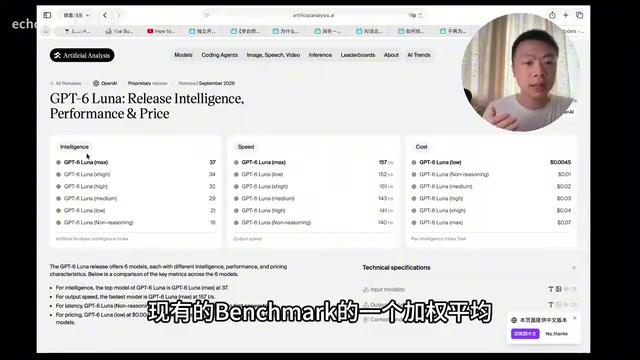
The core logic behind these choices comes from Artificial Analysis, an independent AI evaluation platform. It provides two key metrics: Intelligence and Cost.
The Intelligence index isn't the result of a single test — it's a weighted average across a range of existing benchmarks, giving a rough measure of a model's overall capability. The Cost metric is designed to reflect real-world usage: rather than using raw API list prices, it has models complete a set of realistic tasks, measures the actual tokens consumed, and converts that into a dollar figure. This means a model with a higher per-token price but greater efficiency may not actually be more expensive in practice.
Plot Intelligence and Cost for each model and each reasoning tier on a single chart, and the value-for-money relationships become immediately clear.
Artificial Analysis is an independent platform focused on AI model evaluation. Its core value lies in providing cross-model comparison data that doesn't rely on vendor self-reporting. Its Intelligence index integrates scores from multiple academic and engineering benchmarks — including MMLU, HumanEval, and MATH — using weighted averaging to reduce the bias of any single test. The limitation of this approach is that benchmark performance doesn't always correlate linearly with real-world business tasks, but it remains widely cited as a baseline for cross-model comparison. The Cost metric addresses another common misconception: API pricing is typically quoted per million tokens, but different models consume vastly different numbers of tokens to complete the same task. A reasoning-heavy model with lots of "thinking tokens" can produce a much higher actual bill than its unit price suggests. Artificial Analysis measures real token consumption across a standardized task set, grounding cost comparisons in actual usage.
Breaking Down the Four Tiers
Lula Max: Best Bang for Your Buck
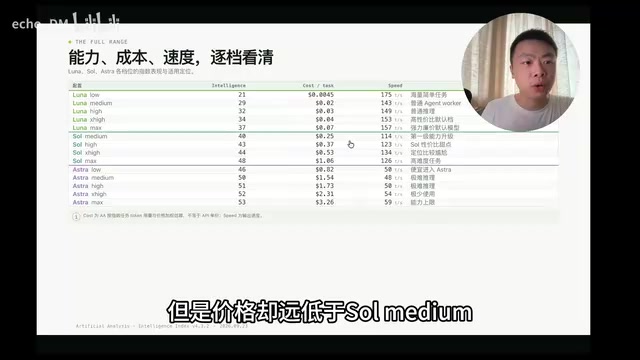
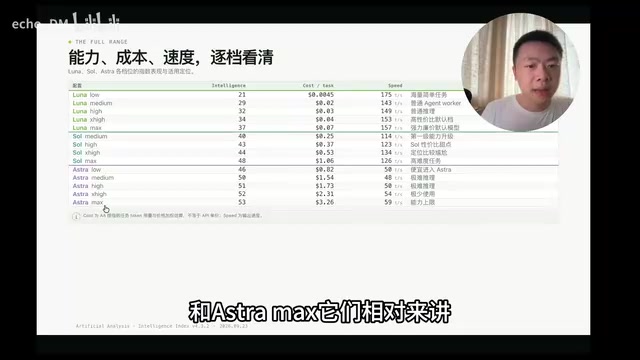
Lula Max has an Intelligence score of 37 and costs just $0.07. Its intelligence level is significantly higher than other tiers in the Lula family and roughly on par with Soar Media — but at a fraction of the price. For the vast majority of everyday tasks, this tier is more than sufficient, and the cost is negligible. In other words, there's simply no reason to reach for a pricier option for routine work.
Soar High: The Middle Ground
When a task requires some reasoning but isn't a hardcore challenge, Soar High is the right middle-ground option. Its Intelligence sits between Lula Max and Soar Max, offering solid performance at $0.37 — well below Soar Max's $1.06. It fills the gap between everyday use and genuinely difficult problems.
Soar Max: For Problems That Actually Need It
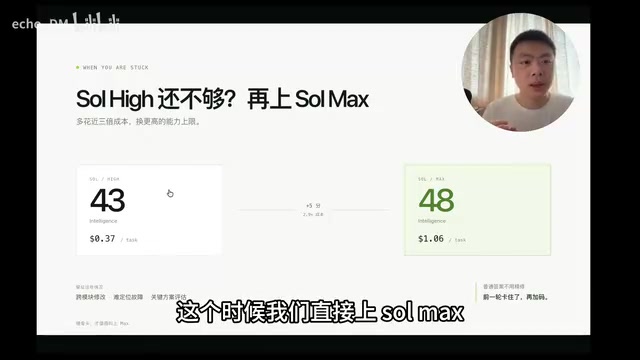
The jump from Lula Max to Soar Max represents a clear qualitative leap in Intelligence — roughly ten points higher. The trade-off is a significant price increase. For exactly this reason, Soar Max shouldn't be used casually. Reserve it for problems that Lula Max and Soar High genuinely can't handle.
Reasoning intensity tiers are essentially a way of adjusting how deeply a model "thinks" before generating a response. Providers like OpenAI typically implement this by controlling the length of the chain-of-thought or through reinforcement learning-trained "slow thinking" modes. Higher tiers mean the model dedicates more compute to self-checking and verification before answering, which increases both token consumption and latency. This explains why the Max and Low tiers of the same base model can show measurable differences in Intelligence: what improves isn't the model's underlying capability ceiling, but the computational depth actually engaged during each inference. Understanding this helps you decide when the higher cost is worth it. For straightforward factual questions with clear answers, extra reasoning depth adds little value. For complex problems requiring multi-step derivation and hypothesis verification, higher tiers genuinely earn their keep.
Astro Media: For Review and Debugging
Looking at the data, Soar Max actually scores higher on Intelligence than the lower Astro tiers, and is priced accordingly. Within the Astro family, the Intelligence gain from each additional reasoning tier is relatively modest. For most people, when you need to review critical information, fact-check important outputs, or debug something, Astro Media is sufficient — there's no need to push further up the reasoning ladder.
The Upgrade Logic: Look for Qualitative Jumps
Put it all together, and the upgrade path is straightforward:
- Everyday tasks → Lula Max
- Tasks requiring some reasoning → upgrade to Soar High
- Hard problems that Soar High can't crack → go straight to Soar Max
- Reviewing critical outputs, fact-checking, debugging → hand it to Astro Media
For most people, day-to-day use really comes down to switching between Lula Max and Soar High. The Astro family rarely comes up.
The single most important criterion when choosing a model or reasoning tier is this: does the upgrade produce a qualitative leap? If moving up a tier barely moves the Intelligence needle while the price jumps, there's no point in upgrading. Only when Intelligence shows a meaningful increase is the higher cost worth paying. The jump from Lula Max to Soar Max is exactly that kind of qualitative leap.
Final Thoughts
This framework is built on publicly available data from Artificial Analysis, combined with real-world usage experience. Its value isn't in providing a single definitive answer — it's in offering a reusable decision framework: evaluate every potential upgrade against two dimensions, Intelligence and real-world cost, rather than blindly chasing the most powerful model. Use cases vary widely from person to person, and the right tier choices are worth revisiting and refining as you gain more hands-on experience.
Related articles

Gaussian Process Bandit Optimization: Exploration Strategies and Inference Regret Guarantees
Cumulative regret guarantees in Bayesian optimization fail to reflect final recommendation quality. This article examines a new study that provides inference regret guarantees for Gaussian process bandit optimization through exploration query strategies and fill distance analysis, validated on hyperparameter optimization and control tasks.

The Most Detailed Codex Guide on Bilibili: From Installation to Real-World Practice
The most detailed Codex guide on Bilibili: from app store installation to daily work mode configuration, with a real coffee shop project demonstrating file organization, data extraction, dashboard creation, and other practical tasks. Learn to use Plan Mode and desktop pets to leverage Codex efficiently.

Appearance Compensation in Volume Rendering: Why RGB Accuracy Cannot Guarantee Density Correctness
Volume rendering research reveals that volumetric data perfectly reproducing external RGB views may still contain density errors: appearance compensation can double central density and keep external rays unchanged even when L2 error exceeds 14.52%. Density recovery depends on appearance capacity, spatial resolution, and measurement design.