How to Choose a Vector Database for Production RAG: A Developer's Practical Discussion
No standard answer for vector database selection — it requires engineering trade-offs among performance, operational cost, and team tech stack.
Based on Reddit developer community discussions about RAG vector database selection, this article outlines the mainstream solution landscape in production environments. Dedicated vector databases have inherent advantages in recall and query speed but bring operational learning costs; vector extensions of traditional databases reuse existing backup, monitoring, and permission systems, suitable when RAG is an auxiliary capability; lightweight in-memory solutions suit rapid MVP validation but require advance migration planning. The core consensus: clarify data scale, latency requirements, team tech stack, and budget constraints before selecting, and maintain retrieval layer replaceability to avoid strong coupling between business logic and specific vector storage implementations. A practical selection checklist is provided.
Why Vector Database Selection Became the First Hurdle for RAG Deployment
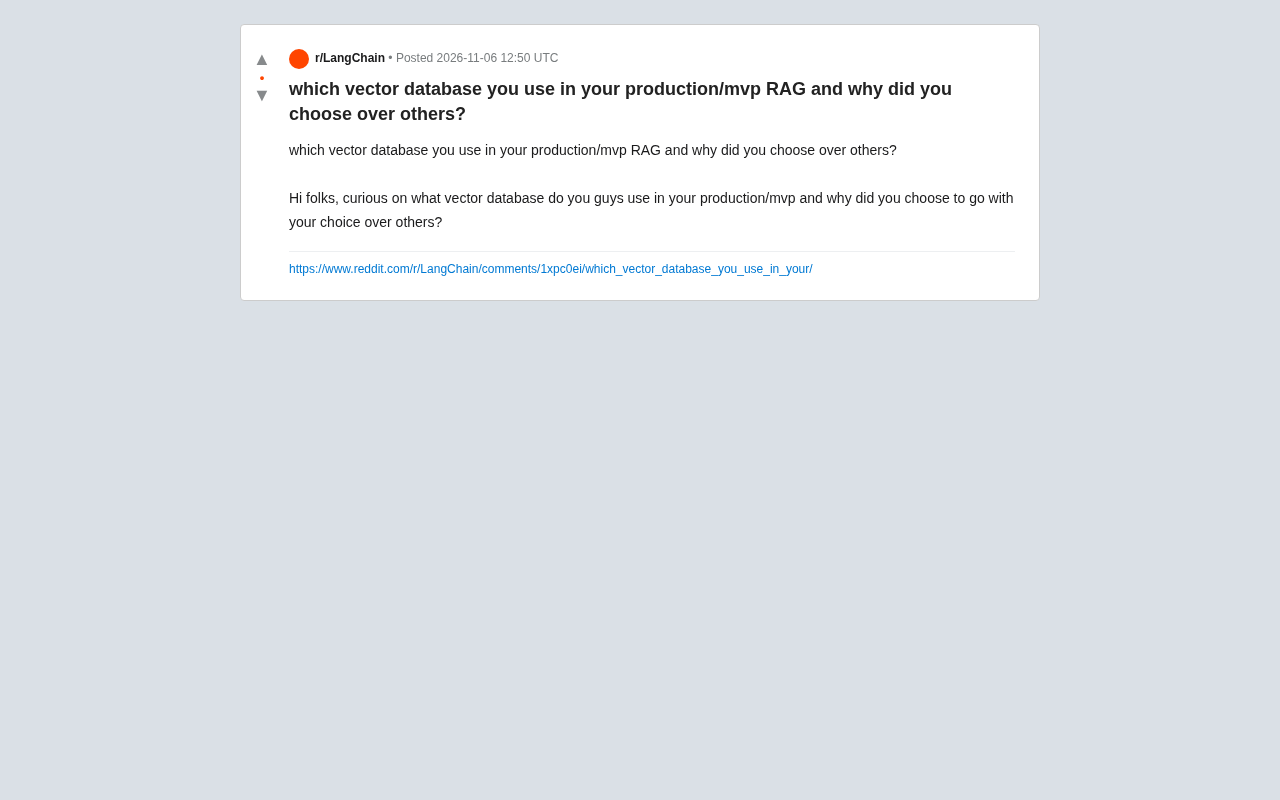
In a Reddit discussion, a developer posted a question: what vector database is everyone using in production or MVP-stage RAG (Retrieval-Augmented Generation) systems, and why choose it over other options? This question seems like a technical detail, but it actually touches on the most practical pain point of RAG engineering — the quality and cost of vector retrieval directly determine the upper limit of the entire system.
In RAG architecture, the vector database plays the role of efficiently storing and retrieving text after embedding it into vectors. Unlike traditional databases, it doesn't have a mature selection methodology, nor is there a "default answer" that satisfies everyone. Different teams make vastly different trade-offs among latency, cost, operational complexity, and ecosystem integration — this is exactly where the value of the discussion lies.
The Landscape of Mainstream Solutions in the Discussion
Based on the direction of the Reddit thread, developers' choices roughly fall into several categories. One is dedicated vector databases, which are deeply optimized for vector similarity search and have inherent advantages in recall and query speed. Another is vector extensions of traditional databases, which leverage existing operational infrastructure and ecosystems to reduce the cost of introducing new components. There is also a category of lightweight in-memory solutions, suitable for rapid validation during the MVP stage, but requiring additional consideration for data persistence and scalability in production environments.
This divergence reflects a core fact: there is no absolute good or bad in vector database selection, only scenario fit. An internal tool with low daily request volume and a high-concurrency retrieval service facing massive users have completely different requirements for the database.
Dedicated Vector Databases: The Trade-off of Performance First
Developers who choose dedicated vector databases typically value their targeted optimization in index structures and retrieval algorithms. These databases often support multiple approximate nearest neighbor (ANN) indexes, enabling fast recall in high-dimensional vector spaces — a key metric for latency-sensitive online RAG services.
But performance advantages come at a cost. Introducing an entirely new database means the team needs to learn new operational practices, monitoring systems, and troubleshooting procedures. For teams that already have a mature database infrastructure, this can be an additional burden. Many developers in the Reddit discussion mentioned that when selecting, they consider "whether anyone on the team is familiar with this component" as an important factor, not just benchmark numbers.
Pragmatic Strategies for the MVP Stage
You might not have noticed, but many voices in the discussion lean toward using lighter solutions during the MVP stage first, then migrating after business validation. This approach is common in engineering practice: first use in-memory or lightweight vector storage to quickly get the pipeline running, confirm the business value of RAG, and then choose a production-grade solution based on actual load characteristics. The benefit is avoiding premature lock-in of the tech stack when requirements are still unclear.
However, the hidden risks of lightweight solutions in production cannot be ignored. Data persistence, concurrent read/write, and service availability during index rebuilds — these issues may be masked during the MVP stage but erupt collectively as user volume grows. Experienced developers suggest that even if starting with a lightweight solution, you should design the data migration path in advance to avoid being caught off guard later.
Vector index structures are key to understanding the performance differences between vector databases. Common approximate nearest neighbor (ANN) indexes include HNSW (Hierarchical Navigable Small World graphs), IVF (Inverted File Index), and PQ (Product Quantization). HNSW performs excellently in query latency and recall but has high memory usage; IVF reduces search scope through clustering, suitable for large-scale datasets; PQ compresses vectors to lower storage costs but loses some accuracy. Different databases vary in their support and default configurations for these indexes, directly affecting their performance in specific scenarios. Understanding the trade-offs of underlying indexes during selection is more meaningful than simply comparing benchmark numbers.
Vector Extensions of Traditional Databases: Balancing Ecosystem and Operations
Another camp of developers prefers to use vector capability extensions of existing databases. The appeal of this approach is that teams can reuse existing backup, monitoring, permission management, and operational processes, without having to build a new system for a new component. For teams with mature database operations experience, this can significantly lower the barrier to introducing vector retrieval.
The cost is reflected in peak performance. Although vector extensions of general-purpose databases can functionally meet the basic needs of RAG, in large-scale vector data and high-concurrency query scenarios, performance may lag behind dedicated solutions. What needs to be evaluated during selection is: how much tolerance does the business have for retrieval latency, and to what scale will data grow. If RAG is only an auxiliary capability in the product rather than a core experience, vector extensions of general-purpose databases are often the more pragmatic choice.
Cross-Source Consensus: Clarify Requirements Before Selecting
Synthesizing multiple viewpoints from the Reddit discussion, a recurring consensus is: clarify your requirement boundaries before selecting. Data scale, query latency requirements, team tech stack, and budget constraints — these four dimensions basically determine the candidate range. Discussing "which vector database is the best" without a specific scenario is meaningless in engineering.
Another consensus is that the vector database field is still rapidly evolving, and today's selection doesn't need to be one-step-to-perfection. Designing for replaceability at the retrieval layer and decoupling business logic from specific vector storage implementations can significantly reduce refactoring costs when migration is needed in the future.
Implementation approaches of vector extensions are worth noting. Take PostgreSQL's pgvector as an example: it adds vector types and distance operators to the database, enabling SQL queries to directly perform similarity search. The advantage is that vector retrieval can seamlessly combine with relational queries — for example, completing metadata filtering and vector recall in the same transaction. But the query optimizer of general-purpose databases is not designed for high-dimensional vector search, and manual index parameter tuning may be needed on large-scale datasets. Understanding the underlying mechanisms of these extensions helps determine whether they suit your RAG workload characteristics.
Retrieval layer replaceability is typically achieved in engineering through abstract interfaces. The specific approach is to define a unified set of vector storage operation interfaces — such as insert, delete, similarity query — and have business code depend only on this abstraction, with different vector database implementations switchable underneath. Some orchestration frameworks (such as LangChain, LlamaIndex) already provide such abstraction layers, but beware that over-abstraction may lose advanced features of specific databases. A reasonable approach is to retain abstraction for core operations while reserving direct access channels for advanced optimizations.
A Selection Checklist for RAG Developers
Based on the experience in the discussion, a pragmatic checklist can be compiled. First, clarify data scale and growth expectations — this determines whether a distributed architecture is needed. Second, evaluate hard requirements for query latency — the standards for online services and offline batch processing are completely different. Third, inventory the team's existing tech stack and operational capabilities — the learning cost of new components is a hidden but real expense. Fourth, consider ecosystem integration, including whether coordination with embedding models and orchestration frameworks is smooth. Fifth, reserve migration space — avoid strong coupling between business logic and database implementation.
Vector database selection is essentially an engineering trade-off, not a search for a standard answer. The value of this Reddit discussion lies not in reaching a unified conclusion, but in presenting the real trade-off logic under different scenarios, enabling newcomers to make clearer judgments based on their own situations.
This article is compiled from public discussions in the Reddit developer community about RAG vector database selection. The views expressed are community experience sharing; please evaluate specific selections in light of your own business scenarios.
Related articles
 Tech Frontiers
Stylome Bot Slammed as Useless Junk: Why Do AI Detection Tools Keep Failing?
Reddit users test the Stylome AI detection bot: Gemini-rewritten text judged human-written, consistently low confidence. An analysis of AI text detection's technical dilemmas, privacy concerns, and credibility crisis in community governance.
 Tech Frontiers
When AI Becomes a Productivity Divide: Clarity or "AI Psychosis"?
A civil engineer's deep use of agentic AI boosted efficiency but bred contempt for peers who refuse to learn. Is this clarity or AI psychosis? An analysis of the cognitive and psychological challenges behind the AI productivity divide.
 Tech Frontiers
Opus 5.5 Benchmark Scores Climb, Community Says Its "Weights Are Blessed"
Reddit community discusses Opus 5.5's rising scores on the Benchmaxxing Bench, with users describing its performance as "weights are blessed." This article interprets the community reaction and cautions against conflating benchmark scores with real capability.