How to Choose Among 4 AI Agent Frameworks: LangGraph, CrewAI, and Two Major SDKs Compared

Choose your AI agent framework based on control flow complexity, agent count, and provider lock-in — not hype.
This article from an AI engineering course series systematically compares the core trade-offs of LangGraph, CrewAI, the OpenAI Agents SDK, and the Claude Agent SDK. Evaluation focuses on abstraction cost, debuggability, and hidden logic — not feature lists. LangGraph offers the most explicit control via graph structures; CrewAI accelerates multi-agent setup through role-based collaboration but hides coordination details; both SDKs stay close to underlying APIs with minimal abstraction but tie you to specific providers or task types. The article also highlights a point most tutorials ignore: for simple scenarios, plain code beats any framework. Selection should start from three questions: control flow shape, number of agents, and provider lock-in.
When building AI agents, LangGraph, CrewAI, the OpenAI Agents SDK, and the Claude Agent SDK all promise to help you ship faster. But they solve different problems — and picking the wrong one could cost you weeks of rework. This content, from Module 4 of the YouTube channel "AI Engineering for Experienced Developers," doesn't crown any single framework. Instead, it maps each framework's trade-offs to real engineering decisions, so you can choose based on your own constraints rather than GitHub star counts.
The Real Criteria for Evaluating Frameworks
Experienced developers evaluating tools never look at feature lists. They look at three things: abstraction cost, debuggability, and how much "magic" is hiding between their code and its output. Agent frameworks are no exception.
Every framework embeds a set of assumptions about how agents should plan, call tools, and hand off work. These assumptions are invisible when your use case falls within the framework's happy path. The moment your requirements go beyond what the framework anticipated, those assumptions surface and start conflicting with your goals.
So before comparing features, keep this core principle in mind: a framework's true cost is determined by what happens when your use case drifts off its happy path.
LangGraph: Modeling Agents as Graphs
LangGraph models your agent as a graph — nodes are steps, edges are transitions, and state flows through them explicitly. If you've written state machines before, this model will feel familiar.
It gives you fine-grained control over branching, retries, and loops, which matters when an agent needs conditional logic beyond a simple loop. The trade-off is verbosity: you wire up control flow explicitly, which means more upfront code — but far less guesswork when something breaks in production.
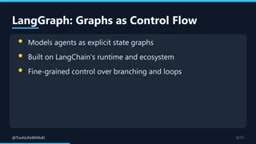
The state machine is the key conceptual backdrop for understanding LangGraph's design philosophy. A state machine is a computational model where a system exists in one of a finite number of states at any given moment, transitioning between states according to explicitly defined rules. LangGraph brings this idea into agent orchestration: each node represents a deterministic processing step (such as calling an LLM, executing a tool, or making a routing decision), edges represent conditional transitions, and the "Graph State" is a data structure shared across and explicitly passed between all nodes. This means you can know at any point exactly which node the agent is on, what context it's carrying, and which edge it will take next. This design stands in sharp contrast to "black-box" agents — where the LLM autonomously decides its next action, making execution paths difficult to predict or reproduce. For scenarios requiring audit compliance, high production stability, or complex branching logic, LangGraph's explicit graph structure is a real engineering advantage, not merely a stylistic preference.
CrewAI: Organizing Agents as Collaborative Roles
CrewAI lets you define agents as roles — like "researcher" or "writer" — assign them goals, and let the framework coordinate handoffs between them. It's purpose-built for multi-agent collaboration.
If your problem naturally decomposes into specialized roles, CrewAI gets things running faster than hand-rolling coordination logic. The trade-off is that it hides more abstraction — when coordination breaks down, you're debugging the framework's assumptions about how agents should communicate, not your own logic.
Two SDKs: Staying Close to the API
The OpenAI Agents SDK takes a closer-to-the-metal approach. It's a thin wrapper over OpenAI's own API primitives, with built-in support for agent handoffs, guardrails, and tracing. Because it's lightweight, there's less framework logic to fight when you need custom behavior.
The trade-off is deep coupling to the OpenAI ecosystem. If you want model flexibility, or you've already invested in another provider, that coupling shifts from a feature to friction.
The Claude Agent SDK is built around long-running, tool-heavy sessions — the kind of work that programming agents do. It favors composability over prescribing a rigid orchestration pattern, offering primitives for file operations, tool calling, and context management. It excels when your agent needs to work autonomously across many steps, but it has fewer opinions about multi-agent coordination — that structure is yours to design.
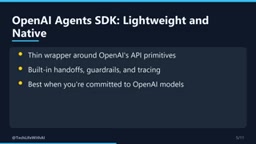
Two primitives in the OpenAI Agents SDK worth calling out separately: "guardrails" and "handoffs." Guardrails let you register check functions on an agent's inputs or outputs — for filtering harmful content, validating formats, or enforcing business rules — and these checks can run in parallel with the main agent to reduce latency. Handoffs are a mechanism for transferring control from one agent to another: when the current agent determines that a subtask falls outside its responsibility, it "hands off" to a more specialized agent along with the necessary context. These two mechanisms are the core means by which the OpenAI Agents SDK supports multi-agent collaboration despite its lightweight design. By contrast, the Claude Agent SDK's composability philosophy means it doesn't prescribe these coordination patterns. Instead, it provides more atomic primitives (file I/O, tool calling, context window management) for developers to combine freely — offering greater flexibility, but requiring developers to take on more of the coordination design work themselves.
Debuggability: A Spectrum of Control vs. Convenience
Plot these four frameworks on a debuggability axis and a pattern emerges.
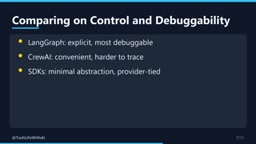
- LangGraph: Explicit graphs make failures traceable, because you can see exactly which node ran and why.
- CrewAI: The convenience comes at the cost of visibility into what happens between agent handoffs.
- Both SDKs: Closer to raw API calls, with less framework logic to debug — but you inherit the constraints imposed by the underlying provider.
There's no right or wrong here — just different positions on the control vs. convenience spectrum.
The Thing Most Tutorials Skip: Sometimes You Don't Need a Framework
The truth most tutorials gloss over: if your agent calls one or two tools in a simple loop, you don't need a framework at all. Plain code — a while loop and direct API calls — is easier to debug and maintain.
Frameworks earn their keep when you're facing genuine complexity — multiple agents, conditional branching, or long-running state that's hard to track by hand. Reaching for a framework before you have that complexity just adds indirection you'll have to untangle later.
There's a general engineering principle behind this judgment: the value of an abstraction layer comes from the complexity it eliminates, not the new capabilities it introduces. Every framework adds a layer of indirection between your code and the underlying API — meaning more learning overhead, harder-to-trace error stacks, and potential compatibility issues when the framework releases a new version. For a structure like "one agent, one while loop, direct API calls," the indirection a framework introduces typically outweighs the boilerplate it saves. A practical threshold for deciding whether you need a framework: if you need to manage state flow between multiple agents, handle complex conditional branching, or persist long-running context, a framework pays off. If your logic can be expressed clearly in a few dozen lines of code, introducing a framework trades complexity for convenience — and that's usually a bad deal.
A Practical Selection Checklist
Match the tool to the shape of your problem, not the other way around:
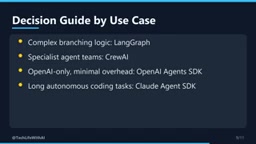
- Need explicit control over complex branching and state? Choose LangGraph.
- Building a team of specialized agents that hand work off to each other? CrewAI is the most natural fit.
- Already committed to OpenAI models and want minimal overhead? The OpenAI Agents SDK is the leanest path.
- Building something that works autonomously across many steps, especially involving code and files? The Claude Agent SDK is designed for exactly that.
No framework is objectively best. Each one bets on a particular assumption about how agents should be organized. Your job is to make that bet match your real constraints — not whatever tool is dominating social media this month.
Asking yourself three questions will narrow the field faster than any comparison chart: What does your control flow look like? How many agents do you actually need? Which provider are you locked into?
Summary
LangGraph offers explicit, graph-based control. CrewAI organizes agents as collaborative roles. The OpenAI and Claude SDKs stay close to their respective APIs with less abstraction overhead. And sometimes, plain code beats all of them. The key is always to match the tool to the shape of your problem.
Related articles

How Big Can Stars Really Get? The Physical Limits of the Largest Stars
Red supergiants are the largest stars by volume, with radii up to 2,000 times the Sun, engulfing the inner solar system. But there is no precise upper limit on stellar size—models predict up to 15,000 solar radii. The most massive blue stars are far smaller than red supergiants—biggest and heaviest are two different things.

Apple HomeView Smart Display Full Feature Breakdown: Wall-Mount or Desktop, $299
Apple launches HomeView, a $299 smart display with wall-mount and desktop options, 12MP camera for facial recognition, smart home control, music playback, and recipe step-by-step cooking. Full breakdown of watch faces, apps, privacy, and cooking integration.

Where Did the Promised New Studio Go? Craft Computing Answers After Five Years
Craft Computing's host responds to viewer questions: the new studio promised five years ago was shelved as construction costs soared from $30,000 to $75,000, and was replaced by a 168-square-foot garage conversion.