How to Choose an AI Text Humanizer? A Practical Guide to Removing the AI Feel from ChatGPT and Claude

Before hunting for humanizing plugins, try prompt engineering to make AI writing sound more human from the start.
Starting from a Reddit user's frustration with AI writing's robotic feel, this article breaks down the three types of humanizing tools — standalone rewriters, browser extensions, and prompt-based approaches — and explains why the "machine feel" stems from models favoring high-frequency, safe expressions. It argues that prompt engineering (style anchors, breaking sentence symmetry, iterative drafting) is often more effective, safer, and cheaper than third-party tools. For those who still need external tools, it outlines key evaluation criteria: output quality, privacy, cost, and controllability. Ultimately, true humanization comes from deep human involvement, not one-click rewriting algorithms.
Why Everyone Is Looking for Ways to "De-AI" Their Writing
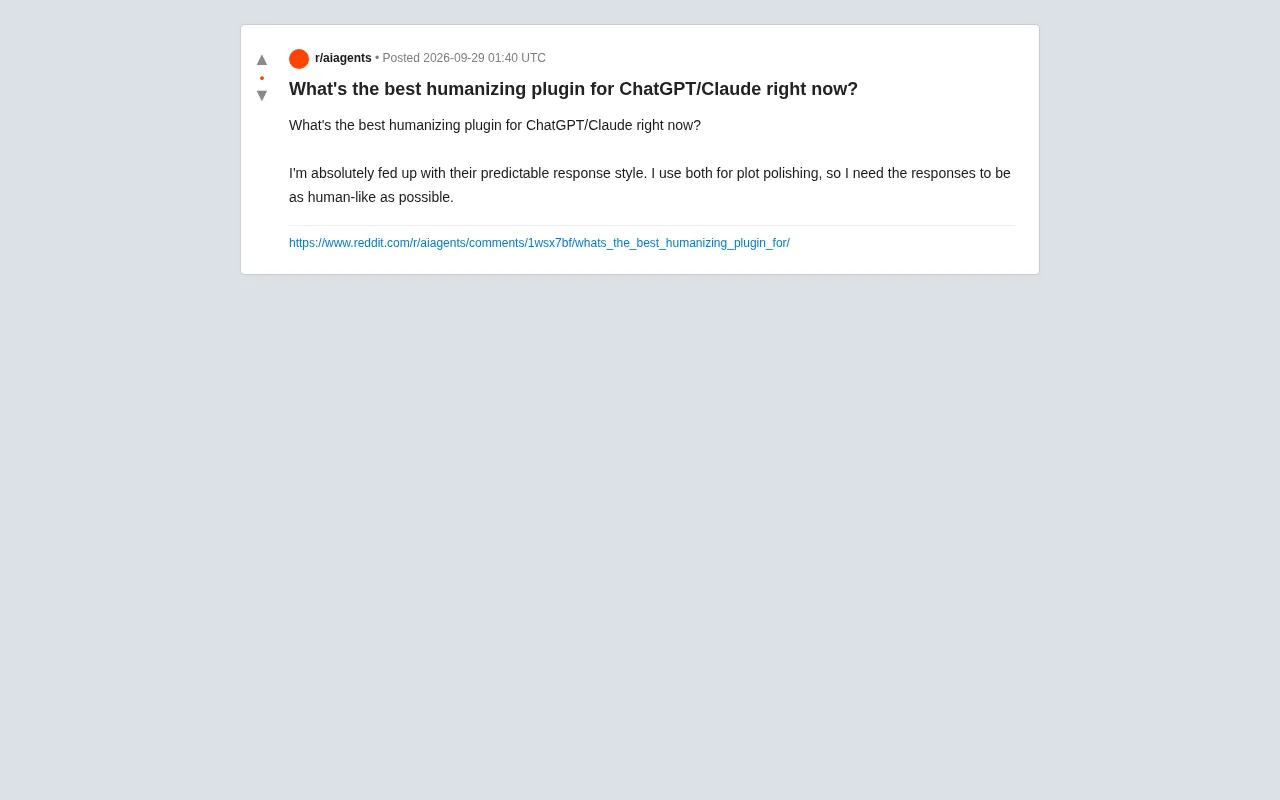
A Reddit user voiced a frustration shared by many creators: he uses both ChatGPT and Claude to polish novel plots, but has grown increasingly fed up with their "predictable" patterns — well-structured sentences, cautious word choices, and eerily uniform paragraph rhythms. He wanted a "humanizing plugin" to make AI output read more like something written by an actual person.
Behind this request lies a widespread pain point in generative AI writing. Large language models generate text based on probability distributions, naturally gravitating toward the "safest, most frequent" expressions. The result is content that flows smoothly but lacks personality — read enough of it and the "machine feel" becomes unmistakable. For creative writing and narrative polishing, where style and emotion are everything, this homogeneity is particularly damaging.
What "Humanizing Plugins" Actually Are
AI text humanizing tools are, at their core, systems that rewrite AI-generated content with the goal of breaking the model's fixed patterns and making the text feel closer to natural human expression. The most common forms on the market fall into a few categories:
Standalone Rewriting Platforms
These tools (such as various AI Humanizer websites) take AI-generated text and restructure sentences, swap out vocabulary, and adjust pacing using their own models or rule sets. They originally marketed themselves on "bypassing AI detectors," but for creators, their more practical value lies in breaking monotonous expression habits. That said, output quality varies wildly — some of these tools can make perfectly readable sentences even more awkward than before.
Browser Extensions and Integrated Tools
Some tools exist as browser extensions that can process ChatGPT or Claude output directly within the web interface with a single click. Convenience is the main advantage, but watch out for overly broad permissions, privacy risks, and heavy reliance on paid subscriptions.
Prompt-Based Approaches
Strictly speaking, this isn't a "plugin" — but it's often the most effective and lowest-cost solution. With carefully designed prompts, you can get the model itself to produce more human-sounding content from the start.
Prompt engineering works at the source because it directly intervenes in the model's generation probability distribution, rather than patching up the output after the fact. Specific techniques include: setting a narrative persona in the System Prompt, providing "counter-examples" so the model knows which expressions to avoid, and using a role-play framework that has the model write as a fictional author. Claude is especially responsive to detailed style instructions, while ChatGPT's custom GPT feature lets you persist style directives so you don't have to re-enter them every time. Compared to any third-party rewriting tool, this approach introduces no additional privacy risks and no extra costs.
What to Try Before Reaching for a Third-Party Plugin
Before rushing to install a plugin, creators can actually resolve most issues from within the model itself. The original poster's core need — plot polishing — is precisely where prompt engineering shines.
Use Style Anchors Instead of Vague Instructions
Rather than saying "write more like a human," give the model a concrete style reference: a specific author's voice, a particular narrative perspective, a clear emotional register. Provide a paragraph or two of text you're happy with, and let the model mimic its rhythm and word choices. This almost always outperforms abstract requests.
Actively Break Sentence Symmetry
You can explicitly tell the model: mix long and short sentences, allow colloquial interjections, avoid using the same connective phrases to open every paragraph, and cut the summarizing boilerplate. Much of that "AI feel" comes from over-symmetric structure — deliberately breaking it goes a long way toward authenticity.
Work in Stages, Not One Shot
Break the polishing process into multiple rounds — have the AI generate a draft, then go in and adjust specific passages sentence by sentence. Iterative refinement is far better at preserving a human author's intent and voice than trying to generate a perfect result in one go.
What to Weigh When Choosing a Third-Party Tool
If prompt engineering still isn't enough, here are the dimensions to evaluate before turning to external tools:
- Output quality: Is the rewritten text still coherent? Does it preserve the original meaning, rather than just swapping synonyms?
- Privacy and security: Will your creative content be uploaded, stored, or even used for training? This matters especially for unpublished work.
- Cost model: Most humanizers charge by word count or subscription — for long-form creative work, costs can add up fast.
- Controllability: Can you adjust the intensity of rewriting or specify a style, or are you stuck with a black-box result you can't influence?
It's worth noting that the "bypass AI detection" feature many humanizing tools lead with is largely irrelevant for pure creative purposes — and may actually sacrifice readability. What creators actually need is better writing, not harder-to-detect writing. The two aren't always the same thing.
Privacy risk deserves special attention in creative contexts. Most free or budget humanizer services rely on cloud-based APIs to process text, and their terms of service often include clauses allowing input data to be used for model optimization. For unpublished novels, screenplays, or commercial copy, once that content is uploaded to a third-party server, it becomes vulnerable — potentially used as training data, exposed to competitors, or leaked in a data incident. Before using any such tool, read its privacy policy carefully, confirm whether data is deleted immediately after processing, and check whether local or on-device processing options are available.
A More Fundamental Mindset: Treat AI as a Collaborator, Not a Ghostwriter
The "find a tool and fix it in one click" expectation in the original post reflects a common misconception — the hope that some plugin will completely erase AI fingerprints. But in practice, the work that retains the most human quality tends to come from a deeply involved collaborative process: the AI handles scaffolding and generates options, while the author makes judgments, curates, and injects personal voice.
This is especially true for plot polishing. Real "humanization" doesn't come from algorithmic rewriting — it comes from the author's understanding of and investment in the story. Tools can reduce friction, but they can't substitute for creative intent. Rather than chasing the "best humanizing plugin," it's worth putting that energy into learning how to direct AI more precisely and how to add meaningful value on top of what it produces.
In Summary
There's no simple "best tool" answer to the question raised in that Reddit thread. For most creators, the priority order should be: first, use prompt engineering to squeeze the most out of the model itself; then, carefully evaluate third-party humanizers if needed; and always keep a human in the final review seat. Tools will keep changing, but the principle of "human-AI collaboration with humans in the lead" is what makes AI-assisted writing feel genuinely alive.
Background: The Technical Roots of the "Machine Feel"
The "machine feel" has a clear technical explanation. Large language models learn statistical patterns from massive text corpora during training, and at inference time, a "temperature" parameter controls randomness — the lower the temperature, the more the output converges on the most frequent expression combinations found in training data. ChatGPT and Claude default to lower temperatures to ensure coherence, with the side effect that the same sentence structures keep appearing: "It's worth noting that…", "Overall…", and the rigid introduction-body-conclusion paragraph format. Researchers refer to these high-frequency patterns as "LLM stylistic fingerprints" — each model has its own signature expressions, and experienced readers can often spot them immediately.
Related articles

"Black October": Did AI Uncover 3% of All Critical Vulnerabilities Ever?
A Reddit post claims 3% of all critical software vulnerabilities ever were found in the past month, dubbed 'Black October.' We break down the statistical issues, how AI-assisted code auditing accelerates discovery, and how developers should respond.

Microsoft Project Gecko: Using AI to Bridge Language Gaps for African Farmers
Microsoft's Project Gecko launches PharmaChat, letting African farmers ask questions in their native language and get precise video clips and farming book chapters via AI. The project also releases three interactive manuals to advance inclusive AI.

Musk's Space Dominance: How Starlink Throttling Undermines Ukraine's Defense
SpaceX's Starshield throttling disabled Ukraine's high-speed interceptor drones, exposing how Musk's private control over low Earth orbit communications affects battlefield dynamics and national security, and highlighting the risks of commercial space militarization and space governance dilemmas.