How to Choose an FDE Beginner Course? Bilibili Creator Reveals Three Major Pain Points in Course Design

FDE roles resist standardized teaching; a Bilibili creator uses real business cases to bridge the gap.
This article explores Bilibili creator "Teacher Li's" FDE beginner course, examining why Forward Deployed Engineer roles are both hard to teach and learn. FDE demands span business understanding, technical implementation, and client communication—technical skills can be drilled, but business acumen and project experience are highly subjective. The creator goes deep into a real platform's operations, converting firsthand FDE workflow experience into immersive case-based teaching, while deliberately avoiding overly detailed notes and blurring confidential content. The essence of education, he argues, is using people to inspire people.
Why the FDE Role Is Hard to Teach and Hard to Learn
FDE (Forward Deployed Engineer) has become an increasingly common role in tech companies in recent years, especially in AI application deployment and enterprise services. But Bilibili creator "Teacher Li" admits in his latest FDE beginner course that this role is extremely difficult to teach, because the job requirements span an incredibly wide range—covering business understanding, technical implementation, client communication, and more.
Many learners feel that FDE job requirements are "hollow"—the technical part can be tackled by grinding algorithms and memorizing standard interview questions, but business acumen and project experience are highly subjective things that are hard to acquire by reading documentation or simple memorization. This is precisely the core challenge of FDE course design.
FDE (Forward Deployed Engineer) was first established at scale and made famous by Palantir in the 2000s. Unlike traditional R&D engineers, the core working model of an FDE is "on-site deployment": engineers go directly to client sites, understand the client's business pain points, rapidly build usable technical solutions, and then distill generalizable capabilities back into the product. This role sits between pre-sales, solutions architect, and full-stack engineer—requiring the ability to understand the client's business language while also being hands-on with code delivery. In the wave of AI application deployment, because there is often a huge "last mile" gap between large model capabilities and specific business needs, the value of FDEs has been further amplified—they are responsible for translating abstract model capabilities into products that clients can actually use. This places high demands on business understanding, technical implementation, and client communication simultaneously, which is the fundamental reason why this role is difficult to teach in a standardized way.
Pain Point 1: How to Teach a Course That Isn't "Hollow"?
The creator's solution is to "ground it in reality"—personally going deep into the front lines of business, using a horse-racing learning platform as a real case study for FDE work. He asked various department heads within the platform (class advisors, traffic, operations, etc.) to cooperate, walking through the complete FDE workflow, and then converting these firsthand experiences into teaching cases.
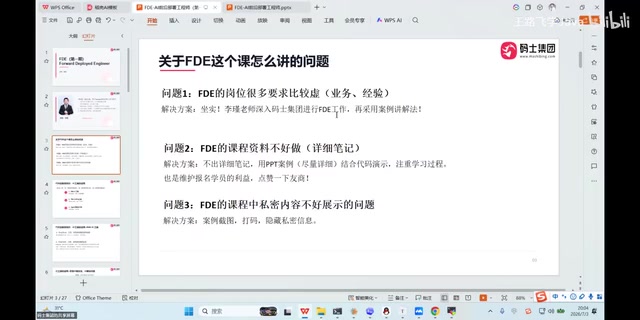
There are two key words here: depth and case-based explanation. The creator emphasizes that many people who are on the front lines doing new things simply don't have time to take complete notes, so the course uses a "case + problem" immersive approach. Compared to some FDE videos on the market that only talk about grand principles, cases drawn from real business scenarios have more reference value. Of course, details involving trade secrets won't be fully disclosed—which is also why many FDE sharers deliberately avoid specifics.
So-called "business sense" refers to a practitioner's intuitive grasp of an industry's operating logic, key metrics, and stakeholders. It differs from rote-learnable knowledge points—it's a judgment formed through long-term immersion in real business scenarios. For example, when building a marketing system, someone with business sense will immediately recognize the interconnected relationships between conversion funnels, repurchase rates, customer acquisition costs, and other metrics, while someone without it can only see feature requirements. There are typically three paths to developing business sense: first, personally participating in real projects and doing retrospectives; second, shadowing experienced practitioners; third, repeatedly training through structured case analysis. For FDE learners, the third point is especially important—because most people don't have the opportunity to go directly to the front lines, indirectly gaining business sense through complete real-world cases becomes the most cost-effective alternative.
Pain Point 2: Why Aren't the Notes Detailed?
Some students hoped to get detailed notes, but the creator's response was: he won't produce overly detailed notes. The reason is that he's doing the work, preparing the course, and teaching all at once, so his energy needs to be allocated to course organization and code demonstrations. He prefers to use PPT cases combined with code demos to explain things, focusing on the learning process rather than the completeness of notes.
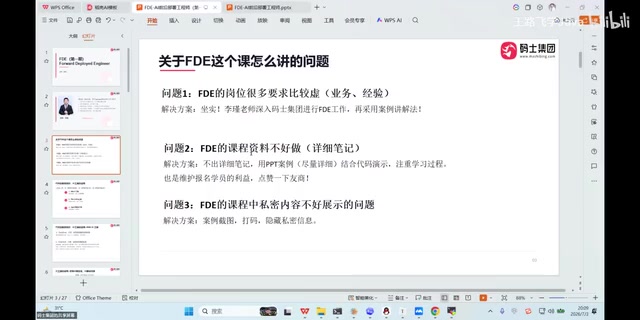
The creator also mentioned a practical issue: overly detailed notes are easily shared, which actually harms the interests of paying students. Teaching a project course is different from teaching a programming fundamentals course—the latter can have blackboard notes organized by knowledge points, while the former involves a large amount of business operations that are hard to standardize into notes.
Pain Point 3: How to Show Private Content?
FDE work involves a great deal of sensitive information, such as communication records with internal department heads, business strategy discussions, and the platform's core competitiveness. The creator's approach is: show case screenshots as much as possible, but blur and hide private information.
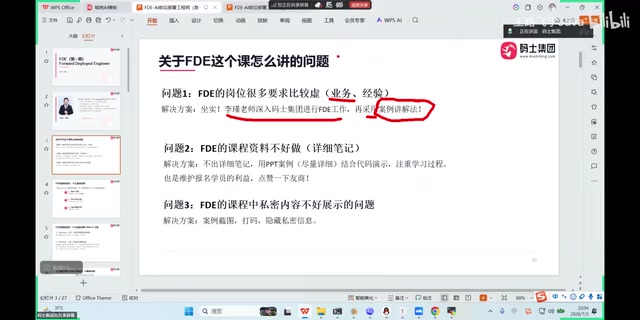
This approach is standard practice in the industry. For learners, the key is not to see every detail, but to understand the thinking frameworks and problem-solving methodologies that FDEs use in different business scenarios.
The Essence of Education: Using People to Inspire People
In the video, the creator shared his understanding of online education: simply memorizing knowledge points isn't very meaningful—the essence of education is "using people to inspire people." He hopes to influence students through his own hands-on experience, enabling learners to draw inferences and adapt when facing interviews for different types of FDE positions in banking, healthcare, government, and other sectors.
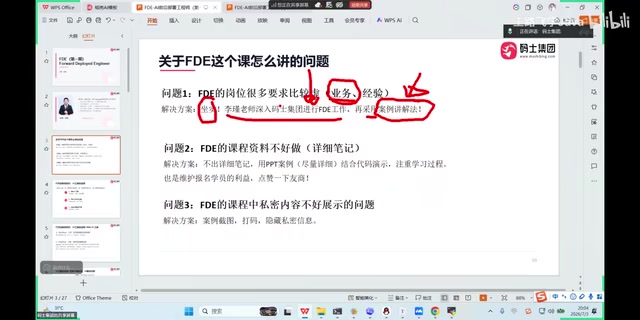
The horse-racing learning platform itself is a complete company structure with full role divisions including development, sales, logistics, and instructors—this provides real business soil for FDE teaching. The creator believes that learning through the real case of a complete organization helps students build business sense better than abstract theoretical explanations.
Takeaways for FDE Learners
The design philosophy of this course reflects a core issue: FDE role competencies are very difficult to acquire through the traditional "attend class + take notes" approach. The truly effective learning path is to follow someone with hands-on experience and understand the intersection of business logic and technical implementation through real cases. For developers starting from zero who want to break into FDE, when choosing a course they should focus on whether the instructor has real project experience and whether the course is based on actual business scenarios.
One-line Summary
FDE roles are hard to teach and learn because business experience resists standardization; this creator uses real business cases to address it.
Paragraph Summary
This article discusses Bilibili creator "Teacher Li's" FDE beginner course, exploring why the Forward Deployed Engineer role is both hard to teach and hard to learn. FDE demands span business understanding, technical implementation, and client communication; while the technical part can be practiced and memorized, business acumen and project experience are highly subjective and hard to gain from documentation or memorization. The creator's strategy is to personally go deep into the front lines of a horse-racing learning platform's business, walk through the complete FDE workflow, and turn real experiences into immersive case-based teaching. He also makes clear he won't produce overly detailed notes—because project course notes are hard to standardize, energy must go to course delivery and code demos, and detailed notes could harm paying students' interests. For content involving trade secrets, the course uses blurring and hiding, focusing on conveying thinking frameworks rather than complete details. The article concludes by emphasizing that the essence of education is "using people to inspire people," and that learners should build business sense by following instructors with real experience and studying real business cases, so they can adapt to different FDE positions in banking, healthcare, government, and beyond.
Related articles

"Black October": Did AI Uncover 3% of All Critical Vulnerabilities Ever?
A Reddit post claims 3% of all critical software vulnerabilities ever were found in the past month, dubbed 'Black October.' We break down the statistical issues, how AI-assisted code auditing accelerates discovery, and how developers should respond.

Microsoft Project Gecko: Using AI to Bridge Language Gaps for African Farmers
Microsoft's Project Gecko launches PharmaChat, letting African farmers ask questions in their native language and get precise video clips and farming book chapters via AI. The project also releases three interactive manuals to advance inclusive AI.

Musk's Space Dominance: How Starlink Throttling Undermines Ukraine's Defense
SpaceX's Starshield throttling disabled Ukraine's high-speed interceptor drones, exposing how Musk's private control over low Earth orbit communications affects battlefield dynamics and national security, and highlighting the risks of commercial space militarization and space governance dilemmas.