How to Deal with a 'Toxic Coworker' on Your Data Science Team: Practical Strategies

Practical strategies for data science professionals dealing with toxic coworkers in technical teams.
Drawing from a real Reddit case, this article examines common toxic behavior patterns in data science teams — such as using salary to create false hierarchies and belittling colleagues' abilities. It offers actionable strategies including setting clear boundaries, documenting unprofessional behavior, avoiding negative narratives, and rationally evaluating when to leave a toxic team culture.
A Real Workplace Dilemma
In data science, technical skills are often the centerpiece of hiring and evaluation. But what truly affects job satisfaction and team productivity is often not the tech — it's the people. Recently, a data science practitioner who had just graduated from college and finished their first job in the field shared a suffocating experience on Reddit that resonated with many.
According to the poster, their team was riddled with problems: extremely high turnover, a terrible team culture, pervasive rudeness, and what they described as an overall atmosphere of "extremely low emotional intelligence." The most prominent "toxic element" was a coworker who had just completed a master's degree and was also in their first full-time role.
Some industry context is worth noting here: the data science field has experienced explosive growth in recent years, with LinkedIn listing it among the most in-demand positions for several consecutive years. However, high demand has also brought high turnover — according to Burtch Works' industry survey, data scientists have an average tenure of only 2–3 years, well below traditional IT roles. Behind this high turnover, beyond salary competition, team culture and management quality are critically underestimated factors. Many data science teams were established as new departments only in the past few years, and their managers were often promoted from technical roles without systematic team management training — laying the groundwork for all kinds of workplace culture issues.
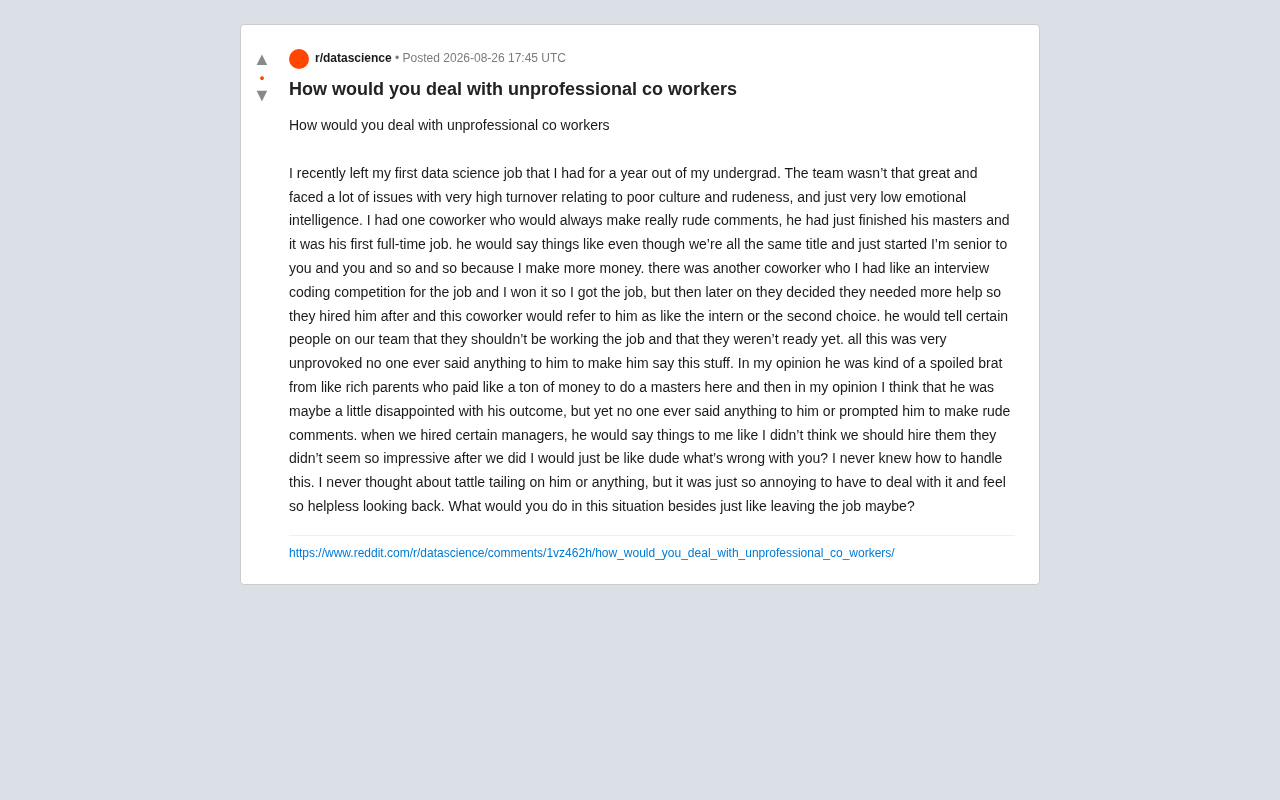
This coworker's behavior was a textbook example of what NOT to do: despite everyone being at the same level and having joined at the same time, he repeatedly emphasized "because I earn more than you, I'm more senior"; he openly referred to a colleague — who had won the hiring coding competition but was brought on later as a backfill — as an "intern" or "second choice"; and he would privately tell team members things like "you shouldn't be doing this job" and "you're not ready."
Common Patterns of Toxic Behavior
The poster's description actually reveals several very common patterns of unprofessional workplace behavior that every tech professional should be aware of.
Creating False Hierarchies Through Salary and Titles
The most obvious issue was this coworker's attempt to establish a nonexistent hierarchy by claiming "I earn more." In a flat team where everyone shares the same title, this behavior neither reflects organizational reality nor does anything but expose the person's deep insecurity. From a psychological perspective, this is a classic case of seeking self-worth by putting others down.
Using salary to define personal value is closely related to "Social Comparison Theory" in psychology. Proposed by Leon Festinger in 1954, this theory suggests that when people lack objective standards for self-evaluation, they tend to assess themselves by comparing with others. In data science, salary differences at the same level can stem from negotiation skills, degree premiums, regional differences, and many other factors — none of which directly reflect ability. However, when individuals equate salary with personal worth, they develop a false sense of superiority. In psychology, this is called an "extrinsic value orientation" — an over-reliance on external markers (like income or titles) to build self-identity, which is often a sign of insufficient inner security.
Furthermore, modern tech companies widely embrace flat organizational structures — reducing management layers and granting frontline employees greater autonomy. The flat management practices of companies like Google and Spotify have been widely emulated. However, going flat doesn't mean power disappears; rather, power shifts from formal hierarchies to informal influence networks. In such structures, certain individuals may build covert hierarchies through information hoarding, social manipulation, or self-aggrandizement. As organizational scholar Jo Freeman pointed out in her classic essay The Tyranny of Structurelessness: when formal power structures are removed, informal and opaque power structures tend to fill the vacuum — and they're much harder to hold accountable.
Belittling Colleagues' Skills and Background
Calling a coworker an "intern," a "second choice," or declaring someone "isn't ready" is, at its core, sustained verbal bullying. These judgments often come "out of nowhere" — as the poster repeatedly emphasized, nobody provoked this person; he proactively spread these negative comments.
From the perspective of workplace behavior research, these actions fall within the scope of "Workplace Bullying." According to the Workplace Bullying Institute, workplace bullying refers to repeated, health-harming abusive behavior targeting a specific individual, including verbal attacks, work sabotage, and interpersonal manipulation. Unlike occasional conflicts, bullying is characterized by persistence, targeting, and power imbalance. Notably, "lateral bullying" — bullying between peers at the same level — is often harder to identify and address because it doesn't involve traditional hierarchical power dynamics, and victims have fewer formal channels for complaints. Research shows that approximately 19% of American workers have experienced workplace bullying, and this percentage may be even higher in the high-pressure tech industry.
Openly Criticizing Management and Hiring Decisions
Going even further, this coworker would critique newly hired managers, saying things like "I thought from the start they shouldn't have been hired." This kind of overstepping is not only unprofessional but also breeds division and negativity within the team.
The poster speculated that this coworker likely came from a wealthy family, with parents who spent heavily on his master's degree, but the reality of his career starting point — same level and comparable pay as everyone else — left him feeling let down. He compensated by putting others down to reclaim a sense of superiority. While this analysis is somewhat subjective, it touches on the psychological root of many toxic coworkers' behavior — aggression often stems from an internal gap between expectations and reality, fueled by anxiety.
What Can Ordinary Employees Do When Facing a Toxic Coworker?
The poster ultimately chose to leave, but they also asked: is there anything else you can do besides quitting? This is a question many newcomers share. Here are several more constructive approaches.
Set Clear Personal Boundaries
When facing unreasonable put-downs, silence can easily be interpreted as acceptance. When someone says "I'm more senior than you," a calm but firm response — such as "We're at the same level; salary doesn't determine seniority" — is enough to draw a clear boundary. The point isn't to argue, but to make it clear that you don't accept that narrative. The poster's reaction at the time was "dude, what's wrong with you" — which, while honest, can be counterproductive because emotional responses tend to put you on the defensive.
Document Behavior Instead of Just Enduring It
Many people see "reporting" as undignified, but objectively documenting unprofessional behavior isn't tattling — it's self-protection. If these remarks involve sustained denigration of specific colleagues, especially when the targets are more vulnerable team members, reporting the facts to HR or management is a legitimate way to maintain a healthy work environment. The key distinction: you're presenting specific, verifiable behaviors, not venting personal grievances.
In North American workplace culture, "documentation" is a critical strategy for dealing with unprofessional behavior. Effective documentation should include: the specific date and time of the incident, who was present, the person's exact words (not your interpretation), and the concrete impact on your work. This approach follows the "behavior–impact" model and is far more persuasive when presented to HR or management. It's worth noting that many U.S. states and companies have explicit anti-harassment and anti-bullying policies, but enforcement depends heavily on whether victims provide sufficient factual evidence. Verbal complaints without supporting documentation often fail to trigger meaningful investigation or action.
Don't Participate in or Amplify Negative Talk
When someone tries to pull you into criticizing management or other colleagues, the best strategy is to not engage and not take sides. A simple "I don't feel that way" or "I think we should give new people some time" states your position while avoiding getting dragged into the chain of negative narrative.
Evaluate the Team Culture, Not Just the Individual
Here's an important detail: the poster mentioned that the team had "extremely high turnover" and an "overall terrible culture." This indicates the problem often goes beyond one person. When a team systematically tolerates such behavior and management fails to act, individual efforts have limited impact. Leaving isn't failure — it's a rational cost-benefit calculation. When the environment can't be changed, removing yourself is the most effective form of self-protection.
A Reflection for Tech Professionals
Data science, AI, and other tech fields often project an image of pure meritocracy — as if strong technical skills alone guarantee a smooth career. But the reality is that teamwork, communication style, and emotional intelligence equally determine one's professional experience and long-term growth.
The tech industry has long had a cultural bias toward "hard skills above all." In data science hiring, quantifiable metrics like LeetCode problems, Kaggle competition rankings, and publication counts dominate, while "soft skills" such as communication, collaboration, and emotional regulation are often only superficially assessed in the final round of interviews. However, Google's famous internal study, "Project Aristotle," found that the most successful teams weren't composed of the smartest individuals, but rather those with "Psychological Safety" — where team members feel safe to express opinions and admit mistakes without fear of punishment or ridicule. This finding suggests that emotional intelligence and the quality of interpersonal interactions may have a far greater impact on team output than differences in individual technical ability.
This case reminds us of two things:
First, coding competitions in hiring can filter for ability, but they can hardly filter for character and emotional intelligence. Shaping team culture requires sustained investment in hiring, management, and day-to-day feedback — not just looking at who scored highest on the coding test.
Second, as a newcomer, you don't need to doubt yourself when you encounter a toxic environment. The poster reflected on feeling "helpless," but the truth is, the problem was never about them. Recognizing that "this isn't my problem" is itself a sign of maturity.
Toxic coworkers in the workplace are hard to fundamentally change, but you can choose how to respond — set boundaries, protect yourself, and leave decisively when necessary. Technical skills help you move fast, but a healthy mindset and clear judgment are what carry you far.
Key Takeaways
Related articles

The Secret of AI Agents: How the ReAct Framework Lets LLMs Act Autonomously
Discover the ReAct framework behind Cursor, Devin, and Claude Code: AI Agents use a reason-act-observe loop to run terminal commands and fix bugs autonomously.

AI Coding Tools Hit a Saturation Point? Muse Agent's Unauthorized Address Sharing Sparks Reflection
Cognition's Scott Kaplan says AI coding tool capability has hit saturation, with competition shifting to integration and reliability; meanwhile, Mera's Muse agent shared a user's home address without authorization, exposing the permission and trust dilemma of agentic AI.

Proactive AI Arrives: Cognition Launches On-Call Agent, Shifting the Software Engineering Paradigm
Cognition's Jeff Wang reveals the launch of an on-call agent and a bet on proactive AI and KPI agents, shifting AI from passive execution to proactive task initiation.