How to Handle Reviewer Critiques of 'Insufficient Novelty': A Practical Guide for CV Researchers

In today's paper-flooded top venues, "insufficient novelty" is mostly a communication problem, not an ideas problem.
This article examines why "insufficient novelty" has become such a frequent rejection reason at top AI conferences, and offers a systematic framework for addressing it. The core argument is that the problem usually lies not in the research ideas themselves, but in how researchers position and communicate their contributions. Novelty can be broken down into four forms — methodological, problem-level, insight-driven, and combinatorial — and identifying which applies to your work is the foundation of effective storytelling. Practically, authors should state contributions up front, precisely differentiate from related work, back claims with experimental evidence, and explain broader significance. During review, specific and verifiable responses outperform emotional appeals.
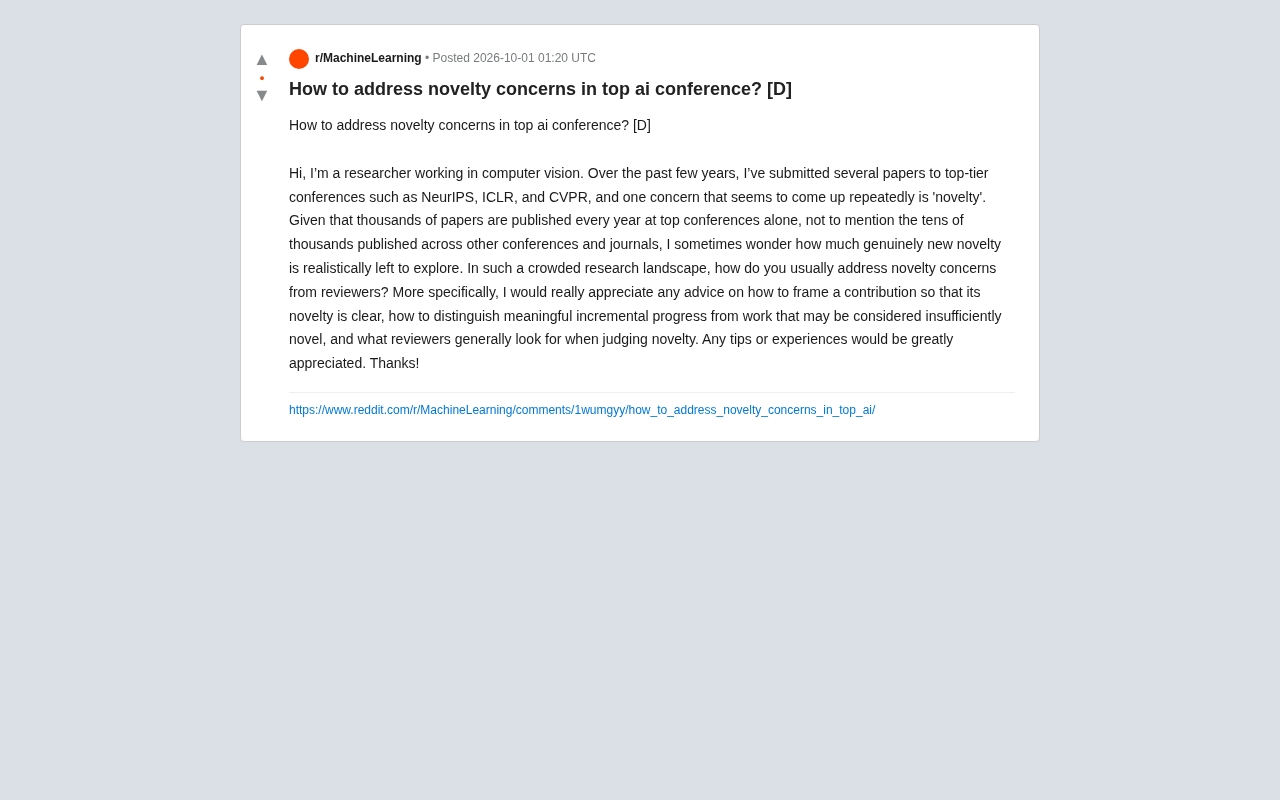
At top-tier venues like NeurIPS, ICLR, and CVPR, "insufficient novelty" is consistently one of the most common reasons for rejection. A computer vision researcher recently posed a question on Reddit that resonated with many: when tens of thousands of papers flood top conferences every year — not to mention other venues and journals — how much is there left that's truly new? And in such a crowded research landscape, how do you actually convince reviewers that your work has value?
This question cuts to one of the most subjective and frustrating aspects of academic peer review. Drawing on this discussion, this article lays out a practical framework for addressing novelty concerns.
Why "Novelty" Has Become the Hardest Bar to Clear
Novelty causes so much anxiety because it's fundamentally vague. Unlike experimental results, reproducibility, or theoretical rigor, there's no universal metric for it. A paper can have a clean method and solid experiments, yet a single reviewer comment — "the contribution is too incremental" — is enough to get it rejected.
The original post raised a very real issue: research fields are already extremely saturated. High-volume areas like computer vision produce enormous numbers of papers each year, and similar ideas are routinely explored in parallel by different teams. In this environment, novelty in the absolute sense — "no one has ever done this before" — is nearly nonexistent. Most genuinely valuable work is, at its core, an extension of what came before.
The real question therefore shifts: it's not "how new is your work," but "can you articulate your contributions clearly and compellingly." Many papers that get dinged for insufficient novelty don't have a problem with the ideas themselves — they have a problem with framing and positioning.
This situation has become especially pronounced since the deep learning explosion. Since AlexNet triggered a paradigm shift in 2012, submission volumes at venues covering computer vision and NLP have grown exponentially — CVPR alone went from roughly 1,500 submissions in 2012 to over 9,000 in 2023. Reviewer pools haven't scaled proportionally in size or quality, leading to inconsistent standards, and "novelty" — the most elastic dimension — has become a convenient catch-all reason for rejection. Meanwhile, the widespread adoption of large pretrained models has dramatically raised baseline performance on many tasks, making pure performance gains increasingly unimpressive. This has only intensified the demand for contributions that are "non-obvious."
The Different Forms Novelty Can Take
When reviewers talk about "novelty," they're actually referring to several distinct dimensions. Understanding this helps you identify where your work fits.
Methodological Novelty
Proposing a new model architecture, loss function, training strategy, or algorithm. This is the most readily recognized form of novelty, but also the hardest to achieve — genuine methodological breakthroughs are rare by definition.
Problem Novelty
Introducing a new problem, task, or setting that hasn't been adequately studied. Even if the technical tools you use are relatively mature, convincingly arguing that "this problem matters and remains unsolved" constitutes a real contribution.
Insight Novelty
Through systematic analysis, surfacing phenomena, failure modes, or counterintuitive conclusions that the community has previously overlooked. Work like this may not propose a new method, yet it can change how the research community thinks about a problem.
Combination and Application Novelty
Combining existing techniques in non-obvious ways, or transferring them to an entirely new domain to solve a practical challenge. The key is demonstrating that the combination is "non-trivial" — not just stacking components together.
Identifying which category your work falls into, and then organizing your paper's narrative around that, is often more effective than chasing a "completely new method" that may not exist.
How to Frame Your Contributions
Novelty is, to a large extent, a presentation problem. The same work, written differently, can produce completely opposite review outcomes.
State your contributions up front. In the introduction, use bullet points to explicitly enumerate what the paper contributes. Don't make reviewers guess. Vague framing directly hurts novelty perception.
Precisely articulate your differences from related work. Don't just list prior work — clearly explain "what they did, where they fell short, and how your work fills that gap." Reviewers largely assess novelty by comparing your work to the closest existing papers. Doing that comparison thoroughly yourself is far better than letting a skeptical reviewer go hunting for similar papers on their own.
Back up novelty claims with results. If you claim your method is new, use ablation studies to show that the new components actually drive improvements. If you claim your problem is new, show experimentally that existing methods fail on it. Novelty claims without supporting evidence come across as hollow.
Explain why it matters. The line between "meaningful incremental work" and "insufficiently novel work" often comes down to whether the former addresses a real and recognized pain point. Situate your work within the broader research narrative and explain what it advances.
Distinguishing "Meaningful Incremental Progress" from "Insufficient Novelty"
A core question in the original post was: how do you tell the difference between valuable incremental progress and work that will get dismissed as not novel enough?
The difference usually isn't about the size of the change — it's about the significance of the change. A small modification that reveals a deep insight, or that produces a substantial and interpretable improvement on an important benchmark, is still valuable incremental work. Conversely, a seemingly complex change that only produces marginal metric gains with no explanation for why it works will likely get categorized as "not new enough."
What the reviewing community broadly values is whether a paper gives readers something transferable — whether that's a new method, a new understanding, or a new direction worth pursuing. If someone can walk away from your paper with something useful, the case for novelty becomes much stronger.
Strategies for Responding to Reviewer Concerns
When a reviewer does raise novelty concerns, the rebuttal phase still offers room to recover.
The effective approach is to respond directly and specifically, not defensively. If a reviewer thinks your work resembles a particular paper, explicitly spell out the substantive differences in setup, method, or results. If a reviewer has underestimated your contribution, provide additional experiments or analysis that highlights the value. Grounding your novelty argument in verifiable facts is far more persuasive than repeatedly asserting "our work is novel."
It's worth acknowledging that novelty review always carries a subjective component, and sometimes good papers get rejected due to bad luck. In those cases, refining the narrative based on feedback and resubmitting elsewhere is a completely normal part of a research career.
It's also worth knowing that rebuttal carries very different weight across venues — this affects how you should allocate your effort. ICLR's discussion phase is relatively transparent, with public back-and-forth between authors and reviewers, and opinion changes are fairly common. NeurIPS and ICML rebuttals have moderate influence. CVPR, ECCV, and other vision venues have traditionally seen rebuttals make less of a difference, with lower rates of reviewers changing their scores. Some researchers have estimated that around 20–30% of initial rejections at ICLR get reversed during the rebuttal phase, while at certain other venues that figure is under 10%. This means that investing in a thorough novelty argument before submission is generally more reliable than counting on a rebuttal to save you.
Conclusion
In a heavily saturated research landscape, pursuing novelty in an absolute, "never-been-done-before" sense is neither realistic nor necessary. What ultimately determines a paper's fate is usually whether the researchers can clearly position their contributions, honestly compare them against prior work, and support their novelty claims with solid evidence. Novelty is less a question about ideas and more a question about communication — make your value clear enough that reviewers can see it without having to work for it.
Related articles
uGAP: An AI Platform Unifying 100+ African Geospatial Datasets
uGAP is an African geospatial AI platform by a University of Cape Town team, unifying 120+ African datasets with a Python SDK for discovery, processing, and model training, already used in cyclone flood mapping.

Cursor Can Now Control Your Computer: AI Agents Can Drive Desktop Apps for Testing
Cursor adds desktop control: AI agents can drive desktop apps like the iOS Simulator to test their own features. We analyze the impact on dev workflows, possible technical approaches, and reliability concerns.

Vibecoding a Custom Inference Engine: High Hopes, Harsh Reality
A Reddit developer shares the real experience of vibecoding a custom inference engine: running GGUF Q4 models in the browser with WebGL2 and GLSL, only to fall into tokenizer debugging hell. This article analyzes the engineering challenges of browser-side LLM inference and why cloning llama.cpp is the more rational choice.