How to Improve Your Agent System Building Skills? Reddit Developers Share Practical Experience

Reddit community summary: breaking down the harness, data-driven iteration, quantitative evaluation, and hands-on practice are key to improving agent building skills.
The article discusses a Reddit thread on improving agent system building skills and outlines four core paths. First, when designing a harness, break down modules such as planner, executor, tool layer, memory, and evaluator, understand their trade-offs, and build progressively from a minimal viable version. Second, iterative improvement requires systematically collecting failure patterns, locating weak points through labeling and statistical analysis, supplemented by unit tests and trace replay. Third, evaluating changes requires defining quantitative metrics (such as success rate and average steps), continuously measuring on diverse task sets, and avoiding overfitting. Finally, learning resources include classic papers, open-source project source code, technical blogs, and hands-on experience building different use cases from scratch. The author emphasizes that coding agent tools may provide outdated advice, and real growth comes from the cycle of hands-on design, failure, analysis, and improvement.
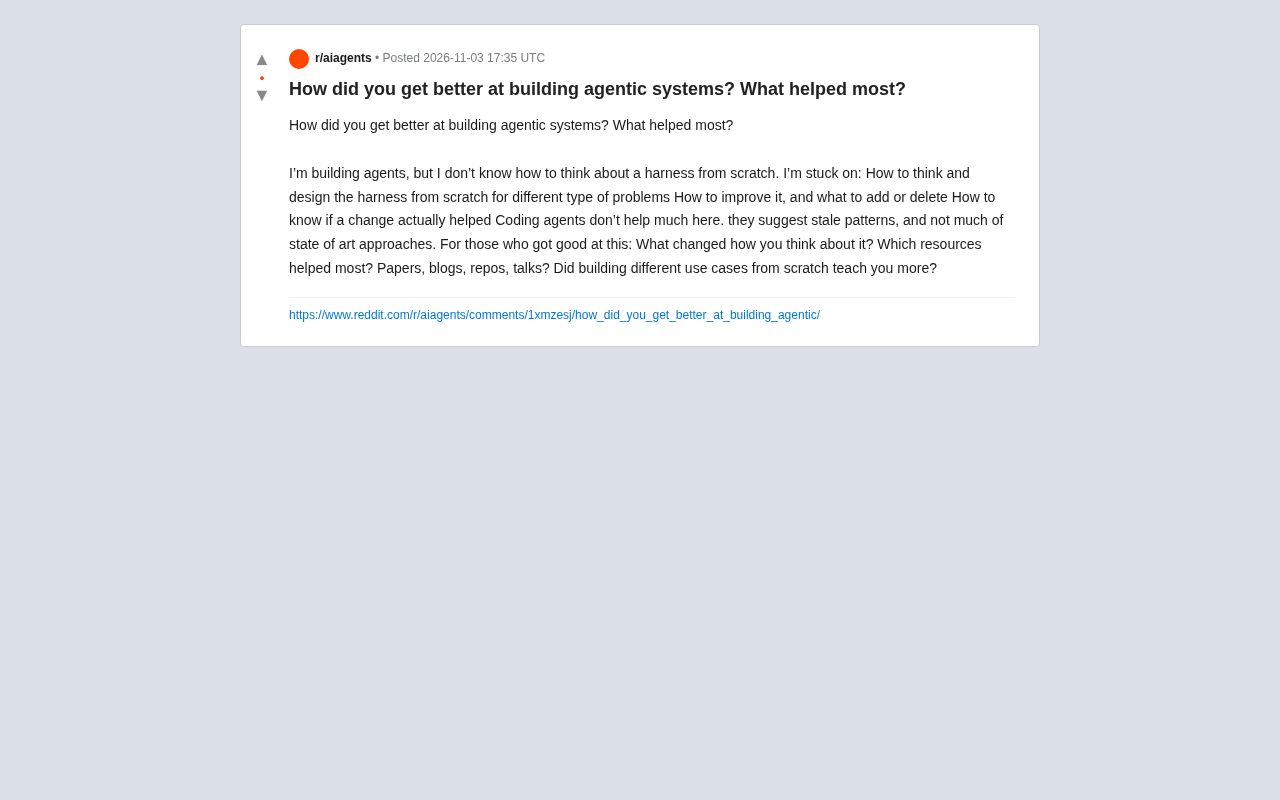
Introduction: The Core Confusion in Building Agent Systems
On Reddit, a developer raised a question that struck a chord: how do you get better at building agent systems? He admitted that although he was developing agents, he felt lost when it came to "designing a harness (execution framework) from scratch," "how to iteratively improve it," and "how to evaluate the effect of changes." More frustratingly, existing coding agent tools were of no help here—their suggestions were often based on outdated patterns rather than state-of-the-art methods.
This question hits a pain point for many AI engineers. As agent systems move from experimentation to production, builders need more than the ability to call LLM APIs—they need a systematic engineering mindset. This article combines community discussions and practical experience to outline several proven paths for improvement.
Designing a Harness from Scratch: Understanding Core Components and Trade-offs
The harness is the skeleton of an agent system. It determines how the agent perceives the environment, calls tools, remembers history, and makes decisions. In the Reddit discussion, several senior developers emphasized that you shouldn't reinvent the wheel from scratch, but first deeply understand the design philosophy of existing open-source frameworks.
First, break down the typical modules of a harness: Planner, Executor, Tools, Memory, and Evaluator. Each module involves design trade-offs. For example, should the planner use ReAct-style step-by-step reasoning, or plan first and then execute? Should the tool layer use static registration or dynamic discovery? These choices directly affect the agent's flexibility and controllability.
One developer shared: "I spent a week reading the source code of LangChain and AutoGPT, then tried to draw data flow diagrams for each module. This process helped me understand which components are essential and which can be trimmed as needed." Another suggested starting with a minimal viable harness—containing only a planner and tool invocation—and then gradually adding memory and evaluation modules based on specific problems. This "progressive construction" approach avoids over-engineering.
Core Ideas of ReAct and Reflexion
ReAct (Reasoning + Acting) is an agent paradigm that interleaves reasoning and action: the model first outputs a thought (Thought), then decides to execute an action (Action), observes the result (Observation), and then proceeds to the next round of thought. This loop allows the agent to dynamically adjust strategies in uncertain environments rather than generating a complete plan all at once. The limitation of ReAct is its lack of reflection on its own failures.
Reflexion builds on this by introducing a "self-reflection" mechanism: after a task failure, the agent uses a language model to review the failed trajectory, generate improvement suggestions, and store them in memory for injection as context in the next attempt. This is equivalent to letting the agent perform "trial-and-error learning" at the language level without updating model weights. Understanding these two paradigms helps clarify when designing a planner: when is dynamic action needed, and when is cross-trial experience accumulation needed.
Design Positioning Differences Between LangChain and AutoGPT
LangChain is more like a component library, providing abstractions for LLM calls, tool wrappers, memory, and chain orchestration, which developers can freely combine; AutoGPT is an end-to-end autonomous agent implementation with built-in goal decomposition, task queues, and long-term memory—ready to use out of the box but less customizable. When reading the source code, focus on their different trade-offs in tool registration, context management, and loop control, rather than copying their implementations.
Iterative Improvement: Learning from Failure Cases
How do you improve a harness? The community consensus is: establish a tight feedback loop. Every agent execution failure is a clue for improvement. But the key is to systematically collect failure patterns rather than randomly patching.
An experienced developer mentioned that he labels each failure case (e.g., "tool call error," "confused planning logic," "context loss") and periodically analyzes the label distribution. "I found that 80% of failures were concentrated in tool call parameter errors, so I focused on optimizing tool descriptions and parameter validation, and the overall success rate improved significantly." This data-driven approach is more effective than intuitive modifications.
In addition, unit tests and simulated environments are also crucial. Writing test cases for the harness and simulating various edge conditions (such as tool timeouts or abnormal return data) can expose design flaws in advance. Some developers suggest using a "replay" mechanism: record the complete execution trajectory of the agent, then replay it offline and inject faults to observe the harness's recovery capability.
Trace Replay and Fault Injection
Trace replay refers to serializing and recording all intermediate states (inputs/outputs, tool call parameters, return results, model decisions) generated during a complete agent execution to form a reproducible "execution log." During offline replay, the harness replays these records in the original order, and developers can pause, modify, or inject exceptions at any node to observe subsequent behavior.
Fault injection is the deliberate creation of edge conditions during replay, such as making a tool return a timeout error, return incorrectly formatted data, or suddenly become unavailable. The benefit is that you can test the harness's error recovery logic without a real environment and precisely control variables. Compared with unit tests, trace replay is closer to real execution paths and is suitable for verifying state consistency in multi-step interactions. In practice, replay can be combined with labeled failure analysis—recording the harness's recovery behavior after each fault injection and gradually accumulating a regression test set.
Evaluating the Effect of Changes: Establishing Quantifiable Metrics
"How do you know if a change is actually useful?" This is the hardest part of the original question. The community's answer points to a core principle: define clear evaluation metrics and continuously measure them on a representative task set.
Common metrics include task success rate, average number of execution steps, tool call accuracy, and human-evaluated response quality. But note that the weights of metrics differ by task type. For example, for information retrieval agents, accuracy is prioritized; for automation operation agents, execution efficiency and error recovery capability are more important.
One developer shared his approach: build an evaluation set of 50 diverse tasks, run a full evaluation after each harness modification, and compare metric changes. "If the success rate improves but the average number of steps increases significantly, I'll weigh whether it's worth it." He also emphasized avoiding overfitting to the evaluation set and regularly updating tasks to reflect real scenarios.
Overfitting to the Eval Set
When developers repeatedly tune the harness on the same fixed task set, the system may gradually "memorize" specific patterns of that set, leading to inflated metrics but degraded generalization in real scenarios. This is essentially the same as overfitting in machine learning: the evaluation set becomes a training signal.
Mitigation methods include: regularly rotating or expanding evaluation tasks, reserving a portion of tasks not used in daily iteration (similar to a held-out test set); stratified sampling by task type to ensure diversity; focusing on trade-off changes among metrics rather than a single value; and introducing human blind evaluation as a supplement. In community practice, some adopt a "dual-set strategy"—a fast feedback set for daily iteration and a low-frequency updated gold standard set for periodic validation. Separating the two can effectively reduce the risk of overfitting.
Learning Resources and Practical Paths
Which resources helped the most? The Reddit discussion mentioned several types of high-value materials:
- Classic papers: such as ReAct, Reflexion, and Toolformer, which laid the foundational paradigms for agent design.
- Open-source projects: the source code of LangChain, AutoGPT, and BabyAGI are living textbooks for learning harness design, but note their limitations—some implementations are outdated.
- Technical blogs: Lilian Weng's agent overview, Anthropic's agent design guide, etc., provide systematic perspectives.
- Hands-on projects: multiple developers emphasized that building different use cases from scratch (such as customer service agents, code generation agents, data analysis agents) is the fastest way to improve. Each new use case forces you to rethink the balance between generality and specificity of the harness.
One interviewee summarized: "Reading ten blogs is not as good as building one project yourself. But after finishing the project, looking back at theory will deepen your understanding." This cycle of "practice-theory-practice" seems to be the community-recognized growth path.
Conclusion: Key Thinking for Agent Engineering
Improving agent system building skills is essentially an engineering practice problem. It requires developers to have systematic design thinking, data-driven iteration habits, and an open mindset for continuous learning. The Reddit discussion reveals a consensus: there is no silver bullet, but by breaking down the harness, establishing feedback loops, quantifying evaluation, and diversifying hands-on practice, anyone can gradually improve.
For developers who have been "led astray" by coding agent tools, the advice is: treat them as aids, not authorities. Real improvement comes from the cycle of hands-on design, failure, analysis, and improvement.
One-line Summary
Reddit community summary: breaking down the harness, data-driven iteration, quantitative evaluation, and hands-on practice are key paths to improving agent building skills.
Paragraph Summary
The article centers on a Reddit discussion about how to improve agent system building skills and outlines four core paths. First, when designing a harness, break down modules such as planner, executor, tool layer, memory, and evaluator, understand their trade-offs, and build progressively from a minimal viable version. Second, iterative improvement requires systematically collecting failure patterns, locating weak points through labeling and statistical analysis, supplemented by unit tests and trace replay. Third, evaluating the effect of changes requires defining quantitative metrics (such as success rate and average number of steps), continuously measuring them on diverse task sets, and avoiding overfitting. Finally, learning resources include classic papers, open-source project source code, technical blogs, and hands-on experience building different use cases from scratch. The author emphasizes that coding agent tools may provide outdated advice, and real growth comes from the cycle of hands-on design, failure, analysis, and improvement.
Related articles
 Tech Frontiers
How Do You Stop AI Agent Emails From Sounding Like AI? One Developer's Solution
AI agent emails always sound like AI? A developer shares reright: a rewrite step that validates numbers, names, and links, preventing humanizers from tampering with key info. Test data and integration details inside.
 Tech Frontiers
Starlink Mobile: SpaceX's Carrier Ambitions and the 5G Deployment Challenge
SpaceX plans to make Starlink Mobile a mainstream carrier, deploying thousands of direct-to-cell satellites and building a terrestrial 5G network to challenge AT&T, Verizon, and T-Mobile. This article analyzes its dual-track strategy, 5G deployment challenges, and the competitive landscape.
 Tech Frontiers
OpenAI Raises Another $11 Billion, Valuation Hits $1.25 Trillion
OpenAI has raised an additional $11 billion in a new funding round at a valuation of $1.25 trillion. The deal is not yet closed and is expected to be completed in the coming weeks, further consolidating its leading position in AI.