How to Keep the Joy of Programming Alive in the Age of LLMs

LLMs are changing what makes programming fun — here's how to protect what matters.
LLMs dramatically boost coding efficiency but risk eroding the flow and creative satisfaction that make programming enjoyable. A widely discussed Hacker News thread reveals this is a shared pain point: whether the fun survives depends on where developers place AI in their workflow. The article outlines four strategies — using AI selectively, treating it as an accelerator not a replacement, finding new satisfaction in high-level architectural thinking, and deliberately keeping handcrafted personal projects. At a deeper level, it's a question of developer identity: as the barrier to writing code falls, the question of *why* we code becomes more urgent than ever.
When Programming Meets Large Language Models
Large language models (LLMs) are reshaping how software gets built. From code completion to generating entire functions, AI assistants have made writing code more efficient than ever. But for many developers, this productivity boost comes with a conflicting emotion: the satisfaction of solving hard problems and building systems from scratch — the very things that made programming fun — seems to be fading.
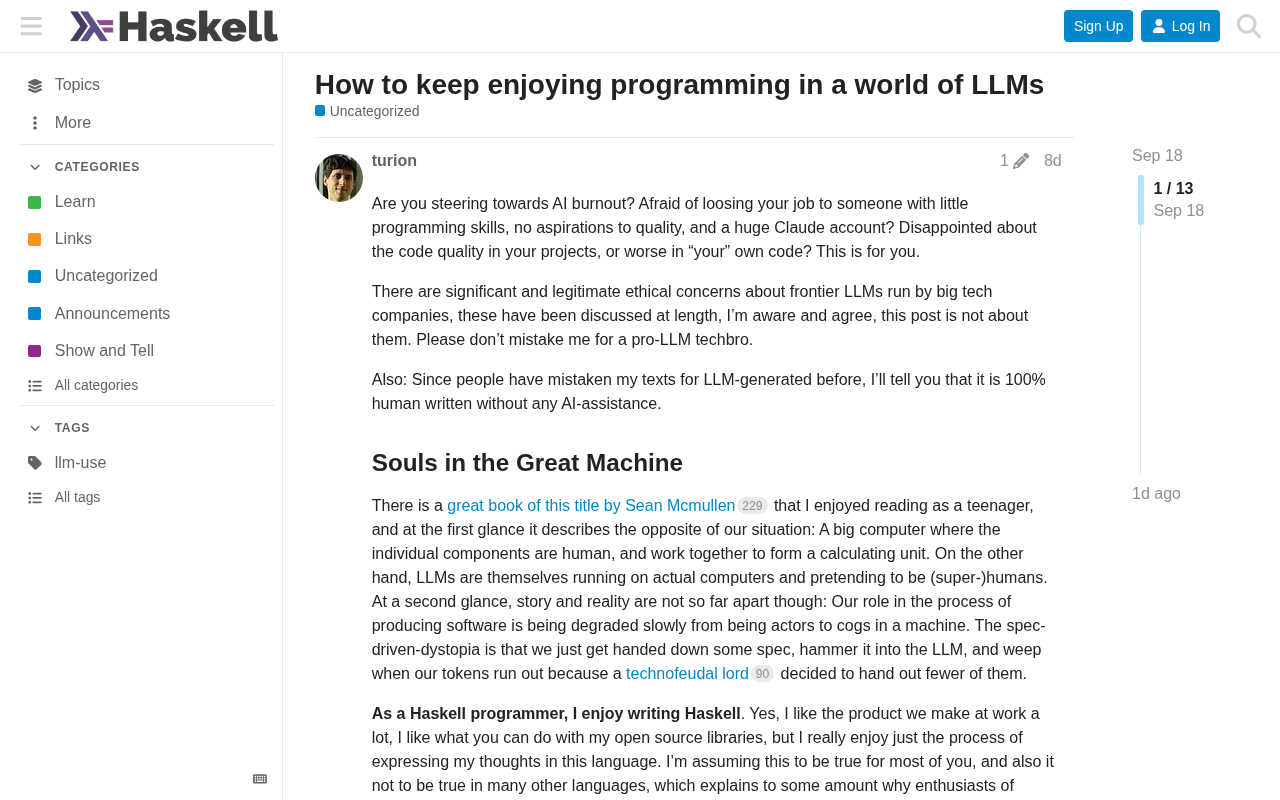
This article sparked lively debate on Hacker News (82 points, 136 comments), touching on a real and widespread pain point: how do we continue to find joy in programming in a world saturated with LLMs? The intensity of that discussion alone signals that this isn't the anxiety of a few outliers — it's a shared growing pain felt across the entire developer community.
The Tension Between Efficiency and Enjoyment
The joy of programming often comes from two places: the intellectual challenge of solving problems, and the creative satisfaction of building something from nothing. LLMs boost output efficiency, but they may undercut both of these experiences at the same time.
When an AI can instantly generate working code, developers shift from "thinking about how to implement something" to "reviewing and patching AI output." That shift leaves some people feeling hollow — they miss the moments of wrestling with an algorithm until a solution finally clicks. Comments in the thread reflect a common worry among experienced developers: not that they'll be replaced, but that the most interesting parts of their job are being automated away, leaving only the tedious work of proofreading and integration.
On the other hand, some developers see it differently: LLMs have freed them from repetitive boilerplate, letting them focus their energy on genuinely valuable work like architectural design and creative problem-solving. Whether the fun disappears depends largely on where you place LLMs in your workflow.
Psychologist Mihaly Csikszentmihalyi's concept of Flow offers a useful framework for understanding this sense of loss. Flow is an optimal state of deep immersion in a challenging task — and it's triggered when task difficulty closely matches personal skill level. When LLMs dramatically reduce the friction of programming tasks, developers may lose their on-ramp to flow altogether: waiting for AI to generate output, reviewing code line by line — these activities differ fundamentally from the deep focus of solving a problem yourself, both in rhythm and cognitive load. This explains why some developers report feeling more drained and less accomplished even as they become "more productive." Efficiency gains don't automatically translate to a better experience.
Ways to Keep Programming Fun
Use AI Selectively
Not every task needs LLM involvement. For projects you genuinely enjoy digging into — learning a new language, exploring a complex algorithm, or building something purely for fun — you can simply turn off the AI assistant and return to the flow state of writing code by hand. Treating LLMs as an optional tool rather than a default dependency is the first step many developers take toward reclaiming their enjoyment.
Use AI as an Accelerator, Not a Replacement
Position LLMs as assistants for tedious tasks: generating test cases, writing documentation, handling format conversions, or quickly scaffolding prototypes. This way, you get the efficiency benefits while keeping the core design and thinking for yourself. The key is staying in the driver's seat, rather than passively accepting whatever the AI produces.
Redefine What "Interesting" Means
As AI takes on more code generation work, developer value and satisfaction are migrating to higher levels of abstraction — system architecture, requirements modeling, technology selection, performance trade-offs. These domains require deep understanding and judgment, which LLMs can't easily replicate in the near term, and they may well become a new source of genuine satisfaction.
Keep Some Projects Purely Handcrafted
Many developers in the discussion mentioned deliberately maintaining personal projects where they use no AI at all — a kind of protected space for pure craft. Just as a carpenter might enjoy hand-planing wood even when power tools are available, programming as a craft has an intrinsic joy worth preserving and protecting.
The Deeper Signal Behind This Discussion
The reason this article resonated so broadly is that it's touching on more than just tool preferences — it's about the reconstruction of developer identity. When the barrier to writing code drops significantly, the question "why do I write code?" becomes more important than it's ever been.
For those who code as a livelihood, embracing LLMs to boost productivity is the rational choice. For those who code out of passion and self-expression, actively guarding the craftsperson's joy against the tide of efficiency is something that requires conscious effort. These two positions aren't mutually exclusive — perhaps the most mature approach is: leverage AI to get more done at work, while preserving space for the act of creating by hand in what you love.
This crisis of developer identity is hardly new. Every major wave of tooling innovation has triggered similar anxieties: from assembly language to high-level programming languages, from the command line to graphical IDEs, from local development to cloud-based collaboration platforms. Each time, people worried that "real programming" was dying — and each time, the result was an upward shift in the skill center of gravity, not its disappearance. Harder, more abstract problems surfaced as the new frontier. The current conversation around LLMs is fundamentally a continuation of that historical arc. What's different this time is the speed and breadth of the change, leaving practitioners with a narrower window to adapt and reposition themselves — which is why the anxiety feels more concentrated and acute.
Final Thoughts
LLMs won't kill the joy of programming, but they are changing where that joy comes from and what form it takes. Rather than passively worrying, the better move is to actively redesign how you collaborate with AI. Let it handle the parts you don't enjoy, and keep the parts you truly love for yourself — that's probably the most practical answer for continuing to find meaning in programming in this new era.
Programming has never just been about typing out code. It's a process of thinking, creating, and solving problems. That essence won't change, no matter how the tools evolve.
Related articles

CSS Anchor Positioning: A New UI Positioning Approach Without JavaScript
A deep dive into CSS Anchor Positioning: from anchor-name and position-anchor to the anchor() function, position-area shorthand, position-try-fallbacks, anchor-size, and upcoming anchor queries.

New AI Chart Interaction: Continuous Follow-up Questions and Visualization in Conversation
Explore a new AI interaction method for continuously generating charts in conversation. Use the /visualize command to ask follow-up questions and visualize answers in the same chat window, improving data analysis efficiency.

Cursor Merges Into X Subscription: Paid Plans Share Unified Usage Pool, Grok Model Coding Usage Doubled
Cursor joins The X Subscription with a unified usage pool and doubled Grok coding quota. Third-party models shift to API pricing. Existing users can keep or migrate plans.