How to Learn Programming in the Age of LLMs: Building Real Capability with AI Assistance
LLMs lower the bar to writing code, making deep understanding and engineering judgment more valuable than ever.
Large language models are reshaping how people learn to program: traditional friction costs like syntax memorization and debugging are dramatically reduced, letting beginners reach working code faster. But this convenience carries a risk — the "it runs, good enough" mindset can cause learners to skip the processes that build real engineering ability. The key is to treat LLMs as scaffolding rather than a crutch: think independently before consulting AI, ask for explanations not just answers, debug deliberately, and read great open-source code. As AI handles more of the coding itself, the competitive edge for future programmers will shift toward problem definition and system-level judgment — areas where engineering thinking becomes more valuable, not less.
LLMs Are Reshaping the Fundamental Logic of Learning to Program
When large language models (LLMs) can generate runnable code directly from natural language descriptions, the meaning of learning to program is being redefined. A beginner today can ask an AI to produce sorting algorithms, REST endpoints, or even complete web scrapers in seconds — something that would have taken weeks of study just a few years ago. That raises an unavoidable question: if AI can write code, do people still need to learn programming?
The answer isn't simple. A discussion on Hacker News about "learning programming in the age of LLMs" cuts to a core tension: AI has lowered the barrier to writing code, while simultaneously raising the value of understanding code and mastering systems. Plenty of people can use AI to generate code; the ones who can judge whether that code is correct, secure, and maintainable remain scarce.
The Bar to Entry Has Dropped — But the Value of Deep Understanding Has Risen
Much of the pain traditionally associated with learning to program came from "friction costs" — memorizing syntax, configuring environments, and deciphering cryptic error messages. LLMs are uniquely good at eliminating exactly this kind of friction: they explain obscure errors, autocomplete API calls you can't quite remember, and produce boilerplate code on demand. For beginners, this means experiencing the satisfaction of "getting the program to run" far earlier in the journey, smoothing out the steep front end of the learning curve.
But that's also where the danger lies. When code can be generated so easily, learners can get stuck at the surface level — copy, paste, it runs, good enough — and skip the process that actually builds engineering ability: understanding how data structures affect performance, why concurrency goes wrong, what makes an abstraction good. These capabilities can't be outsourced to AI, because they are fundamentally about judgment, and judgment can only be built by making mistakes yourself.
The "Generation Effect" from cognitive science helps explain this risk: when learners actively produce an answer, memory encoding and depth of understanding are significantly better than when they passively receive one. AI handing you the code neatly sidesteps this process. An even subtler problem is overconfidence — code that runs is not the same as code that is correct. Beginners often lack the metacognitive ability to ask "does this still hold at the edge cases?" and that ability only develops after repeatedly experiencing the humbling lesson that code can run and still be wrong.
AI Should Be a Scaffold, Not a Crutch
The real distinction comes down to how you use it. Learners who treat LLMs as a crutch are helpless the moment AI can't answer or answers incorrectly. Learners who treat LLMs as scaffolding use them to accelerate exploration, validate hypotheses, and expand their horizons — while always keeping ownership of the code.
A few practical principles are worth adopting:
- Think first, then ask AI: Before having AI generate code, try solving the problem with your own approach. Then compare your solution to the AI's. That gap is where the learning happens.
- Ask for explanations, not just answers: Have AI walk through its code line by line, turning generation into a mini pair-programming session.
- Deliberately introduce bugs and debug them: Break things on purpose and train yourself to locate and fix the problem independently, rather than handing every bug off to AI.
- Read high-quality open-source code: AI-generated code tends to be stylistically mediocre and lacking in context. Real engineering taste comes from reading what skilled humans have built.
The concept of "scaffolding" comes from educational psychologist Vygotsky's Zone of Proximal Development: learning is most effective in the zone where a learner can't quite manage alone, but can succeed with appropriate support. Good scaffolding withdraws as the learner's ability grows. Treating LLMs as scaffolding means consciously managing your dependency — deliberately avoiding AI on tasks you can already handle independently, using AI to open up territory beyond your current reach, and then going back to fill in the understanding. This kind of dynamic calibration is far more aligned with how learning actually works than a binary "use it" or "don't use it" stance.
Where Will the Core Competencies of Future Programmers Lie?
If AI takes over a large portion of code writing, human value will migrate upstream and downstream. Upstream is problem definition — figuring out exactly what problem needs solving, what the constraints are, and how to decompose it. This requires deep domain understanding and the ability to think in abstractions. Downstream is system judgment — evaluating the quality of AI output, making trade-offs between approaches, and taking responsibility for the overall architecture. This requires experience and a broad view of the whole.
In other words, what will be scarce isn't typists — it's engineers who can ask good questions, make good decisions, and own the outcomes. LLMs make coding cheap; they make engineering thinking more valuable than ever.
For anyone just starting out, this shift calls for a rebalancing of priorities: syntax can be picked up faster, but you should invest more effort in computer science fundamentals, systems design, and critical thinking. These are precisely the areas where LLMs are hardest to replace — and where the answers AI gives most need to be scrutinized by a human.
The "system judgment" that experienced engineers bring is what the field often calls architectural sensibility: an intuition for the trade-offs between latency and throughput, an understanding of data consistency boundaries, a sensitivity to module coupling, and the ability to anticipate bottlenecks as a system scales. Developing this kind of judgment typically requires having lived through the full lifecycle — building from scratch, shipping to production, and being on call when things break. AI can generate locally correct code snippets today, but it has almost no sense of how a system evolves across time and scale. That is the irreplaceable core of what human engineers bring.
Conclusion: The Tools Have Changed. The Essence of Learning Hasn't.
LLMs have changed the path and pace of learning to program, but not its core: programming has always been a craft of clear thinking and problem solving. AI is the most powerful learning accelerator in history — provided you treat it as a partner in exploration rather than an excuse to avoid thinking. In an age when AI can write code, the most valuable capabilities are precisely the ones AI cannot write.
Related articles

AI Agent Terminology Too Confusing? One Interactive Concept Map to Untangle 40+ Core Terms
Confused by AI Agent terms like MCP, harness, orchestration, and skills? AI Concept Atlas is an interactive map visualizing 40+ concepts and their relationships, with cited sources.

Meta's Broken Promise: Community Demands to Know Where the Muse Spark Weights Are
Meta promised to open-source Muse Spark model weights over a month ago, but still hasn't delivered. The community questions how this squares with Zuckerberg's "can't delay even a month" stance.
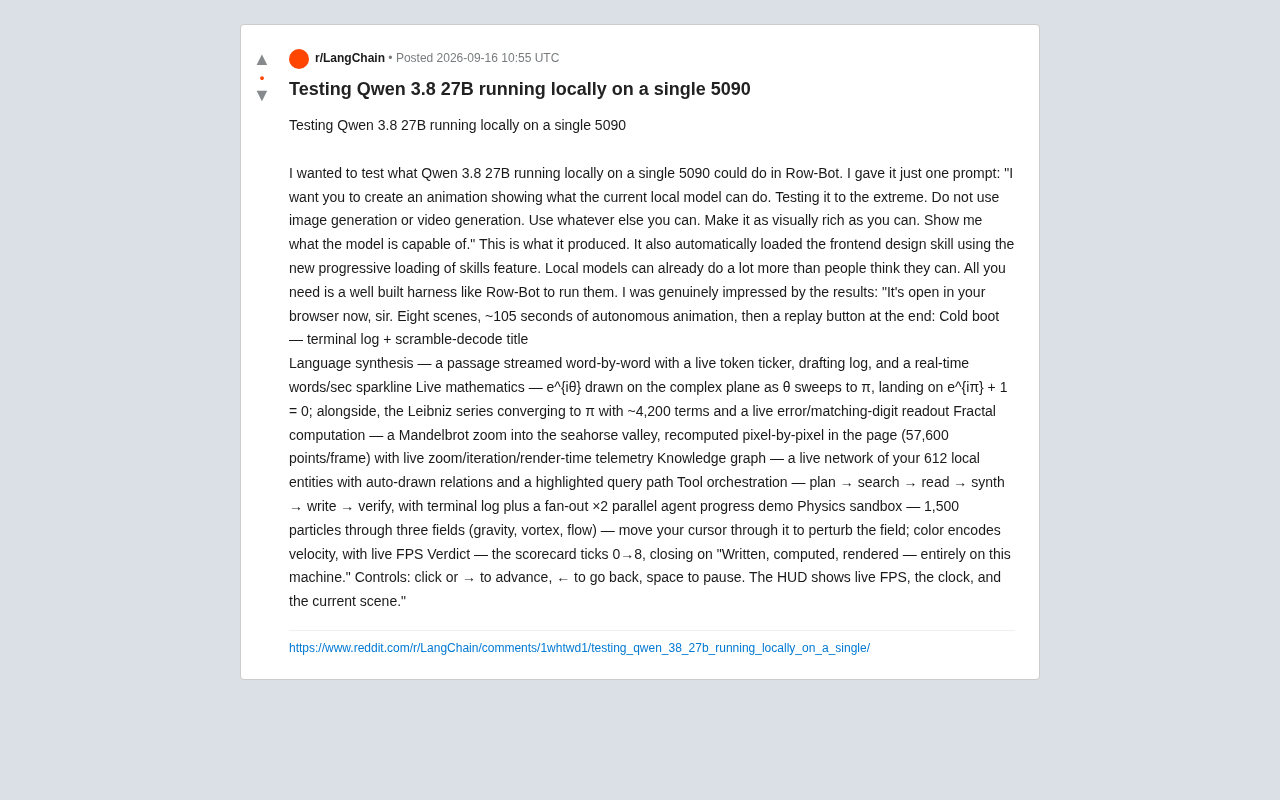
Running Qwen3 27B Locally on a Single RTX 5090: What Can It Actually Do?
A developer runs Qwen3 27B locally on a single RTX 5090 via the Row-Bot Agent framework, generating an 8-scene, 105-second interactive animation from one prompt — including real-time math, fractals, and physics.