How to Level Up Your Angular Skills by Contributing to Open Source Projects
A practical guide to leveling up your Angular skills by contributing to open source projects.
This article explores how contributing to open source Angular projects can help developers bridge the gap between tutorials and real-world engineering. It covers the benefits of engaging with real codebases, how to find suitable projects in both the official Angular ecosystem and third-party community, and practical tips for making your first contributions—from starting small to communicating effectively with maintainers.
The Value of Learning Angular Through Open Source Projects
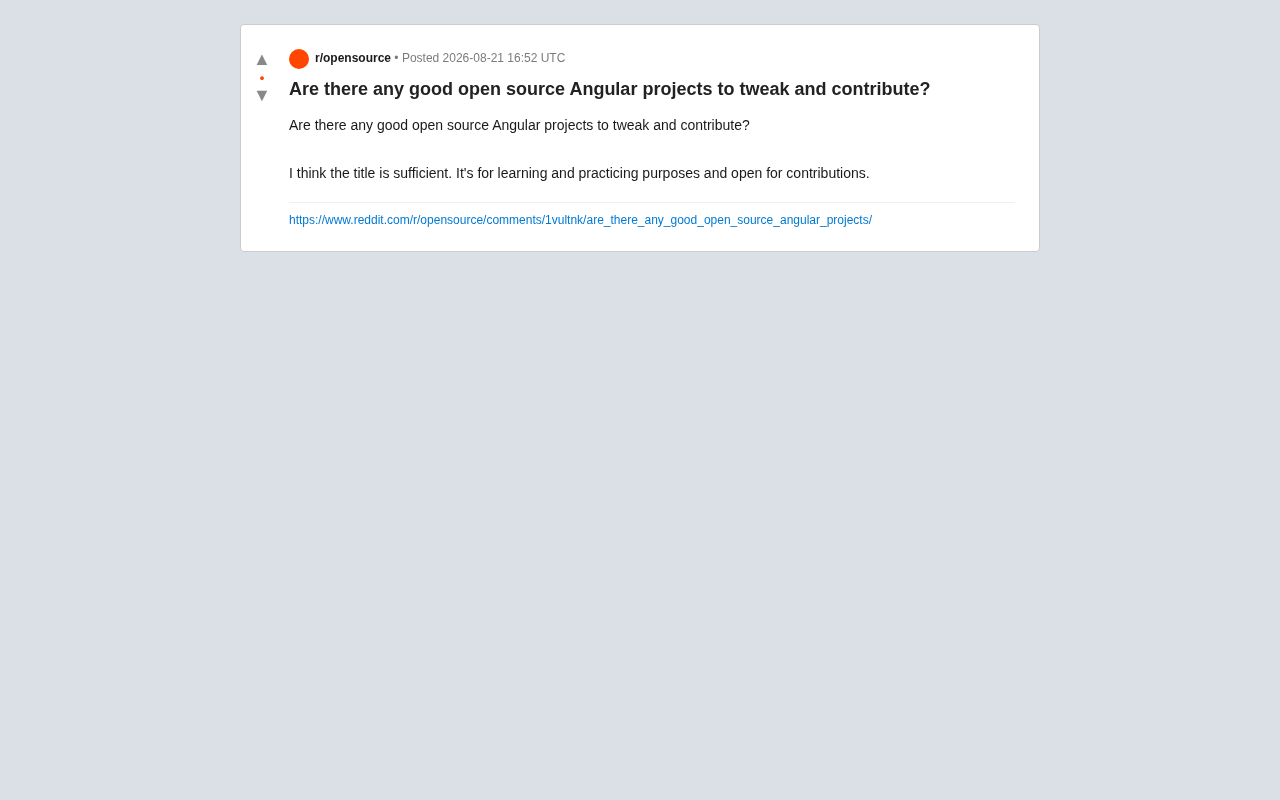
In Reddit's Angular community, a common question keeps coming up: Are there any quality open source Angular projects worth contributing to? The intent behind this question is clear—learning and practicing the Angular framework by hands-on coding, optimizing, and contributing to real projects.
This seemingly simple question actually touches on a core challenge in every frontend developer's growth journey: How do you bridge the gap between tutorials and real-world engineering? Reading documentation and watching video tutorials can help you grasp basic syntax, but true engineering skills—including modular architecture, state management, performance optimization, and coding standards—can only be cultivated by working within real, reasonably-sized codebases.
Why Contributing to Open Source Is the Best Path to Improving Your Angular Skills
Exposure to Real-World Engineering Complexity
Personal practice projects are usually limited in scope and rarely cover the scenarios found in enterprise-grade applications. Mature open source projects, on the other hand, often embody complete engineering practices: proper use of dependency injection, reactive programming patterns with RxJS, Angular module organization, and writing unit tests and end-to-end tests. These are areas that beginners rarely encounter proactively in their own small projects.
Among these, Dependency Injection (DI) is one of Angular's core design patterns. It allows components to avoid directly creating instances of the services they depend on—instead, the framework's Injector manages and distributes them centrally. This decoupling makes code easier to test and maintain, since you can easily swap real services for mock objects in unit tests. RxJS (Reactive Extensions for JavaScript) is the foundational library Angular uses for handling asynchronous data streams. Through the Observable pattern, it provides a unified abstraction for HTTP requests, user events, state changes, and more as composable data streams. Developers can use operators like map, filter, switchMap, and debounceTime to declaratively transform these streams—offering significant advantages over traditional callbacks and Promise chains when dealing with complex async scenarios (such as search autocomplete or real-time data push). In real open source projects, you'll frequently see both of these technologies used extensively, providing intuitive experience that tutorials alone can't deliver.
Learning Community Collaboration Standards
Contributing to open source isn't just about writing code—it's about learning how to collaborate within a team. You need to understand the project's contribution guidelines (CONTRIBUTING.md), follow the Code Review process, write well-formatted commit messages, and learn to communicate with maintainers through Issues and Pull Requests. These soft skills are just as important as technical skills in real-world work.
Code Review is a critical quality assurance step in open source projects. After you submit a Pull Request, project maintainers and other contributors will review your code line by line, providing feedback on functional correctness, code style, performance impact, security concerns, and more. This process itself is a highly efficient learning method—you get targeted guidance directly from experienced developers. Well-formatted commit messages typically follow the Conventional Commits convention, using the format type(scope): description, such as fix(forms): resolve validation error on empty input. This structured commit message format not only makes project history more readable but can also be automatically parsed by tools to generate changelogs (CHANGELOG) and semantic version numbers. Mastering these collaboration standards will help you quickly adapt to professional development workflows when joining an enterprise team.
Building a Demonstrable Portfolio
For job seekers, a real open source contribution record on GitHub is more convincing than any resume description. Even if you only fixed a small bug or improved a piece of documentation, it serves as proof of your participation in real-world engineering.
How to Find Suitable Angular Open Source Projects
Start with the Official Angular Ecosystem
Angular's official ecosystem and surrounding projects offer a wealth of material worth studying. The Angular framework itself (github.com/angular/angular), while large and having a high barrier to entry, is the best resource for learning framework design philosophy. For newcomers, look for Issues labeled good first issue or help wanted—these are typically entry-level tasks that maintainers have specifically prepared for new contributors.
GitHub's good first issue label reflects a broad consensus in the open source community to lower the barrier for new contributors. Issues with this label typically share these characteristics: clearly defined problem boundaries, limited scope of changes, no core architectural modifications required, and maintainers usually provide implementation ideas or references to relevant code files in the Issue description. GitHub even features a dedicated "Good first issues" recommendation section in its Explore page to help new developers discover suitable contribution opportunities. The similar help wanted label identifies tasks where the project team welcomes community participation but isn't necessarily limited to beginners. Many major projects like Angular, VS Code, and TypeScript systematically use these labels to manage community contributions.
Additionally, official component libraries and toolchain projects like Angular Material and Angular CLI are excellent resources for understanding Angular best practices. Angular Material is Google's officially maintained UI component library, strictly following Material Design specifications, offering dozens of production-grade components including buttons, forms, dialogs, data tables, navigation bars, and more. It's not only one of the most commonly used UI solutions in Angular applications—its source code is also an outstanding reference for learning Angular component design patterns (such as Content Projection, dynamic components, and accessibility/a11y). Angular CLI (Command Line Interface) is Angular's official command-line tool, built on Webpack and esbuild under the hood, responsible for project scaffolding, development server startup, production build optimization, and code generation (Schematics). Understanding how the CLI works—particularly its Schematics mechanism, a framework for code generation and project transformation—gives developers deep insight into the core concepts of Angular engineering.
Explore Active Third-Party Angular Projects
Beyond official projects, the community hosts a wide range of active open source applications, including admin dashboard templates, UI component libraries, state management tools, and more. When choosing, consider the following indicators:
- Activity level: Are there recent commits and Issue responses?
- Documentation completeness: Is there a clear README and contribution guide?
- Community friendliness: Are maintainers open and welcoming to new contributors?
- Tech stack alignment: Does the project use the Angular version and related technologies you want to learn?
Regarding tech stack alignment, it's especially worth paying attention to the project's modular architecture and state management approach. Angular's module system (NgModule) is a key differentiator from other frontend frameworks—it organizes related components, directives, pipes, and services into cohesive functional units and supports lazy loading to optimize initial load performance. Standalone Components, introduced in Angular 14, offer a lighter alternative that allows components to exist independently of NgModule, simplifying project structure. For state management, the most mainstream solution in the Angular ecosystem is NgRx, which draws on Redux's unidirectional data flow philosophy, building predictable state management architecture through Store, Action, Reducer, Effect, and Selector—particularly well-suited for managing complex state in medium to large applications. In recent years, Signals, a primitive introduced in Angular 16, has laid the groundwork for lighter reactive state management, and an increasing number of open source projects are adopting Signal-based approaches. Choosing projects whose tech stacks align with your learning goals makes your contribution process more focused and purposeful.
Leverage GitHub Search Techniques to Locate Projects
You can use GitHub's advanced search to filter by language (TypeScript), labels (angular), star count, and last updated date to quickly locate projects that have both significant influence and active maintenance. Searching label:"good first issue" language:TypeScript angular is a practical starting point.
Practical Tips for Contributing to Open Source
Start Small to Build Trust
Don't try to refactor a core module right from the start. The best starting points are often: fixing typos in documentation, adding missing comments, improving test coverage, or resolving a well-defined small bug. These low-risk contributions help you familiarize yourself with the project's workflow while building trust with maintainers.
Understand the Project Architecture Before Writing Code
Before submitting any code, take time to read the project's architecture documentation, contribution guidelines, and existing code style. Understanding the overall design intent of the project and avoiding changes that conflict with the project's direction will significantly increase the chances of your PR being merged.
Communicate Proactively to Minimize Rework
If you plan to work on an Issue, it's best to first leave a comment explaining your intent and proposed approach, and wait for the maintainer's confirmation. This avoids duplicated effort and lets you receive guidance before you start, reducing the need for rework.
Conclusion
This Reddit question about finding open source Angular projects reflects a common aspiration among learners—breaking through skill plateaus through real-world project practice. The open source community provides virtually unlimited resources for this purpose; the key is choosing the right project, maintaining the right mindset, and progressing step by step.
Start by fixing a small bug, then gradually go deeper. You'll not only rapidly improve your Angular technical skills but also become part of the global developer community, gaining growth that extends beyond technology. For any developer looking to sharpen their frontend skills, contributing to open source is a proven, highly effective path.
Related articles

United Airlines CEO Calls for a National Wealth Tax: A Tech and Business Perspective
United Airlines CEO Scott Kirby calls for a national wealth tax, sparking Hacker News discussion. A tech and business analysis of the debate's core divides, tech industry reactions, and potential impact on aviation.

High School Student Builds 3D Open-World Game Hedra from Scratch
High school student builds 3D open-world game Hedra from scratch, drawing attention on Hacker News. This article analyzes its technical challenges, indie dev insights, and lessons for the AI coding era.

AI and the Enclosure of the Scientific Commons
Starting from a Hacker News discussion, this article analyzes how AI is changing the public nature of scientific knowledge, exploring enclosure risks facing the scientific commons and possible institutional responses across data privatization, model opacity, and evaluation shifts.