How to Maintain Progress When Self-Learning Machine Learning: A Project-Anchored Middle Path

Use projects as anchors with flexible weekly goals to sustain self-directed ML learning over months.
Self-learning machine learning without external structure often leads to topic-hopping and abandoned plans. This article explores a middle path: anchoring learning around concrete projects for clear endpoints, setting loose weekly directional goals for flexibility, and measuring progress by completion rather than hours spent—balancing structure with adaptability to sustain momentum over months.
When External Structure Disappears, Why Learning Becomes Chaotic
In a post on Reddit by a self-learner with a teaching background, a question was raised that many independent learners encounter but rarely discuss seriously: When there's no syllabus, no semester deadline, and no class to prepare for, how exactly should you organize your machine learning studies?
The author admitted that when transitioning from a teaching position to independently learning machine learning (ML), he underestimated how dependent he was on external structure. Class schedules, semester milestones, lessons to prepare—these seemingly ordinary frameworks were silently handling a massive amount of decision-making on his behalf. Once they're all removed, learners must answer three questions every day: What to study today, how long to study, and whether they're actually making progress.
This predicament has deep theoretical roots in educational psychology. Zimmerman's Self-Regulated Learning theory points out that successful learners need to cycle through three phases: the forethought phase (setting goals and planning), the performance phase (monitoring and strategy adjustment), and the self-reflection phase (evaluating outcomes). Traditional education systems, through syllabi, assignment deadlines, and exam schedules, essentially handle most of the forethought phase for learners. Once this scaffolding is removed, learners must shoulder all metacognitive burden alone—which explains why many people who excel in school feel lost the moment they enter self-study mode.
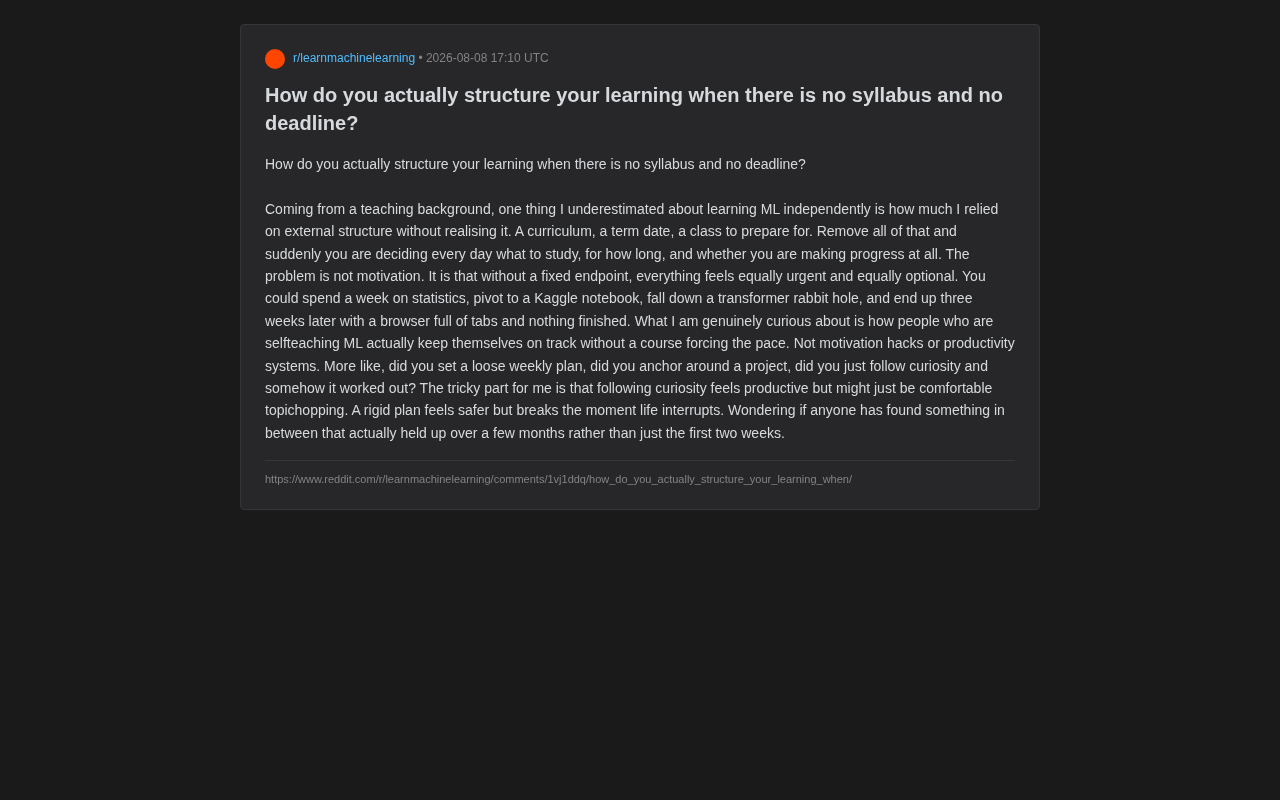
The author particularly emphasized that the core problem isn't lack of motivation, but lack of fixed endpoints. When there are no clear goal markers, everything feels equally urgent yet equally deferrable. You might spend a week on statistics, then switch to a Kaggle notebook, then dive into the Transformer rabbit hole, and three weeks later you're left with nothing but a screen full of browser tabs—without having completed a single thing.
It's worth noting that machine learning is particularly difficult as a self-study target because of the knowledge structure of the field itself. ML spans multiple dimensions including linear algebra, probability and statistics, optimization theory, programming engineering, and domain knowledge, and its subfields (computer vision, natural language processing, reinforcement learning, generative models, etc.) overlap but each evolve rapidly. Unlike more linear disciplines, ML has no universally agreed-upon standard path from basics to advanced topics. This network-like rather than chain-like knowledge structure makes it extremely easy for self-learners to hop between nodes, producing the "screen full of browser tabs" phenomenon the author described.
The Kaggle notebooks and Transformers mentioned in the post happen to be the two most common "rabbit holes" for ML self-learners. Kaggle is the world's largest data science competition platform, and its notebook feature lets users directly run others' complete code. This instantly-runnable characteristic easily creates the illusion of "I'm learning," but if you're just running code without understanding the underlying logic, the gains are extremely limited. Transformers, on the other hand, were proposed by Google in the 2017 paper Attention Is All You Need and have since become the foundation of large models like GPT and BERT. Their influence makes nearly every ML learner want to tackle them early, but truly understanding Transformers requires solid foundations in linear algebra, attention mechanisms, and sequence modeling—skipping these to jump straight to the architecture typically yields only surface-level understanding.
Is "Following Your Curiosity" Real Progress or Comfort Zone Avoidance?
The most thought-provoking point in the post is the author's questioning of "following your curiosity" as a self-study approach.
Following curiosity sounds wonderful—it aligns with our ideal of "active learning" and does deliver immediate satisfaction. But the author astutely points out: this feeling may simply be the comfort of "topic-hopping" rather than genuine learning progress.
From a cognitive science perspective, topic-hopping is closely linked to the brain's "novelty bias." The dopamine system responds far more strongly to new information than to repeated deep processing—the excitement of encountering a new concept is essentially a neural reward signal. But real skill formation requires deliberate practice: the process of repeatedly training at the boundary of known ability, which is often accompanied by frustration rather than novelty. Therefore, "following curiosity" easily keeps people at the shallow contact stage: each time difficulty is felt, switching to a new topic provides fresh dopamine reward, forming a comfortable cycle of "pseudo-learning."
The Dilemma of Two Extreme Approaches
The author compared two common self-study strategies and pointed out where each fails:
- Rigid learning plans: Creating a strict study plan looks safer and more controllable, but its fatal weakness is that "it collapses once life interrupts." Take a week off, work gets busy, family matters arise—the plan breaks, and it's very hard to resume afterward.
- Purely following curiosity: Flexible and hard to interrupt, but lacks accumulation. Learning a bit today, changing direction tomorrow—it seems efficient but no single topic ever gets truly mastered or applied.
What he's really looking for is something in between—a method that can sustain itself for months, not just the first two weeks. This "two-week phenomenon" is practically a universal affliction among self-learners: starting with high enthusiasm and detailed plans, gradually loosening after two weeks, and eventually giving up.
The "two-week phenomenon" aligns closely with behavioral science research on habit formation. Phillippa Lally et al., in a 2009 study published in the European Journal of Social Psychology, found that a new behavior takes an average of 66 days to become an automatic habit, with enormous individual variation (18-254 days). Two weeks is precisely the "danger window" where initial motivation (the novelty from external goal-setting) is depleted but habitual automatic execution hasn't yet been established. At this stage, without external accountability mechanisms or an internal reward system, the probability of quitting is highest. This is also why willpower-dependent rigid plans tend to collapse at this point.
A Potentially Effective Middle Path: Project-Anchored Learning
Although the original post was an open-ended question, combining commonly validated experiences from the community, we can distill several self-study approaches that might truly "hold up."
Replace Courses with Projects, Define Progress by Output
For those self-learning machine learning, the most reliable "external structure" is often not a schedule but a specific project goal. Projects naturally provide:
- A clear endpoint—when the project is done, it's done, solving the core pain point of "no fixed endpoint";
- A natural learning sequence—whatever the project needs, that's what you learn, avoiding aimless knowledge collection;
- Measurable progress—code runs, models have metrics, demos can be shown—progress is visible.
This project-anchored approach to learning is known in education as "Project-Based Learning" (PBL), with theoretical roots tracing back to Dewey's pragmatic educational philosophy and constructivist learning theory. PBL's core assumption is that knowledge is constructed through solving real problems, not through passively receiving information. In the ML domain, this means "building a working text classifier" produces far more lasting understanding than "systematically completing all NLP concepts," because projects force learners to make decisions under specific constraints—what model to choose, how to handle data imbalance, how to evaluate results—and these decisions themselves constitute the process of deep learning.
In other words, changing "I want to learn Transformers" to "I want to build a text classifier using Transformers" instantly clarifies the learning direction. Curiosity then transforms from a distraction into exploratory drive serving the project.
Set "Loose but Directional" Weekly Plans
Completely rigid plans collapse when life interrupts, so a more realistic approach is to plan in weekly units, setting only direction rather than details. For example, "this week, get the project's data preprocessing running" rather than "Monday: study pandas for two hours, Tuesday: study numpy for one hour." Directional goals have elasticity—even if one day gets interrupted, the weekly goal can still be achieved.
This loose weekly planning is particularly suited for people learning ML alongside work—it acknowledges time uncertainty while preserving forward direction.
Use "Completion" Rather Than "Hours" as Your Metric
A common trap for self-learners is measuring progress by study hours, but hours don't equate to outcomes. A healthier signal is: did I make something go from non-functional to functional this week? Even if it's just getting a piece of code to run correctly or reproducing one small result from a paper, this sense of "completion" combats the feeling of being lost far better than accumulated study hours.
Core Takeaways for Independent Learners
This Reddit question resonated because it touches on a structural contradiction of self-learning machine learning: Knowledge resources are more abundant than ever, but the structure for organizing learning is scarcer than ever.
Courses, tutorials, open-source code, and papers are all readily available, yet it's precisely this abundance that makes choice itself the biggest cost. This phenomenon closely relates to psychologist Barry Schwartz's "Paradox of Choice." Schwartz's research shows that when options exceed a certain threshold, decision quality and satisfaction actually decline because every choice is accompanied by regret over abandoned alternatives. In the ML learning domain, the explosive growth of free resources (Coursera, fast.ai, Stanford CS229, YouTube tutorials, arXiv papers, GitHub projects, etc.) means that "choosing what to learn" itself consumes enormous cognitive resources, producing so-called "decision fatigue" that ultimately causes learners to either jump randomly or fall into analysis paralysis and never start.
For those who want to systematically master machine learning, the real challenge may not be "what to learn" but "how to set boundaries for yourself when no one else is setting them for you."
Overall, a self-study approach that can sustain itself over several months typically has three characteristics:
- Projects as anchors provide clear endpoints
- Loose weekly plans provide flexible direction
- Completion rather than hours measures real progress
It's neither as prone to dissipation as pure curiosity-following, nor as fragile as rigid planning—it finds a balance between structure and flexibility.
For everyone navigating machine learning on their own, this may be a more fundamental question than any "productivity hack"—first solve how to organize your learning, then talk about specific technical roadmaps.
Related articles

Gaussian Process Bandit Optimization: Exploration Strategies and Inference Regret Guarantees
Cumulative regret guarantees in Bayesian optimization fail to reflect final recommendation quality. This article examines a new study that provides inference regret guarantees for Gaussian process bandit optimization through exploration query strategies and fill distance analysis, validated on hyperparameter optimization and control tasks.

The Most Detailed Codex Guide on Bilibili: From Installation to Real-World Practice
The most detailed Codex guide on Bilibili: from app store installation to daily work mode configuration, with a real coffee shop project demonstrating file organization, data extraction, dashboard creation, and other practical tasks. Learn to use Plan Mode and desktop pets to leverage Codex efficiently.

Appearance Compensation in Volume Rendering: Why RGB Accuracy Cannot Guarantee Density Correctness
Volume rendering research reveals that volumetric data perfectly reproducing external RGB views may still contain density errors: appearance compensation can double central density and keep external rays unchanged even when L2 error exceeds 14.52%. Density recovery depends on appearance capacity, spatial resolution, and measurement design.