How to Split Work Across Four AI Coding Subscriptions: 3 Rules for Assigning Tasks by Quota

Divide work among AI tools by strengths, use weekly quota as the hard metric, and never outsource four types of work.
The article shares creator Leo's method for dividing work across four paid AI subscriptions: assign by tool strengths (Claude Code for writing and acceptance, Codex for clear-cut code and tests, Grok for X, Cursor for repo batch tasks). Manage quota by the weekly figure with two tightness thresholds, shifting routine tasks to tools with margin. Judgment, acceptance, records, and anything involving money or passwords stay in-house.
Title
How to Split Work Across Four AI Coding Subscriptions: 3 Rules for Assigning Tasks by Quota
Meta Description
Paying for Claude Code, Codex, Cursor, and Grok at the same time? Here's how to assign tasks based on remaining quota. This article lays out three rules: divide work by strengths, watch only the weekly quota, and spread consumption evenly every day—plus advice on which to pick if you only buy one.
Article Content
With Claude Code, Codex, Cursor, and Grok all in front of you, which one should you pick? That question has been asked far too many times. But the question you actually have to answer every day is a different one: given the quota you have left, who should this piece of work go to?
A creator named Leo, who pays for all four tools at once, shared his division-of-labor method—don't look at price, look at strengths; watch only the weekly quota; and keep quota flowing every day. Here are the three rules behind his measured numbers.
Rule One: Divide Work by Strengths, Not by Price
In his hands, the four tools each have a clear role—not whoever is cheaper gets the job.
- Claude Code: handles writing, judgment calls, and final acceptance.
- Codex: handles code whose requirements are clearly spelled out, plus testing and verification.
- Grok: handles everything related to X (Twitter)—reading posts, searching for information, monitoring accounts.
- Cursor: the command-line agent takes on clearly scoped repo tasks and batch work.
If a project needs to be followed for several weeks straight, he'll spin up a separate Grok bot to keep an eye on it long-term. The core logic of this division is: every tool has a scenario it's best at, and forcing one tool to do everything wastes quota.
Rule Two: Watch Only the Weekly Quota—Ignore the Five-Hour Window
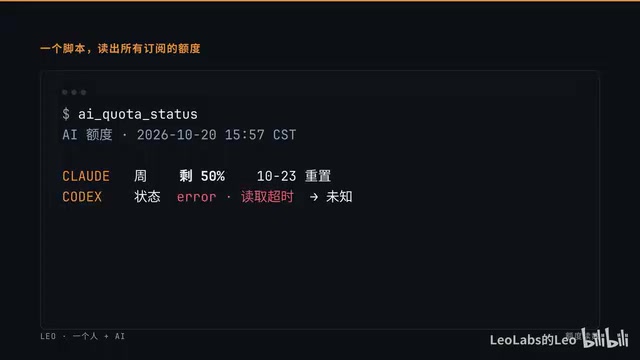
Every afternoon he uses a script to read the quota of all subscriptions in one go. Measured data: Claude's weekly quota was half left, Codex had just reset a few hours earlier and was full, Cursor's monthly plan still had about 88% left, and Grok had 64% left for the week. Anything that couldn't be read was marked "unknown," and he never guessed from old screenshots.
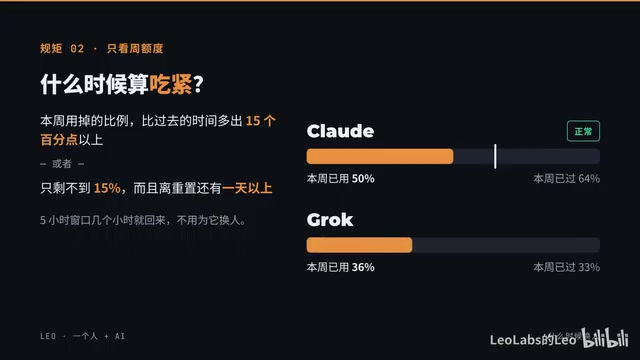
There are two criteria for judging "tight":
- The share used this week exceeds the share of the week that has already elapsed by more than 15 percentage points;
- Less than 15% remains, and there's more than a day until reset.
Take that day's data as an example: Claude had used half its weekly quota while 64% of the week had passed—not over. Grok had used 36% with a third of the week gone—also normal.

Once one tool gets tight, newly started routine tasks, batch tasks, and mechanical work get moved to whichever tool still has margin and can do the job. But there are four things the orchestrating AI keeps for itself and never outsources:
- Judgment
- Final acceptance
- Writing results back into the record
- Anything touching money and account passwords
How subscription quota windows work: Most AI coding tools use dual rate limiting—a rolling five-hour window and a weekly total. The five-hour window limits short-term bursts, while the weekly quota reflects long-term consumption. He watches only the weekly quota because the five-hour window fluctuates wildly and easily leads to misjudgment, whereas the weekly quota better reflects remaining available resources. People often get led around by the five-hour window, interrupting work frequently and actually reducing efficiency.
Quantifying "tight": Leo set two thresholds—the share used this week exceeding time progress by 15 percentage points, or less than 15% remaining with more than a day until reset. The former measures whether consumption is too fast; the latter focuses on whether the absolute margin is dangerous. This quantification avoids gut-feeling judgments and gives scheduling decisions a basis.
Rule Three: Use Quota Every Day—Don't Rush Before the Reset
He has a task dispenser that runs once an hour, sending work out according to a fixed list. That day it sent out seven tasks: three to the Grok bot, two to Codex, one to Cursor, and one to ChatGPT. The list includes topic radar, product feedback, data syncing, code review, running tests, repo health checks, and long-form outlines—all outputs land in the same folder.
If a task goes unused for 14 consecutive days, it's automatically shut off. The point of this mechanism is to consume quota evenly, rather than discovering a big surplus or an early exhaustion just before the reset.

The task dispenser mechanism: a script that runs once an hour and automatically assigns tasks to different AI tools according to a preset list. The list is fixed and covers routine work like topic radar and product feedback. Outputs are stored uniformly for easy tracking. Tasks unused for 14 consecutive days are automatically disabled to prevent waste. This achieves even quota consumption and avoids both last-minute rushes and idling before a reset.
What If You Only Buy One?
If you plan to buy just one subscription, choose based on the work you do most:
- Mostly writing and judgment → Claude Code
- Mostly code with clear requirements → Codex or Cursor
- Information mainly on X → Grok
If you're already paying two of them, stop comparing and start dividing the work.
Editor's View
The value of this method isn't in the specific numbers—it's in turning "which tool to choose" into "how to schedule quota." A common problem among multi-subscription users is paying twice but using only one, or getting led around by the five-hour window. Leo's approach treats the weekly quota as the only hard metric, uses scripts to quantify what's left, and then allocates flexibly by task type—essentially a personal-level resource scheduling strategy. For developers holding multiple AI subscriptions, what's worth borrowing is the bottom-line thinking of "four things never outsourced": judgment, acceptance, records, and sensitive information always stay in your own hands.
(This article is based on a sharing by Bilibili creator Leo. Specific quota numbers change over time; the method's logic is reusable.)
One-line Summary
Divide work among multiple AI tools by strengths, treat the weekly quota as the hard metric, and never outsource four categories of work.
Paragraph Summary
The article introduces the division-of-labor method of Leo, a creator who pays for Claude Code, Codex, Cursor, and Grok simultaneously. He advocates dividing work by tool strengths rather than price: Claude Code handles writing, judgment, and acceptance; Codex handles code with clear requirements and testing; Grok specializes in X platform information; Cursor takes on repo batch tasks. Quota management looks only at the weekly dimension, with two tightness criteria: usage exceeding time progress by 15 percentage points, or less than 15% remaining with more than a day until reset. Once tight, routine tasks shift to tools with margin. But judgment, acceptance, writing back records, and anything involving money and account passwords always stay with him. He also uses an hourly task dispenser to keep quota flowing daily, with tasks unused for 14 days automatically shut off. If buying only one subscription, choose the tool matching your most frequent work.
Related articles

AI Reverse-Engineers Monitor Firmware in 15 Minutes — Has the Hacking Barrier Been Flattened?
A security researcher used AI to reverse-engineer Dell monitor firmware in 15 minutes—entropy analysis, key extraction, MD5 verification—revealing encryption design flaws.

Mistral Voxtral 3: Real-Time Voice at 4 Cents per Minute, Challenging OpenAI
Mistral Voxtral 3 cuts real-time voice agent costs to 4 cents per minute, bundling three speech recognition models, a speech generation model, and a real-time voice toolkit, supporting 50+ languages and self-hosting. This article analyzes its pricing structure, sub-second response performance, and its strategic divergence from OpenAI and Gemini on data privacy versus out-of-the-box convenience.

WebMCP: Every Website as Its Own MCP Server, So AI Agents No Longer Rely on Screenshots
WebMCP lets websites expose tools via the document.modelcontext API, becoming directly callable MCP servers. This article explains its architecture, the Claude Code remote-debugging demo, Chrome's current support stage, and its impact on the agent ecosystem.