How to Test AI Agents Before Going Live? A Practical Framework Beyond LLM Evaluation

Production AI Agent testing must go beyond LLM eval to cover data, tools, permissions, and end-to-end behavior.
Traditional LLM evaluation only measures response quality, but AI Agents executing real business tasks require a completely different evaluation framework. Using a lending scenario, the article shows how a professionally worded response can hide five layers of risk: data authenticity, identity verification, retrieval accuracy, speech bias, and compliance. It outlines six testing approaches — manual QA, custom datasets, LLM-as-a-Judge, tool unit tests, observability platforms, and production monitoring — organized into a layered framework. Post-deployment failures are rarely about language quality; they're about hallucinated data, missed escalations, lost context, and permission gaps.
Why Traditional LLM Evaluation Falls Short
When evaluating a large language model, the question is usually straightforward: "Is the model's response good?" That standard might have worked in the chatbot era, but as AI evolves from "conversation" to "task-executing Agent," the evaluation dimensions change entirely.
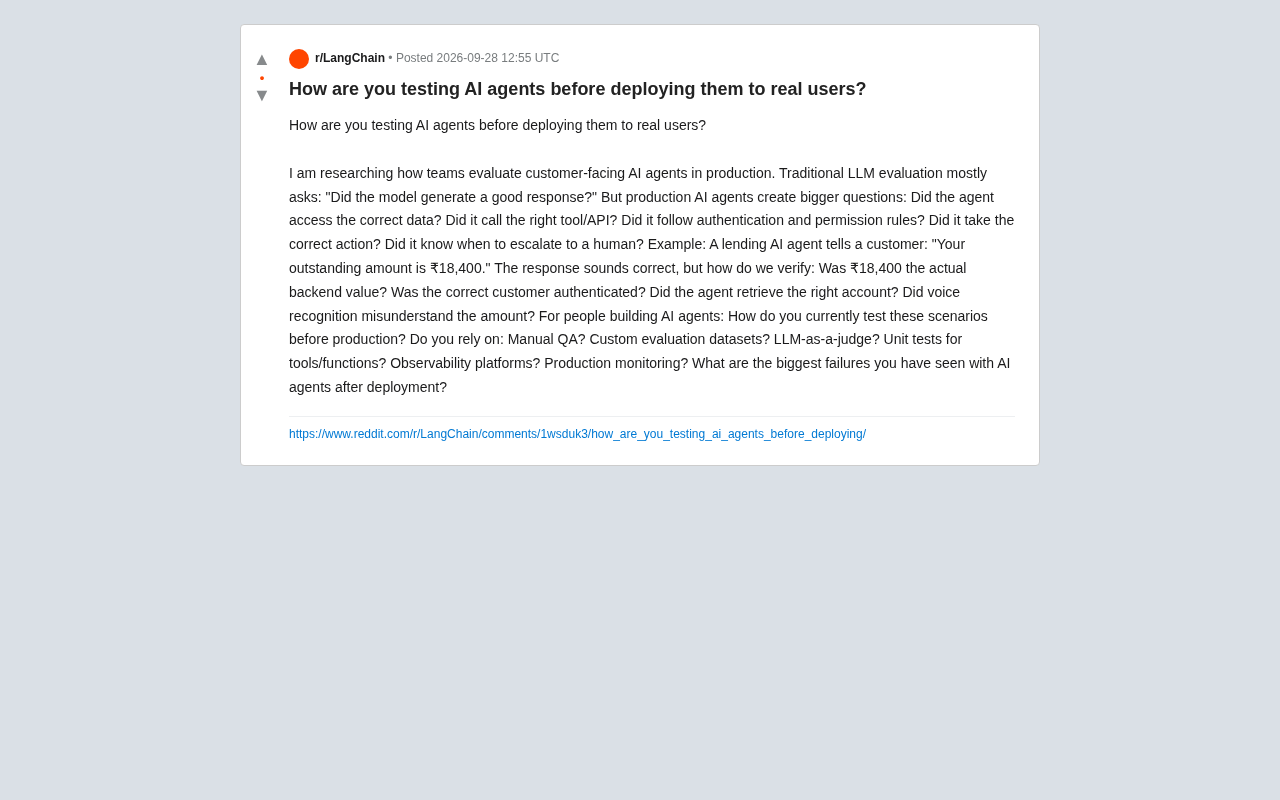
A Reddit developer raised a pointed observation: AI Agents deployed to real users introduce problems far more complex than "response quality." An Agent needs to access the right data, call the right tools/APIs, respect authentication and permission rules, execute the correct actions, and know when to escalate to a human. If any of these steps go wrong, even a response that sounds correct can lead to catastrophic outcomes.
A Lending Scenario That Exposes Five Layers of Risk
The original post offers a highly representative example: a lending AI Agent tells a customer, "Your outstanding balance is ₹18,400."
On the surface, this sounds smooth, professional, and airtight. But from a production system perspective, at least five risks need to be verified:
- Data authenticity: Is ₹18,400 the actual value in the backend system, or did the model hallucinate it?
- Identity verification: Is the person talking to the Agent actually the account holder?
- Retrieval accuracy: Did the Agent pull the correct account record, or mix up records?
- Speech recognition bias: In a voice scenario, could ₹18,400 be the result of a recognition error?
- Permissions and compliance: Does the Agent's disclosure of this sensitive amount comply with authorization and regulatory requirements?
The value of this example lies in how clearly it separates "response quality" from "business correctness." A grammatically perfect, appropriately toned response can be built entirely on wrong data, the wrong user, or the wrong action. In high-stakes domains like finance, healthcare, and law, the latter represents the truly fatal failure mode.
Six Common Approaches to Testing AI Agents
The original post outlines several testing and evaluation methods currently used in the industry, each with its own applicable scope:
Manual QA
The most direct approach — testers manually walk through the Agent's behavior. It excels at catching contextual issues that automation misses, but doesn't scale, struggles to cover long-tail scenarios, and can't continuously track changes in production.
Custom Evaluation Datasets
Building test sets tailored to specific business needs, covering typical conversation flows, edge cases, and abnormal inputs. This is a critical step in making "how the Agent should behave" explicit — but building and maintaining these datasets is costly, and they naturally lag behind how real users actually behave.
LLM-as-a-Judge
Using another large model to evaluate the Agent's output quality. This can automate subjective evaluation to some degree and scales well — but the "judge" itself makes mistakes and carries biases, and it's often powerless when it comes to objective correctness questions like "Was the right tool called?" or "Is the data accurate?"
The LLM-as-a-Judge concept originated from using strong models (like GPT-4 or Claude) as automated reviewers to score or rank another model's output against given criteria. This approach has been widely adopted in well-known benchmarks like MT-Bench and Chatbot Arena. Its strength lies in approximating human judgments about "helpfulness," "safety," and "logical coherence" at far lower cost than human annotation. However, its limitations are equally clear: judge models exhibit positional bias (favoring answers listed first), verbosity bias (preferring longer responses), and self-preference (rating outputs stylistically similar to themselves more highly). In Agent evaluation, these biases are further amplified — determining whether a tool call was correct or whether returned data is accurate is fundamentally a factual verification task, not a language quality assessment. Using a language model to audit factual errors is like hiring a literary critic to audit financial statements: a fundamental mismatch of responsibilities.
Tool/Function Unit Testing
Treating each tool or API the Agent calls as a traditional software module and writing unit tests for it. This is the hard-core approach to verifying "did the Agent do the right thing" — for instance, confirming that ₹18,400 in the lending scenario actually came from a real backend query. These tests are deterministic and reliable, but they only cover the tool layer and can't govern the model's decision-making logic.
Observability Platforms
Recording the Agent's complete execution trace: which tools it called, what parameters it passed, what it received in return, and how it reasoned step by step. These platforms turn a "black box" into something traceable, forming the foundational infrastructure for diagnosing production issues.
The concept of observability originates from control theory and distributed systems engineering. In microservices, it typically refers to fully understanding a system's internal state through three signal types: Logs, Metrics, and Traces. Applied to AI Agents, its core value lies in visualizing the model's "chain of thought" alongside its "tool call chain": the inputs and outputs of each function call, the actual document chunks retrieved in Retrieval-Augmented Generation (RAG), and token consumption and latency distributions — all captured in a traceable execution graph. Observability platforms designed specifically for LLMs — such as LangSmith, LangFuse, and Arize Phoenix — emerged precisely from this need. Their key distinction from traditional APM tools is that beyond system-level metrics, they also version-manage Prompt templates, model sampling parameters (Temperature, Top-p), and multi-turn conversation context, enabling precise reproduction of failure scenes when issues arise.
Production Monitoring
Continuously monitoring anomaly signals in real traffic after launch — error rates, escalation-to-human frequency, and user dissatisfaction signals. This acknowledges a reality: no matter how thorough pre-launch testing is, it can never exhaust the complexity of the real world.
Layered Validation: From "Saying the Right Thing" to "Doing the Right Thing"
Putting these approaches together, a clearer evaluation framework emerges. AI Agent testing should proceed in layers:
At the tool layer, use deterministic unit tests to guarantee the correctness of API calls and data retrieval. At the decision layer, use evaluation datasets and LLM-as-a-Judge to verify whether the Agent selected the right tool and escalated to a human at the right moment. At runtime, use observability and production monitoring to catch failures that couldn't be anticipated at design time.
The core of this layered approach is separating "response quality" from "business correctness." Traditional LLM evaluation addresses the former, while most of an Agent's real risks come from the latter — wrong data, permission violations, mis-executed actions. No large model acting as a "judge" can ever answer the question: "Is this number actually real?"
Where Failures Most Commonly Occur Post-Deployment
The question raised at the end of the original post is equally worth reflecting on: after an Agent is deployed, where do the biggest failures typically appear?
Based on where the discussion pointed, high-frequency failures cluster into a few categories: the Agent confidently outputs hallucinated data that goes unnoticed; it answers anyway when it should have escalated to a human; it loses context across a multi-turn conversation and operates on the wrong entity; and gaps in permissions and authentication cause the Agent to disclose sensitive information to the wrong person.
What these failures have in common is that almost none of them are about "unnatural language" — they're about "incorrect behavior." This is precisely why evaluating production-grade AI Agents must break out of the traditional LLM evaluation mindset and shift from "what did the model say" to "what did the Agent do, and on what basis."
The "should-have-escalated-but-didn't" problem is academically referred to as escalation failure or handoff failure — the hardest-to-quantify risk in Human-in-the-Loop design. An Agent's tendency to "answer anyway" typically stems from reward signal design during training: if the model is penalized for "refusing to answer" during RLHF, it learns to produce some answer rather than admitting it's out of its depth and handing off to a human. This behavior is especially harmful in customer service, financial advisory, and other scenarios requiring precise judgment about capability boundaries. Common mitigation strategies include: setting explicit confidence thresholds to trigger escalation workflows, constructing test cases in evaluation datasets specifically designed for "should refuse/escalate" scenarios, and tracking escalation rate itself as a health metric in production monitoring.
For any team preparing to deploy an Agent to real users, the sooner this evaluation challenge is taken seriously, the better.
Related articles

AI Reverse-Engineers Monitor Firmware in 15 Minutes — Has the Hacking Barrier Been Flattened?
A security researcher used AI to reverse-engineer Dell monitor firmware in 15 minutes—entropy analysis, key extraction, MD5 verification—revealing encryption design flaws.

Mistral Voxtral 3: Real-Time Voice at 4 Cents per Minute, Challenging OpenAI
Mistral Voxtral 3 cuts real-time voice agent costs to 4 cents per minute, bundling three speech recognition models, a speech generation model, and a real-time voice toolkit, supporting 50+ languages and self-hosting. This article analyzes its pricing structure, sub-second response performance, and its strategic divergence from OpenAI and Gemini on data privacy versus out-of-the-box convenience.

WebMCP: Every Website as Its Own MCP Server, So AI Agents No Longer Rely on Screenshots
WebMCP lets websites expose tools via the document.modelcontext API, becoming directly callable MCP servers. This article explains its architecture, the Claude Code remote-debugging demo, Chrome's current support stage, and its impact on the agent ecosystem.