How to Write a Resume for LLM Jobs: A Guide to Multi-Agent Projects and Practical Experience

A resume for LLM roles should highlight complex Agents and complex RAG while keeping and compressing prior IT projects.
The article targets transitioners who have completed 70–80% of the roadmap and are preparing to job hunt. It argues that the root cause of resumes going nowhere isn't insufficient learning but failure to signal "I can deliver LLM projects in production." It recommends getting a general resume template and an AI large model project template, and organizing projects by name, tech stack, description, implementation details, and problems encountered. Projects must show technical density: agents should be multi-agent or Harness architecture, and RAG should be complex RAG (e.g., graph-enhanced). It also stresses keeping prior test development, frontend, and backend projects in compressed form and placing LLM projects near the front. Technical difficulties should double as interview material, with the ability to explain design trade-offs and pitfalls.
Why Your Resume Needs an "LLM-ification" Makeover
If you've completed 70–80% of the courses in the roadmap and have decided to start job hunting, the first thing you need to do is write your resume. But most students transitioning into LLM application development still write their resumes the way they did for traditional developer roles—and their applications often go nowhere.
The core issue isn't that you haven't learned enough. It's that your resume doesn't send the signal to recruiters that "I can deliver LLM projects in production." According to Bilibili creator "码士集团" (Code Master Group), there are two templates you must get before writing your resume: a general resume template, and an AI large model project template. The latter is provided in Markdown format and covers project name, tech stack, project description, implementation details, and problems encountered in the project—essentially handing you a ready-to-use framework for describing your projects.
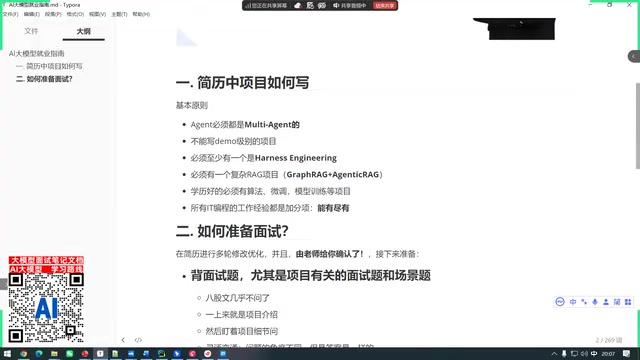
Getting the template is only the first step. What really determines whether your resume passes screening is the "technical density" and "complexity" of your project content.
How to Write Your Projects: Complex Agents and Complex RAG Are Hard Requirements
The original article lays out several clear principles for the project section of your resume. The most critical one: agent projects must be multi-agent, or complex agents built on a Harness architecture. In other words, recruiters want to see that you've handled complex scenarios like collaboration, orchestration, and tool calling—not a single-turn Q&A demo.
The same applies to RAG projects: they must be "complex RAG." The specific example given in the original article is adding a graph structure to RAG.
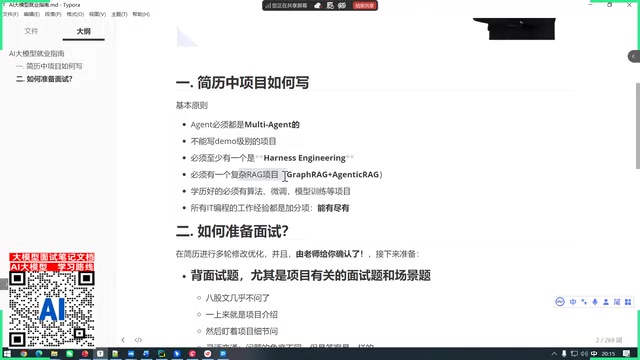
This means your RAG project on the resume can't stay at the textbook pipeline of "vector retrieval + LLM generation." Designs like graph-enhanced retrieval, multi-route recall fusion, and reranking of retrieval results are what demonstrate engineering capability. For candidates with stronger academic backgrounds, the original article also suggests strengthening the fine-tuning or traditional algorithms content, using a stronger technical foundation to support the resume.
Harness architecture in the Agent context usually refers to an engineering runtime framework that wraps the model, tools, memory, and execution loop together ("harness" literally means a set of straps, extended to mean the skeleton that carries and drives the model). It handles tool registration and scheduling, context management, error retries, and orchestration and state maintenance for multi-step tasks, enabling the agent to reliably complete long-chain tasks rather than just making a single model call. Writing "based on Harness architecture" on your resume means you've dealt with engineering issues like tool-calling protocols, context trimming, execution trace logging, and controllability—exactly the basis recruiters use to judge whether a candidate can build production projects.
Agentic RAG refers to a form of RAG in which the retrieval process itself has autonomous decision-making capability: the Agent decides whether retrieval is needed, decomposes and rewrites queries, selects retrieval sources and iterates over multiple rounds, and evaluates recall results before deciding whether to continue retrieving or generate directly. Unlike the traditional fixed pipeline of "one retrieval + one generation," it emphasizes planning, reflection, and tool orchestration, which imposes higher engineering complexity requirements and makes it better suited as a project that demonstrates production capability on your resume.
Don't Delete Your Previous IT Projects—Just Compress Them
This is a point the original article repeatedly stresses and the one most easily overlooked. Many students, when transitioning, completely delete their previous test development, frontend, or backend projects from their resumes, keeping only LLM projects—which is effectively cutting off their own escape route.
The original article's advice is very specific: any IT programming work you've done before should be kept on your resume, just compressed. The approach: write only the project name, timeline, and tech stack, then describe the project content in two or three sentences, without expanding further.
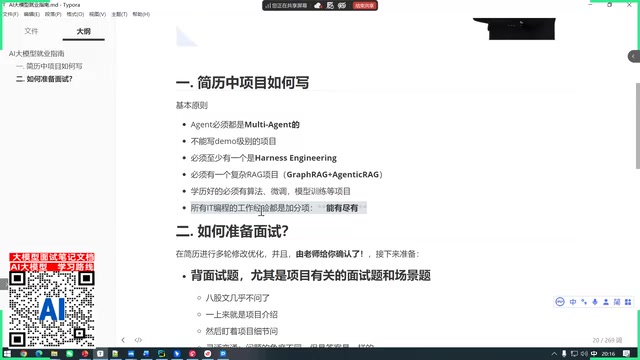
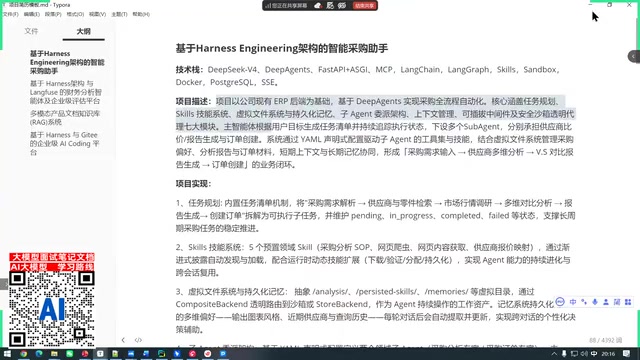
Then, put your LLM projects at the front of the resume and highlight them. The logic is: prior IT work experience is a plus when applying for LLM roles, and candidates with traditional development experience clearly have a higher chance of getting interviews. Test development, frontend, backend, embedded—any programming experience proves your engineering competence, and that's the transferable ability recruiters value.
Beyond the Resume: Interview Methodology and Project Practice Go Together
The original title also mentions single/multi-Agent, Agentic RAG, Harness Engineering, and accompanying interview methodology. From the content, the resume is only the first link in the entire job-hunting chain—the "problems encountered in the project" column in the project template is actually a material library prepared for interviews. Every technical difficulty you write on your resume should be something you can explain clearly in an interview: the design trade-offs, the pitfalls you hit, and the final solution.
How to divide responsibilities in multi-agent collaboration, how Agentic RAG gives the retrieval process autonomous decision-making capability, how Harness engineering manages tool calling and context—these questions are both highlights on your resume and key points interviewers will probe. Writing projects as complex and real as they are is more persuasive than piling up buzzwords.
Graph-enhanced retrieval (Graph RAG) organizes knowledge into a graph structure made of entities and relationships, then combines it with vector retrieval: on one hand, entity linking and relationship expansion can supplement context missed by vector recall; on the other hand, it supports multi-hop reasoning and answering global questions (such as "the overall trend of a certain type of event"). Compared with pure vector retrieval, it requires additional work on graph construction, entity extraction and alignment, graph queries, and fusion ranking of vector results—more engineering effort and design trade-offs—so it is often regarded as a representative approach of "complex RAG." Common interview follow-ups include how the graph is built and updated, how multi-route recall is fused, and how retrieval quality is evaluated.
A Checklist for a Qualified Resume
Based on the views in the original article, you can self-check a resume for an LLM transition in the following order:
- Have you obtained and applied the LLM project template, and does the project description cover the tech stack, implementation, and problems?
- Is the agent project multi-agent or a complex Harness architecture?
- Is the RAG project complex RAG (e.g., graph-enhanced)?
- Have previous IT projects been kept and compressed rather than deleted?
- Are LLM projects placed near the front of the resume and prominently displayed?
The essence of a resume is to let recruiters judge within a dozen seconds whether you "can do the job." Write out the complexity, keep the engineering experience, and interview opportunities will naturally increase.
One-line Summary
A resume for transitioning to LLM roles should highlight complex Agents and complex RAG while keeping and compressing previous IT projects.
Paragraph Summary
The article targets transitioners who have completed 70–80% of the roadmap and are preparing to job hunt, pointing out that the root cause of resumes going nowhere isn't insufficient learning but failure to send the signal "I can deliver LLM projects in production." It suggests first getting a general resume template and an AI large model project template, and organizing content around five parts: project name, tech stack, description, implementation details, and problems encountered. The project section must show technical density: agents must be multi-agent or Harness architecture, and RAG must be complex RAG (e.g., graph-enhanced). It also stresses not deleting previous test development, frontend, or backend projects but keeping them in compressed form, and placing LLM projects near the front of the resume and highlighting them, because traditional development experience is a plus. Technical difficulties on the resume should also serve as interview material, with the ability to clearly explain design trade-offs and pitfalls.
Related articles
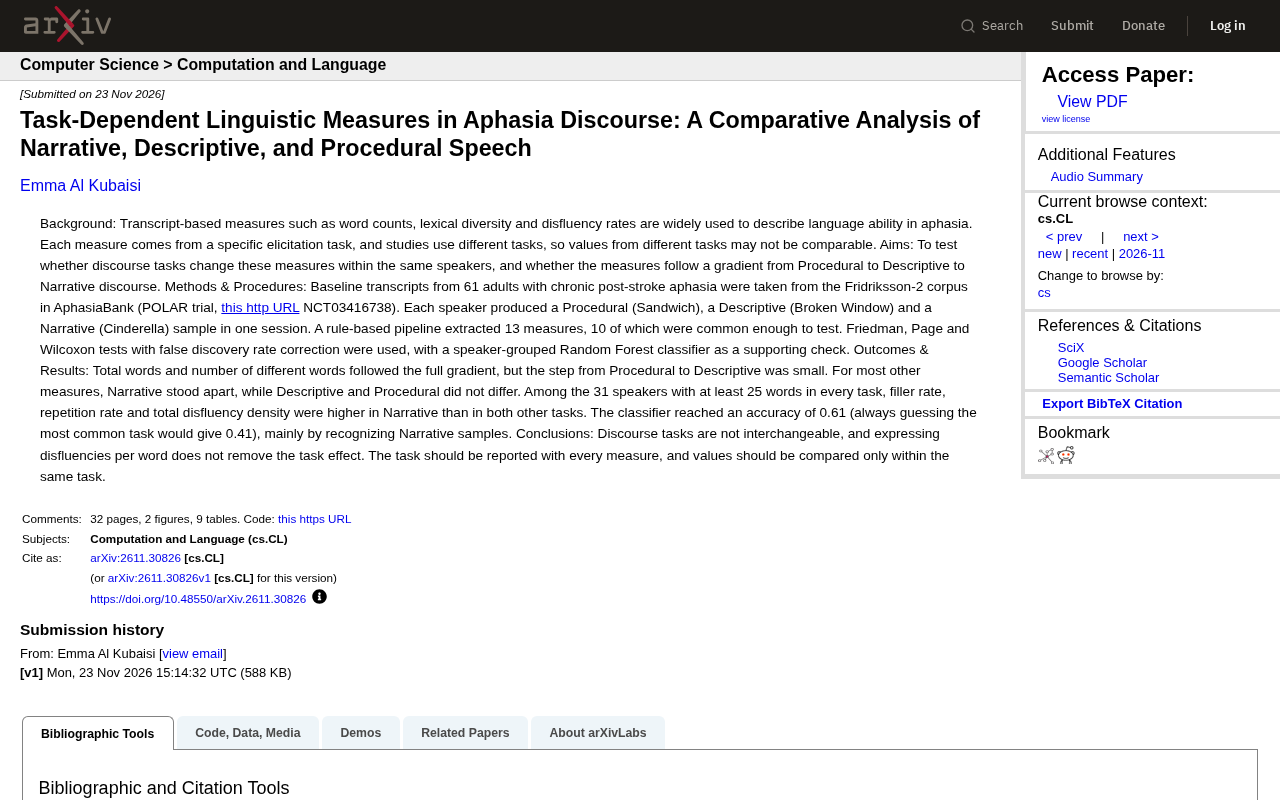
Aphasia Discourse Analysis: Language Metric Differences Across Tasks
A study of 61 adults with aphasia found that narrative, descriptive, and procedural discourse tasks yield non-interchangeable language metrics. Total words and lexical diversity show a gradient; disfluency is higher in narrative tasks. Each metric must be labeled by task type and compared only within the same task.
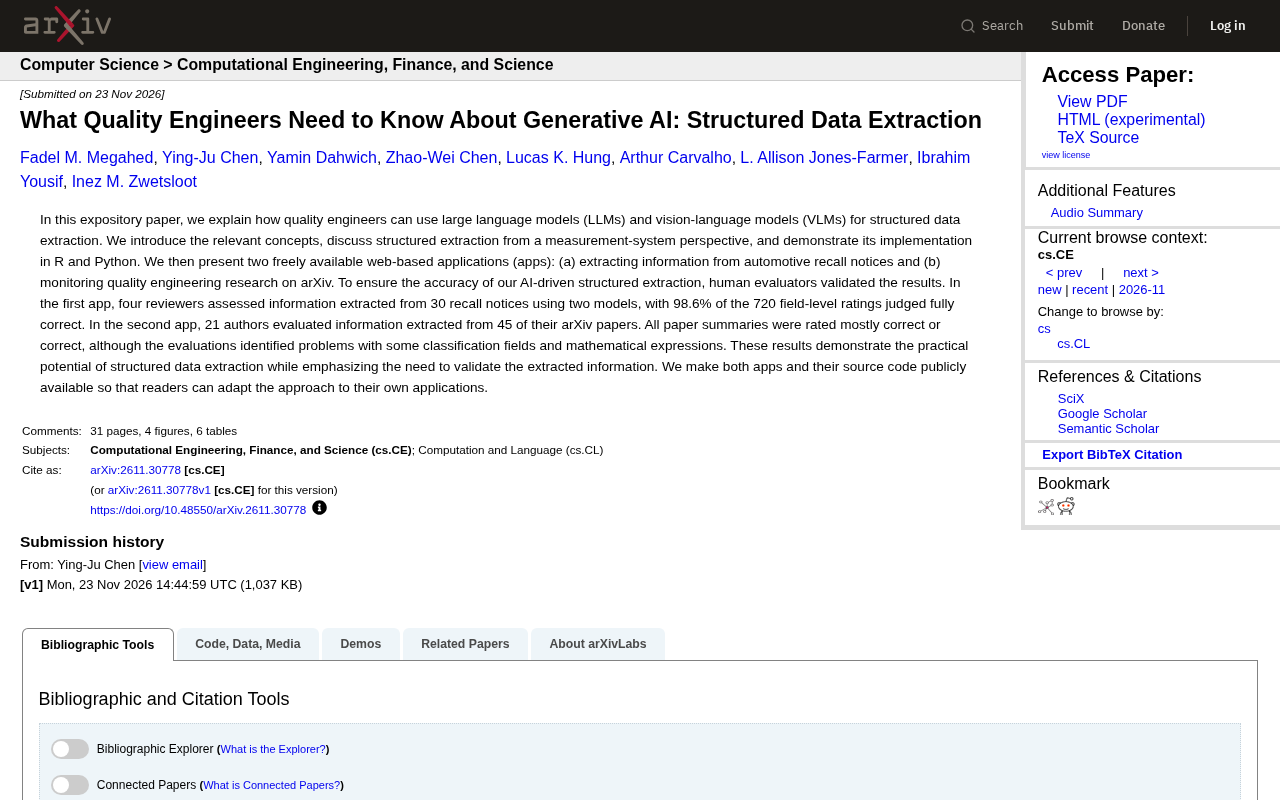
Must-Read for Quality Engineers: A Practical Guide to Structured Data Extraction with Generative AI
A paper shows how quality engineers use LLMs and VLMs for structured data extraction, validated through two web apps, with R and Python implementations.
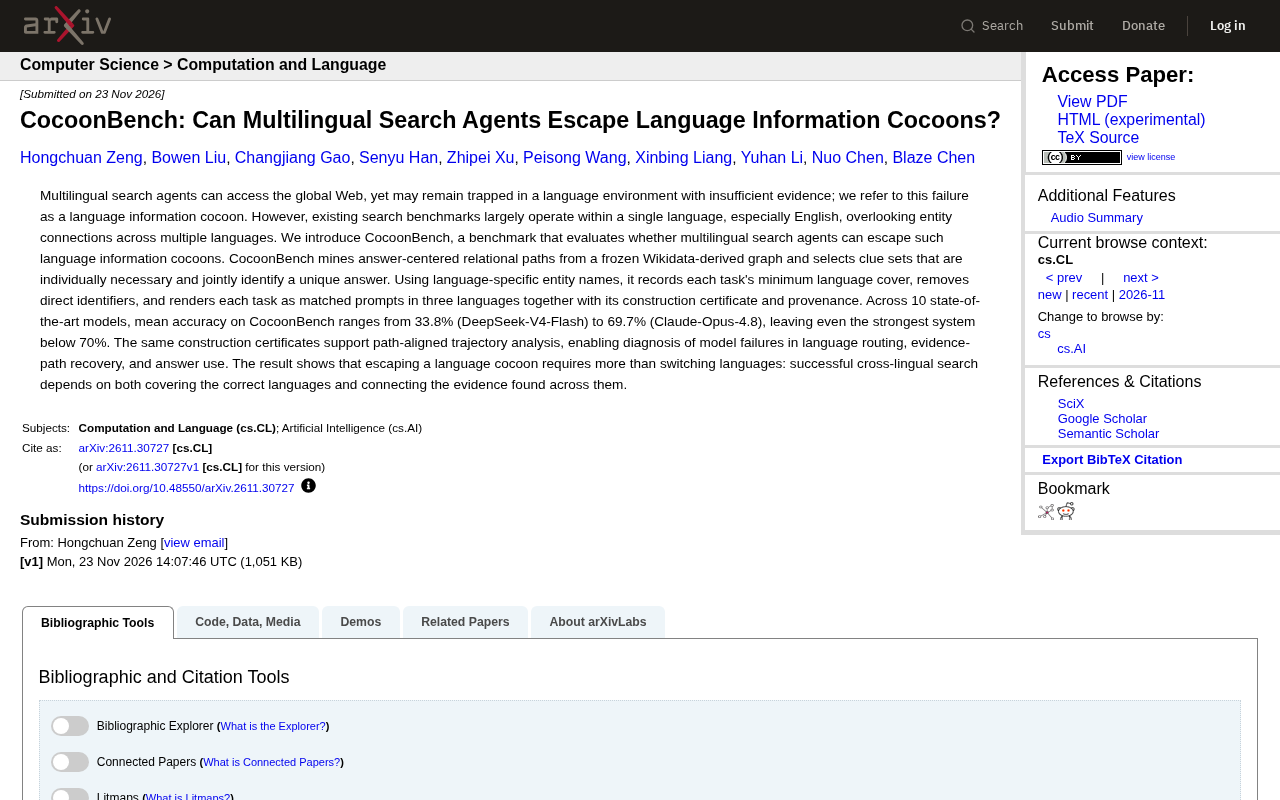
CocoonBench: Can Multilingual Search Agents Break Out of the Language Information Cocoon?
CocoonBench evaluates whether multilingual search agents can escape the language information cocoon. Tests show 10 advanced models range from 33.8% to 69.7% accuracy, with the strongest system still below 70%, revealing key challenges in connecting cross-lingual evidence.