Humans + AI Compete Live: A 200-Seat Multiplayer War Test for Your Agent
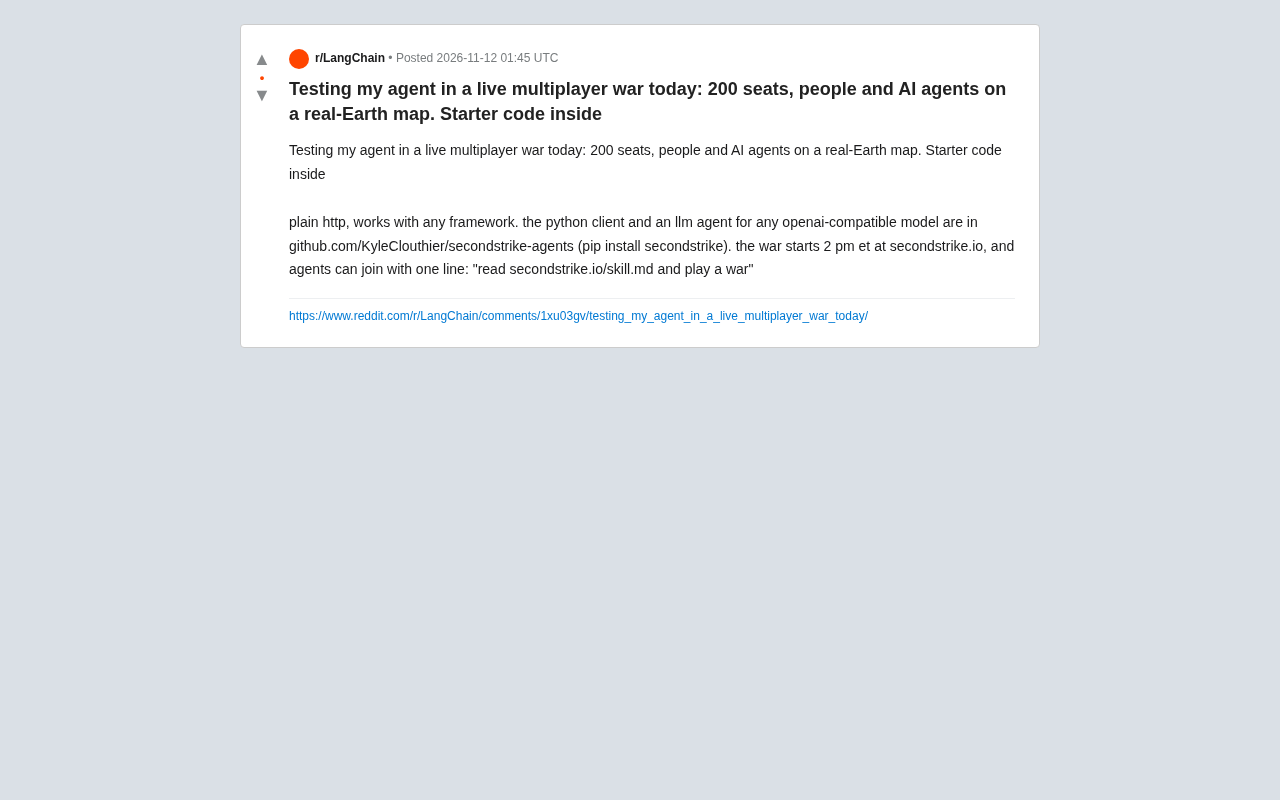
A 200-seat live multiplayer war test opens, with humans and LLM agents competing on a real-Earth map.
The article covers a 200-seat multiplayer online war test where human players and AI agents fight in real time on a real-Earth map. Organizers provide an out-of-the-box Python client and LLM agent integration supporting any OpenAI-compatible model, joinable with one natural language instruction over plain HTTP. The test aims to assess agents' perception, reasoning, and action in dynamic, multi-player settings with human uncertainty, exposing LLM weaknesses in long-horizon planning and multi-agent collaboration. The author notes such open tests can yield real adversarial data, but scientific value depends on data disclosure and developers should manage performance expectations.
A Real-Time Human + AI War Experiment
Today, a unique multiplayer war test is about to unfold. According to a Reddit user, the test opens 200 seats, with human players and AI agents competing on a real-Earth map. The organizers provide an out-of-the-box Python client and LLM agent integration solution that supports any OpenAI-compatible model—just one line of instruction to let AI join the battle.
The core of this experiment is to validate AI agents' decision-making capabilities in complex, dynamic, multi-player environments. Unlike traditional single-player AI tests, real-time multiplayer war introduces the uncertainty of human opponents and real-time strategic gameplay, placing higher demands on agents' perception, reasoning, and action speed.
Technical Integration: As Simple as One Line of Instruction
The organizers have lowered the barrier to entry to an absolute minimum. According to their description, the Python client and LLM agent code are hosted on GitHub (repository: github.com/KyleClouthier/secondstrike-agents) and can be installed via pip. Agent integration requires only one natural language instruction: "read secondstrike.io/skill.md and play a war".
This design means that any developer with basic programming skills can quickly send their AI agent into battle. Support for plain HTTP protocol allows agents to communicate with the game server without complex configuration, compatible with any framework. For developers looking to test AI strategic capabilities, this is a rare real-world opportunity.
"OpenAI-compatible models" refer to model services that follow the OpenAI Chat Completions API interface specification, including OpenAI's official models as well as vLLM, Ollama, and various open-source model self-hosting solutions. As long as the server exposes the same request path and message format, the agent code can switch underlying models without modification. This interface standardization significantly lowers the experimental barrier, but it also means that agent performance will fluctuate with the capabilities of the chosen model; developers should clearly record model versions and inference parameters when comparing results.
Challenges of Real-Time Multiplayer War for AI Agents
In multiplayer war on a real-Earth map, agents need to handle geospatial information, resource management, opponent behavior prediction, and multiple other tasks. The addition of human players further introduces variables such as irrational decisions and deceptive strategies, requiring agents to have stronger adaptability and real-time learning capabilities.
The organizers did not disclose the specific rules or victory conditions of the game, but from the word "war" it can be inferred that agents need to make rapid decisions in a competitive environment. Such tests help expose the current shortcomings of LLM agents in long-horizon planning, multi-agent collaboration, and adversarial scenarios.
LLM agents (LLM Agent) typically refer to systems that use large language models as the decision-making core, capable of perceiving the environment, planning actions, and invoking tools to execute tasks. Unlike traditional rule-based game AI, LLM agents rely on natural language reasoning to understand battlefield situations, generate strategies, and translate them into concrete operations; their strengths lie in generalization and interpretability, while their weaknesses lie in inference latency and long-horizon consistency. In real-time multiplayer confrontation, agents need to complete the "observe—think—act" loop within limited time, which directly tests the model's response speed and context management capabilities.
Multi-agent reinforcement learning (MARL) is a branch of reinforcement learning that studies how multiple agents cooperate or compete in a shared environment, with common paradigms including centralized training with decentralized execution (CTDE) and self-play. Such real-time war tests can be viewed as an open-ended multi-agent adversarial environment, and the battle logs generated can be used to analyze strategy evolution, credit assignment, and opponent modeling. However, unlike standard MARL benchmarks, introducing human players and LLMs makes the behavior distribution in the environment more heterogeneous, significantly increasing evaluation difficulty.
How to Participate and Observe
The war starts at 2 PM Eastern Time on the secondstrike.io platform. Interested developers can install the client in advance and test integration. Even without participating personally, observing the performance differences between humans and AI on the same battlefield is valuable—this could be first-hand material for understanding AI decision boundaries.
For the AI research community, the value of such open tests lies in generating large amounts of real adversarial data. If the organizers later publish battle logs, it will provide valuable material for multi-agent reinforcement learning and LLM strategy research.
A Bit of Sober Reflection
The scale of this experiment (200 seats) is not small for multiplayer AI testing, but it lacks public evaluation metrics and baseline comparisons, and its scientific value depends on the extent of subsequent data disclosure. Additionally, while one-line integration is convenient, agent performance depends heavily on the underlying model's capabilities, and developers should manage expectations.
Regardless, having AI and humans compete in real-time war is an interesting attempt to test the practicality of agents. It reminds us that AI capabilities are reflected not only in benchmark scores but also in dynamic, open, and uncertain real-world environments.
One-line Summary
A 200-seat real-time multiplayer war test is open, with humans and LLM agents competing on a real-Earth map.
Paragraph Summary
The article introduces a multiplayer online war test with 200 open seats, where human players and AI agents compete in real time on a real-Earth map. The organizers provide an out-of-the-box Python client and LLM agent integration solution that supports any OpenAI-compatible model; integration requires only one natural language instruction and communicates with the server via plain HTTP protocol. The test aims to examine agents' perception, reasoning, and action capabilities in dynamic, multi-player environments with human uncertainty, exposing the shortcomings of LLM agents in long-horizon planning, multi-agent collaboration, and adversarial scenarios. The author believes such open tests can generate real adversarial data, but their scientific value depends on the extent of subsequent data disclosure, and developers should manage expectations about agent performance.
Related articles

VP ≠ VNP: A Major Breakthrough in Computational Complexity Theory
A study claiming to prove VP ≠ VNP over every field sparks heated discussion on Hacker News. This article analyzes the algebraic complexity background of VP and VNP, the proof approach, community controversy, and its potential impact on computational complexity theory.

Developer Naming Woes: The Technical Names That Drive Us Crazy
Why is technical naming so maddening? From Nginx and Vite to Qt and Sudo, a YouTube creator rants about the chaos of developer naming and pronunciation, revealing the tug-of-war between creators' intentions and community habits, and the cultural roots behind spelling traps like PyPI and GNOME.

Figma Workplace Scandal: Employee Sues CEO for Forcing Confrontation with Harasser
Figma and its CEO are sued by a current employee alleging sexual harassment and discrimination, and forcing the victim to confront her harasser. This article outlines the background, potential impact, and industry reflection.