Hunyuan Hy3 Goes Open Source + GPT-5.6 Leaked + Japan's Robot Strategy: AI Breaks Through on Multiple Fronts

Hunyuan 3 open-sourced, GPT-5.6 leaked, FunASR upgraded, and Japan unveils a 10-million-robot national strategy.
A wave of major AI updates: Tencent open-sources Hunyuan 3 (295B MoE, 21B activated), benchmarking models 2–5× its size; GPT-5.6 Sol Ultra's multi-subagent coordination may land in Codex; Alibaba's FunASR Realtime achieves near-offline accuracy at sub-second latency; and Japan commits 380B yen to deploy 10 million AI robots across 18 industries by 2040.
The AI industry has seen another wave of major updates in rapid succession — from open-source breakthroughs in Chinese large models to early leaks about OpenAI's next-generation products, from real-time speech recognition upgrades to the rollout of a national-level robot strategy. This article breaks down each development and analyzes the underlying technical trends and industry implications.
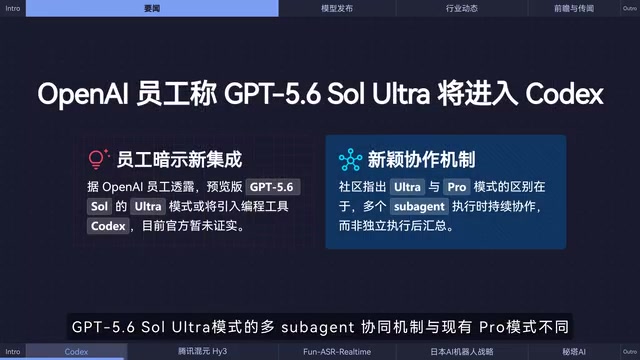
GPT-5.6 Sol Ultra May Be Coming to Codex
According to Tibo, head of Codex, GPT-5.6 Sol Ultra will be made available within Codex. This was further confirmed by late-night leaks from OpenAI insiders, quickly generating significant buzz in the developer community.
Based on what has been disclosed, the defining technical highlight of GPT-5.6 Sol Ultra is its multi-subagent coordination mechanism — a fundamental departure from the existing Pro mode. Traditional single-model inference often hits bottlenecks with context management and task decomposition when handling complex programming tasks. Multi-subagent coordination addresses this by breaking large tasks into parallelizable subtasks, distributing them across different agents, and aggregating the results.
The multi-subagent (Multi-Subagent) coordination mechanism draws from the field of Multi-Agent Systems (MAS) — with academic roots tracing back to distributed AI research in the 1980s. After decades of evolution, it has found renewed engineering value in the era of large language models. In the current LLM context, each subagent is essentially a different instance of the same base model, or a variant prompted for a specific role, handling subtasks such as code generation, test writing, documentation, and code review. Compared to sequential single-model inference, multi-agent architectures offer three key advantages: breaking through the context length limit of a single inference pass; enabling parallel computation to reduce end-to-end latency; and reducing hallucinations and errors through cross-validation mechanisms.
That said, orchestrating multiple LLM instances introduces unique engineering challenges: designing inter-agent communication protocols, maintaining consistent context state, isolating error propagation, and preventing mutual reinforcement of hallucinations across agents — a phenomenon known as the "hallucination amplification effect." OpenAI Codex, as a platform dedicated to code generation, is naturally suited for multi-agent decomposition — a complex software requirement can be broken into architecture design, module implementation, unit testing, and integration verification, all partially parallelizable yet interdependent subtasks. Each subagent focuses on a single responsibility, with an orchestrator consolidating the final output. OpenAI, Anthropic, Google, and other leading players have all explored agent orchestration frameworks to varying degrees, such as OpenAI's Swarm framework and Anthropic's Claude tool-calling chains.
This architectural approach aligns with the broader rise of the Agent paradigm in recent years. If multi-subagent coordination genuinely lands in Codex's programming context, AI coding assistants will leap from "assisted completion" to "autonomously executing complex engineering tasks" — potentially representing a productivity jump for developers comparable to the arrival of the GPT-4 series.
Tencent Hunyuan Hy3 Official Release Goes Open Source, Benchmarking Against Much Larger Models
On the Chinese large model front, Tencent's latest move has drawn considerable attention. Tencent Hunyuan has released and open-sourced the official version of Hunyuan 3, built on a MoE (Mixture of Experts) architecture with 295B total parameters, 21B activated parameters, and support for a 256K ultra-long context window.
The company claims its performance is comparable to flagship models 2 to 5 times its parameter size. This reflects the core advantage of MoE architecture — the sparse activation mechanism means only 21B parameters are engaged during inference, yet the model maintains performance that rivals or even surpasses much larger dense models, striking a better balance between capability and inference cost.
The key innovation of Mixture of Experts (MoE) lies in "sparse activation": the model has a large pool of parameters (expert networks), but only a small subset is activated during each inference pass. In Hunyuan 3's case, only 21B out of 295B total parameters are activated per inference — roughly a 7% activation ratio. This is managed by a lightweight "gating network" that dynamically routes each input token to the appropriate experts. The MoE architecture dates back to academic research from 1991, but large-scale adoption in LLMs began with Google's Switch Transformer (2021), before Mistral's Mixtral 8x7B brought it into the open-source community.
However, MoE architecture is not without engineering challenges at scale. One issue is "expert collapse," where the gating network repeatedly selects the same experts, leaving others undertrained. Another is the communication overhead in distributed inference — different experts may reside on different compute nodes, requiring cross-node data transfer (All-to-All communication) for token routing, placing extreme demands on network bandwidth. Load balancing — preventing some experts from being overloaded while others sit idle — is therefore a key indicator of MoE model maturity. From a commercial perspective, Hunyuan 3's low activated parameter count means that GPU memory usage and compute per inference is closer to that of a 21B dense model, significantly lowering the hardware barrier for enterprise private deployment. This is the underlying logic behind its value proposition: "performance comparable to much larger models, at the inference cost of a small model."
Another notable improvement over the preview version is a significant reduction in hallucination rate. Hallucinations have long been a core obstacle to deploying large language models in enterprise settings, and Hunyuan 3's improvements in this dimension substantially enhance its practical utility in production environments.

Hunyuan 3 is now live across multiple platforms including Tencent Cloud API, Yuanbao, and WorkBuddyAd. This multi-path strategy — open source plus cloud services plus end-user products — expands technical influence and developer ecosystem through open sourcing, while closing the commercial loop through productization. It reflects the maturing business playbook of Chinese large model players.
Alibaba's FunASR Realtime Gets a Major Upgrade
In the speech recognition space, Alibaba has officially upgraded its real-time speech recognition model, FunASR Realtime, with impressive core metrics: first-character latency of just hundreds of milliseconds, with accuracy approaching offline-level performance.
The technical challenge of real-time speech recognition lies in maintaining recognition accuracy at extremely low latency. Offline models can apply bidirectional context modeling (e.g., bidirectional Transformer/LSTM) after receiving the full audio, leveraging past and future context to correct recognition errors. Real-time models, by contrast, must perform unidirectional inference on received audio fragments only, inherently incurring some accuracy loss.
Streaming ASR architectures have evolved from RNN-T (Recurrent Neural Network Transducer) to Conformer to streaming Transformer. RNN-T was long the industry standard due to its native streaming properties, though its modeling capacity is limited. Conformer (convolution-augmented Transformer) dramatically improved accuracy, but its bidirectional attention mechanism is fundamentally at odds with real-time inference. FunASR's "streaming-offline unified" framework (in the spirit of UniASR) uses dynamic chunk-size training, enabling the same model to run in low-latency streaming mode or leverage full global context in offline mode — without maintaining two separate sets of parameters, significantly reducing engineering overhead. At a technical level, the chunk-based processing strategy introduces limited right-context lookahead while preserving causal inference, balancing latency and accuracy. "First-character latency of just hundreds of milliseconds" technically means the system's end-to-end processing time (including audio buffering, feature extraction, model inference, and decoding) must trigger the first output after accumulating only around 5–10 audio frames (typically 10–20ms each) — critical for use cases like live captioning and real-time translation.
The model also supports 16 dialects and 30 languages, demonstrating strong multilingual adaptability for both China's diverse linguistic landscape and international deployment. Supporting 16 dialects requires massive annotated dialect data and a multi-task learning training strategy — a testament to Alibaba's deep reservoir of Chinese speech data.

The model is already deployed in live streaming by well-known content creator "Yingshi Jufeng" and is available on Alibaba Cloud's Bailian platform. Live captioning is one of the most demanding use cases for both latency and accuracy, and successful deployment there serves as strong validation of the technology's maturity.
Japan's National Robot Strategy: 10 Million AI Robots by 2040
Shifting to the industrial policy level, Japan's Ministry of Economy, Trade and Industry (METI) has revised its AI robot strategy plan, outlining an ambitious response to pressing societal challenges.
Under the plan, Japan aims to deploy approximately 10 million AI robots across 18 industries — including manufacturing and caregiving — by 2040 to address a worsening labor shortage. The government will invest 380 billion yen, commissioning companies including Notra to develop "Physical AI," and establishing a national network of robotics centers.
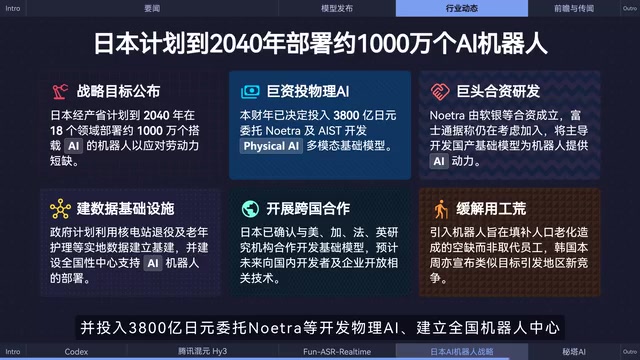
The deeper context is Japan's acute population aging and shrinking workforce. Japan's population aged 65 and above already exceeds 29% — the highest globally — while the country has long led the world in industrial robot density, backed by world-class manufacturers such as Fanuc, Yaskawa Electric, and Kawasaki Heavy Industries.
The term "Physical AI" was systematically articulated by NVIDIA CEO Jensen Huang in his 2024 CES keynote, referring to AI systems capable of understanding and acting upon the physical world — with embodied robots as the most representative application. Compared to purely software-based AI, Physical AI faces three core technical barriers: first, perception fusion, requiring integration of multi-modal sensor data (vision, touch, force) with scene understanding in milliseconds; second, manipulation planning, where robots must plan collision-free trajectories in real time across high-dimensional continuous action spaces; and third, sim-to-real transfer (generalizing from simulated to real environments), as policies trained in simulation often fail in the real world due to physical parameter discrepancies (e.g., friction coefficients, contact dynamics) — with domain randomization and real-data fine-tuning as the primary remedies. Japan's 380 billion yen investment is expected to spur large-scale expansion across the entire value chain: robot hardware manufacturing, AI software stacks, sensors, edge computing chips, and system integration services — with AI software stacks and edge inference chips being the most fiercely contested segments internationally. Japan's national-level initiative reflects the broader global trend of embodied intelligence (Embodied AI) moving from the lab toward mass industrial deployment.
Meta Opens Medical AI Product to Beta Testing
Meta AI has announced that its medical AI product is opening for beta testing, targeting doctors, medical students, and medical researchers — inviting professionals to try the product and provide feedback through WeChat groups.
The medical field demands the highest standards of accuracy and reliability from AI; any hallucination or error can have serious consequences. The core challenges of medical AI go beyond factual accuracy — they include understanding clinical reasoning logic, tracking real-time medical literature, and generalizing to rare cases.
From a regulatory standpoint, medical AI software faces stringent compliance requirements in major markets worldwide: the U.S. FDA classifies it under the SaMD (Software as a Medical Device) framework, requiring either a 510(k) premarket notification or the more rigorous PMA approval process; the EU MDR and China's NMPA guidelines similarly impose clear requirements on model interpretability, dataset representativeness, and post-market surveillance. Meta's decision to first open testing to a targeted group of medical professionals is essentially building a "expert validation loop" before formal regulatory engagement — professional feedback not only improves model performance but also accumulates Real-World Evidence, which will be critical supporting material for future medical device certification. Using private channels like WeChat groups for targeted beta access also effectively controls the risk of misuse — a pragmatic and responsible iteration path, and a necessary step for managing regulatory risk and building trust within the healthcare industry.
Conclusion
Taken together, these developments reveal an AI industry advancing simultaneously across multiple dimensions:
- Foundation model layer: Chinese open-source models (Hunyuan 3) are closing in on — and challenging — international flagship models through the efficiency advantages of MoE architecture, with sparse activation making "small activated footprint, large capability envelope" a reality;
- Agent paradigm: OpenAI's multi-subagent coordination mechanism signals a continued evolution of AI from point tools to "autonomous executors," with parallel task decomposition set to reshape software engineering workflows;
- Vertical applications: Speech recognition is breaking through the accuracy bottleneck of streaming processing, while medical AI is being deployed with careful deliberation — the extreme accuracy demands of professional domains are driving technical progress;
- Industrial policy: Japan's national robot strategy deploys embodied intelligence to address demographic challenges at scale, tracing the industrial pathway from Physical AI research to tens-of-millions-unit deployment.
These seemingly disparate developments collectively paint a coherent picture: AI technology is permeating every layer, from foundational models to end-user applications, and from the virtual world to the physical world.
Related articles

Gaussian Process Bandit Optimization: Exploration Strategies and Inference Regret Guarantees
Cumulative regret guarantees in Bayesian optimization fail to reflect final recommendation quality. This article examines a new study that provides inference regret guarantees for Gaussian process bandit optimization through exploration query strategies and fill distance analysis, validated on hyperparameter optimization and control tasks.

The Most Detailed Codex Guide on Bilibili: From Installation to Real-World Practice
The most detailed Codex guide on Bilibili: from app store installation to daily work mode configuration, with a real coffee shop project demonstrating file organization, data extraction, dashboard creation, and other practical tasks. Learn to use Plan Mode and desktop pets to leverage Codex efficiently.

Appearance Compensation in Volume Rendering: Why RGB Accuracy Cannot Guarantee Density Correctness
Volume rendering research reveals that volumetric data perfectly reproducing external RGB views may still contain density errors: appearance compensation can double central density and keep external rays unchanged even when L2 error exceeds 14.52%. Density recovery depends on appearance capacity, spatial resolution, and measurement design.