Hydrilla: AI-Generated Production-Grade 3D Assets to Speed Up Game and XR Development

Hydrilla uses AI to generate production-grade 3D assets from prompts, targeting fast pipelines for games, film/TV, and XR.
Hydrilla is an AI-driven 3D asset generation tool that claims to turn natural language prompts into "production-grade" models usable directly in game engines or film/TV pipelines, targeting game developers, animation studios, and XR creators. Its core selling point is "minutes-level" generation speed, aimed at accelerating concept exploration and repetitive asset production. It received 82 votes and 8 comments on Product Hunt, indicating above-average attention. However, key information such as technical architecture, export formats, topology quality, and pipeline compatibility has not yet been disclosed, and actual usability needs developer testing. Hydrilla represents the trend of AI moving deeper into 3D content creation, but faces the inherent challenges of quality and controllability.
In game development, animation production, and XR content creation, making 3D models is often time-consuming and labor-intensive. From concept design to a final usable asset, the process involves modeling, texturing, rigging, optimization, and more, often taking days or even weeks. Hydrilla aims to change this with AI—it claims to generate high-quality 3D assets from simple prompts, letting teams obtain production-ready models in minutes rather than waiting for days.
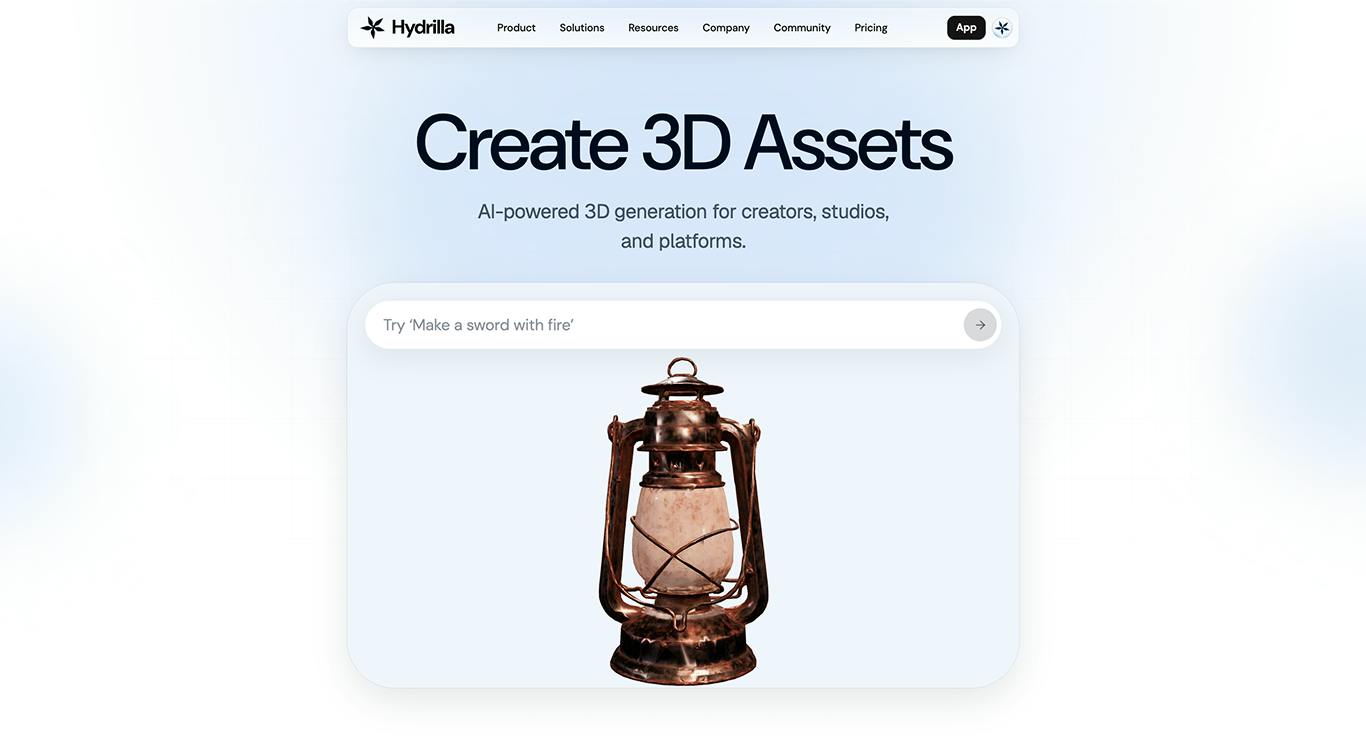
From Prompts to Production-Grade 3D Assets
Hydrilla's core capability is turning natural language prompts into 3D models. According to its Product Hunt page, it focuses on generating "high-quality 3D assets" for game developers, animation studios, and XR creators. This means the generated models are not rough prototypes meant only for preview, but assets that can be imported directly into game engines or film/TV pipelines.
The official selling point is "production-ready"—which usually means the model has reasonable topology, an appropriate level of detail, and usable materials that can meet the requirements of real-time or offline rendering. However, specific technical implementation details (such as the generative model architecture used, supported export formats, polygon count control, etc.) are not explained in detail in public information, and actual usability still needs to be verified by developers themselves.
Topology is a key property of 3D models, referring to how the vertices, edges, and faces of a polygon mesh are connected. Reasonable topology ensures that a model remains stable during animation deformation and avoids tearing or distortion. Production-grade assets usually require mostly quad faces, reasonable edge loops, and polygon counts kept within performance budgets. AI-generated models often suffer from dense triangles or messy topology and require additional optimization before they can be used for real-time rendering.
Level of detail (LOD) refers to creating versions of the same model at different levels of precision, switched based on camera distance to optimize rendering performance. Games and XR applications have strict LOD requirements, and whether AI-generated assets automatically support LOD generation is an important indicator for evaluating their production readiness.
A Fast Pipeline for Games, Film/TV, and XR
Hydrilla clearly positions itself as a pipeline acceleration tool rather than a replacement for professional 3D artists. Its description mentions "helping teams create production-grade models in minutes rather than days" and emphasizes "building faster pipelines for games, film, and immersive worlds."
For indie developers and small studios, this speed boost may be especially critical. Traditional 3D asset production requires hiring modelers or purchasing ready-made asset packs, while AI generation can quickly produce multiple variants during concept exploration, accelerating creative iteration. For large teams, Hydrilla may be able to handle part of the generation of repetitive assets, allowing artists to focus on more complex design work.
Pipeline in 3D content creation refers to a series of standardized processes from modeling, texturing, rigging, and animation to rendering. Professional pipelines usually involve collaboration across multiple software tools, such as Maya or Blender for modeling, Substance Painter for texturing, and Unreal Engine or Unity for real-time rendering. For AI tools to integrate into existing pipelines, they must support common file formats (such as FBX, GLB, USD) and preserve the integrity of data such as materials and skeletons; otherwise, they will increase manual conversion costs.
Market Positioning and Competitive Landscape
3D asset generation is not a brand-new track. There are already players such as Meshy, Kaedim, and Luma AI, some of which already support features such as text-to-3D and image-to-3D. Hydrilla's differentiation lies in emphasizing the two keywords "production-grade" and "minutes," attempting to find a balance between quality and speed.
According to Product Hunt data, Hydrilla received 82 votes and 8 comments, ranking 12th for the day. This level of attention is above average among developer tools, indicating some interest but not yet explosive spread. The specific content of user comments is not reflected in the source material, so it is impossible to judge early users' actual feedback on generation quality.
Meshy, Kaedim, and Luma AI are currently the main players in the text/image-to-3D field. Meshy supports text- and image-to-3D model generation and provides an API; Kaedim focuses on generating game-ready 3D assets from 2D images and emphasizes topology quality; Luma AI is known for neural rendering and 3D capture. These tools each emphasize different aspects of generation speed, quality, and controllability, and Hydrilla's "production-grade" positioning needs to be compared directly with these competitors on topology rationality, material quality, and pipeline compatibility.
Potential Challenges and Questions to Be Verified
The biggest challenge for AI-generated 3D assets has always been quality and controllability. Production-grade assets not only need to look reasonable but also need to meet game engine performance budgets, topology requirements for animation rigging, and compatibility with material systems. Whether Hydrilla meets "production-grade" standards in these areas requires actual testing to confirm.
Another issue is workflow integration. Professional 3D pipelines usually involve tools such as Blender, Maya, Unreal Engine, and Unity. Whether Hydrilla-generated assets can be imported smoothly into these environments and whether they support common file formats (such as FBX, GLB, USD, etc.) is currently unclear. For teams considering adoption, these are key details that must be understood before making a decision.
Overall, Hydrilla represents the trend of AI moving deeper into 3D content creation. If it can deliver satisfactory results in generation quality and pipeline compatibility, it has the potential to become a practical tool for small and medium-sized teams to accelerate prototype development and asset iteration. But before more hands-on data and user feedback appear, it is advisable to keep watching and evaluate cautiously.
One-line Summary
Hydrilla uses AI to generate production-grade 3D assets from prompts, targeting fast pipelines for games, film/TV, and XR.
Paragraph Summary
Hydrilla is an AI-driven 3D asset generation tool that claims to turn natural language prompts into "production-grade" models that can be used directly in game engines or film/TV pipelines, targeting game developers, animation studios, and XR creators. Its core selling point is "minutes-level" generation speed, aimed at accelerating concept exploration and repetitive asset production. It received 82 votes and 8 comments on Product Hunt, indicating above-average attention. However, key information such as the specific technical architecture, export formats, topology quality, and pipeline compatibility has not yet been disclosed, and actual usability needs to be verified by developers through testing. Hydrilla represents the trend of AI moving deeper into 3D content creation, but it faces the inherent challenges of quality and controllability.
Related articles

ChatGPT Plus Subscription Pitfall Guide: Go/Plus/Pro Tier Comparison and Quick Activation
A complete ChatGPT Plus subscription guide based on a Bilibili tutorial: from registering an account, comparing Go/Plus/Pro tiers, to the practical steps for quickly completing your subscription.

GPT-6.2 Sol/Astra Released! A Step-by-Step ChatGPT Plus Subscription Guide and Tier Comparison
GPT-6.2 Sol/Astra is out—here's a ChatGPT Plus subscription guide: register an account, compare Go/Plus/Pro tiers, and subscribe in a minute.

Comparing Three Channels for Subscribing to GPT Plus in China: Is Website Top-Up the Easiest?
How to subscribe to GPT Plus in China? This article compares website top-up, credit card, and mobile top-up channels—process, cost, and risk—with steps and tips to help you choose wisely.