Hydrogen-1.0 Open-Source Science Model: FSR Beats GPT-6 Astra at 72% Lower Cost

Deep Principle releases Hydrogen-1.0, an open-source science model that beats GPT-6 Astra on FSR at ~72% lower cost.
Deep Principle has released Hydrogen-1.0, an open-weight model post-trained on GLM-5.3 for chemistry, materials science, and life sciences. On the team's FrontierScience Research benchmark it reaches a 38.3% pass rate, beating GPT-6 Astra's 33.3%, with estimated output cost of $0.25 per question—about 72% lower. GPQA Diamond accuracy is 92.9%, just under Kimi K3's 93.5%. Training combines SFT and RL using scientist feedback, lab records, and discovery traces to teach coherent research-workflow decisions rather than plain QA. Five workflow demos are shown, with the caveat that they are curated examples, not autonomous research success rates. Weights and model card are on Hugging Face.
The open-source science model space has a new player. The Deep Principle team has released Hydrogen-1.0—an open-weight model post-trained on GLM-5.3, focused on chemistry, materials science, and life sciences. On the team's own FrontierScience Research benchmark, it delivered a headline-grabbing report card: a 38.3% pass rate that beats GPT-6 Astra's 33.3%, while estimated output cost is only about a quarter of the latter's.
Benchmark Performance: Leading and Lagging Side by Side
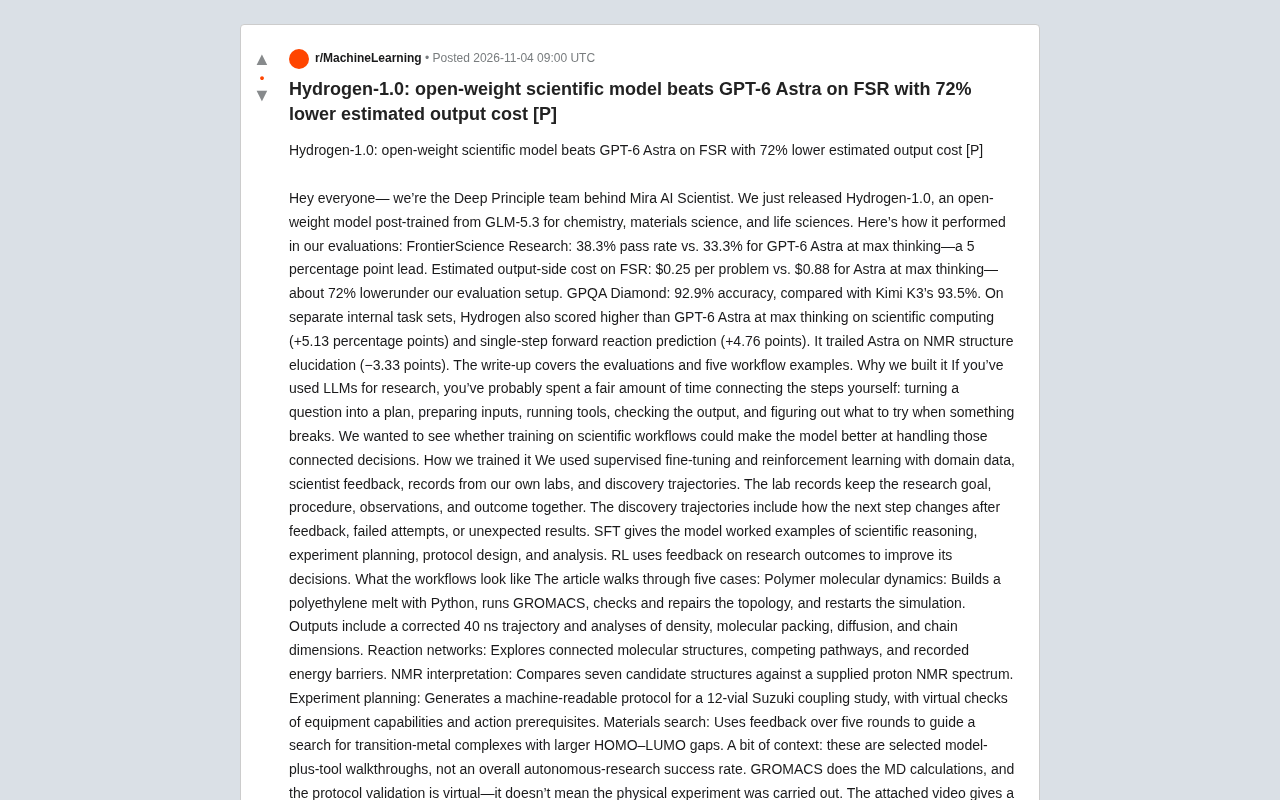
According to Deep Principle's post on Reddit, Hydrogen-1.0 leads GPT-6 Astra (max thinking mode) by 5 percentage points on the FSR benchmark. The cost gap is even more pronounced: an estimated output cost of $0.25 per question versus Astra's $0.88, a reduction of roughly 72%. The team emphasizes that these figures are based on its own evaluation setup and are not the result of independent third-party auditing.
On the general science QA benchmark GPQA Diamond, Hydrogen-1.0 achieves 92.9% accuracy, slightly below Kimi K3's 93.5%—a gap on the order of half a percentage point.
The team also published comparisons on its internal task set: a 5.13 percentage-point lead over Astra on scientific computing tasks and a 4.76-point lead on single-step forward reaction prediction; but it trails by 3.33 points on NMR structure elucidation. This "wins and losses" distribution is actually more worth examining than one-sided marketing—it shows that the model's capability profile is specific rather than a vague "across-the-board superiority."
GPQA Diamond is one of the most representative high-difficulty benchmarks in the science QA space today; its full name is Graduate-Level Google-Proof Q&A Diamond. Questions are written by PhD-level experts in biology, physics, and chemistry, and are designed so that answers cannot be obtained through simple search—placing high demands on a model's depth of domain knowledge and multi-step reasoning. GPQA Diamond contains about 198 four-choice questions spanning subfields such as genetics, quantum mechanics, and organic chemistry. Because the questions are difficult and highly discriminative, it is often used to compare models' graduate-level scientific reasoning. Note that the benchmark consists mostly of closed-ended multiple-choice questions, which differ from real research tasks that are open-ended and require tool coordination; a high score therefore does not directly equate to research workflow capability.
Training Approach: Treating the Research Process Itself as the Learning Target
Hydrogen-1.0 starts from a simple observation: when researchers use large models, much of their effort goes into stitching steps together—turning a problem into a plan, preparing inputs, running tools, checking outputs, and deciding what to do next after an error. The team wanted to know whether a model trained directly on scientific workflows could better handle these interlocking decisions.
The training method combines supervised fine-tuning (SFT) with reinforcement learning (RL), drawing on domain data, scientist feedback, proprietary lab records, and discovery traces. Lab records capture research goals, operational steps, observations, and final conclusions together; discovery traces record how the next step was adjusted after feedback, failed attempts, or unexpected results appeared. SFT provides examples of scientific reasoning, experimental planning, protocol design, and analysis, while RL uses research outcome feedback to optimize decisions.
The significance of this approach: what it trains is not "knowledge QA" but "sequences of research actions."
SFT (supervised fine-tuning) and RL (reinforcement learning) are two core methods in the post-training stage of today's large models. SFT uses high-quality input–output example pairs to teach a base model a domain's answer style, format, and reasoning paradigm—essentially behavior cloning; it is stable and easy to implement but limited by the coverage of the example data. RL has the model generate multiple candidate answers in an environment and optimizes the policy based on verifiable reward signals (such as answer correctness, whether tool calls succeed, or evaluation scores), thereby breaking past the ceiling of example data. In scientific settings, RL rewards can come from whether a computation converges, whether a protocol passes validation, or whether a reaction prediction matches experimental results. The two are usually used in sequence: SFT first to establish baseline capabilities and formatting standards, then RL to finely optimize the decision steps that are hard to cover with examples.
Five Workflow Cases: Capabilities and Boundaries
The post presents five complete walkthroughs of model-plus-tools, covering a range of scenarios from computation to experiment planning:
- Polymer molecular dynamics: Build a polyethylene melt in Python, run GROMACS, check and fix the topology, restart the simulation, and finally output a corrected 40-nanosecond trajectory with analysis of density, molecular packing, diffusion, and chain dimensions.
- Reaction networks: Explore interconnected molecular structures, competing pathways, and documented energy barriers.
- NMR elucidation: Compare seven candidate structures one by one against a given proton NMR spectrum—precisely the kind of task where it trails Astra.
- Experiment planning: Generate a machine-readable protocol for a 12-well Suzuki coupling study and perform a virtual check of equipment capabilities and operational prerequisites.
- Materials search: Guide a search through five rounds of feedback to find transition-metal complexes with larger HOMO–LUMO gaps.
The team explicitly clarifies that these are curated "model + tools" demonstrations and do not represent overall success rates for autonomous research. GROMACS handles the actual molecular dynamics calculations; protocol validation is virtual and does not mean physical experiments were actually performed. This kind of self-limiting framing is uncommon in open-source model releases.
GROMACS is a widely used open-source molecular dynamics simulation package, mainly for classical force-field simulations of biological and soft-matter systems such as proteins, lipids, and polymers. A typical pipeline includes: generating topology files with tools, setting up the simulation box and solvent, performing energy minimization, equilibration, and production simulation, and finally analyzing physical quantities such as density, diffusion coefficients, and radial distribution functions from the trajectory. Molecular dynamics simulations are extremely sensitive to the format consistency of input files; missing topologies or mismatched parameters often cause runs to abort—so "check and fix the topology, restart the simulation" is a high-frequency troubleshooting step in real workflows. In Hydrogen-1.0's polymer case, the model works through exactly this chain of interdependent operational steps rather than directly outputting the numerical value of some physical quantity.
A New Variable in Open-Source Science Model Competition
Hydrogen-1.0 chose to post-train from GLM-5.3 rather than train from scratch, following a "base model + deep domain specialization" route. The weights and model card have been uploaded to Hugging Face, and technical details and evaluation methods are disclosed in the official article. For researchers in computational chemistry and materials science, its value lies not in a few percentage points on a leaderboard, but in being locally deployable, having training and evaluation details that can be scrutinized, and being further fine-tunable for one's own tasks.
At the end of the post, the team directly asks practitioners in computational chemistry and materials science: what would you try it on first, and what would you check before trusting the results? That question itself may be closer to the real state of scientific work than any single percentage-point lead.
One-line Summary
Deep Principle releases Hydrogen-1.0, an open-source science model that beats GPT-6 Astra on FSR at roughly 72% lower cost.
Paragraph Summary
The Deep Principle team has released Hydrogen-1.0, an open-weight model post-trained on GLM-5.3 and focused on chemistry, materials science, and life sciences. On the team's own FrontierScience Research benchmark, it achieves a 38.3% pass rate, beating GPT-6 Astra's 33.3%, with an estimated output cost of $0.25 per question—about 72% lower. GPQA Diamond accuracy is 92.9%, slightly below Kimi K3's 93.5%. Training combines SFT and RL, with data covering scientist feedback, lab records, and discovery traces, aiming to give the model coherent decision-making across research workflows rather than mere QA. The team presents five workflow cases—polymer molecular dynamics, reaction networks, NMR elucidation, experiment planning, and materials search—and explicitly notes these are curated demos, not autonomous research success rates. Weights and model card are on Hugging Face.
Related articles

Qwen 3.8 Beats Opus at Coding—But Can Your Mac Run It?
Open-source Qwen 3.8 beats Opus 4.6 at coding at just 18GB, but how much Mac memory do you need? 24GB crashes; 32GB is the sweet spot. Full config guide inside.

Claude Code + Agent: Building a Fully Automated AI Testing Loop
Bilibili course breakdown: how test developers can use Claude Code terminal-based Agents to build a fully automated AI testing loop. Compares permission boundaries of terminal vs. device Agents, explains why enterprise projects choose Claude Code over Open Claude-type tools, and outlines the Node.js environment setup and DeepSeek model integration path.

Working with AI Agents Requires Nerves of Steel
The more autonomous AI agents become, the heavier the user's psychological burden. Drawing from a Hacker News discussion, this article analyzes black-box anxiety, behavior drift, and monitoring fatigue in agent collaboration, and offers practical approaches like sandbox isolation, permission control, and task granularity management to reduce cognitive load.