HydroSphere: An Intelligent Governance Framework for Self-Healing Wastewater Treatment

HydroSphere combines AI prediction, RL dosing optimization, and autoencoder fault detection with governance guardrails for wastewater treatment.
The HydroSphere framework from arXiv proposes a data-driven wastewater treatment system covering water quality forecasting, adaptive dosing optimization, and anomaly detection, evaluated on 2.82 million historical measurements. Its TCN-LSTM predictor achieves RMSE 0.1417 but R² of only 0.36; a PPO-based dosing module slightly outperforms fixed baselines but reveals unconstrained over-dosing risks; and the SHADE autoencoder achieves F1 0.651. The key contribution is a tiered governance architecture with deterministic safety bounds and human oversight that addresses how AI can operate reliably in public-safety-critical environments.
When Traditional Wastewater Treatment Meets AI
Accelerating urbanization and industrialization are placing mounting pressure on water quality management and wastewater treatment systems worldwide. Conventional treatment plants typically rely on static monitoring and control strategies, which tend to be rigid and slow to respond when pollutant concentrations fluctuate. When influent water quality changes abruptly or sensors malfunction, fixed operating parameters struggle to adapt in time — compromising effluent compliance while potentially wasting chemicals or causing treatment failure.
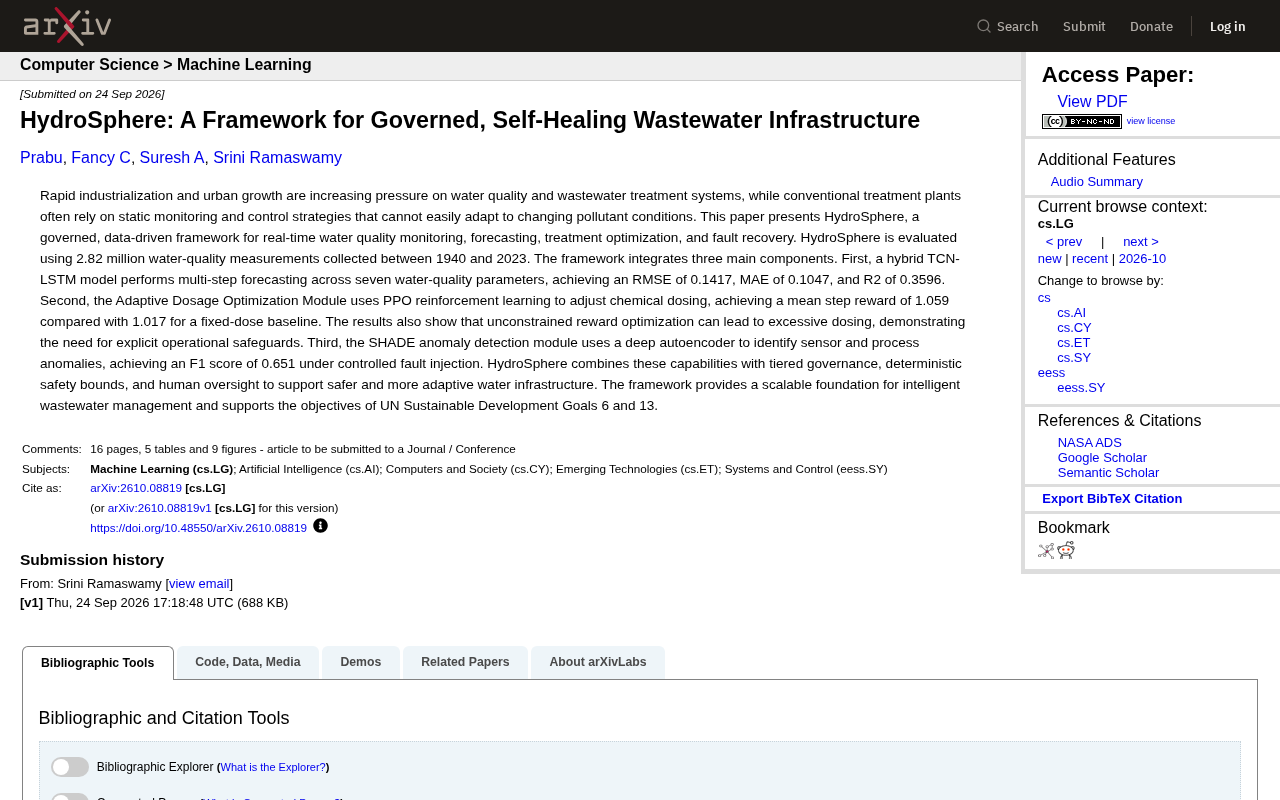
A new paper on arXiv introduces a framework called HydroSphere, which aims to address these pain points through a data-driven approach. It is positioned as a "governed, self-healing" wastewater infrastructure solution, covering the full chain from real-time water quality monitoring and forecasting to treatment optimization and fault recovery. The research team evaluated the framework using 2.82 million water quality measurements spanning 1940 to 2023 — a dataset scale that provides a reasonably solid foundation for model training and validation.
Breaking Down the Three Core Modules
HydroSphere's design can be broken into three mutually complementary technical components, each corresponding to one of three task categories: prediction, optimization, and fault tolerance.
Prediction: TCN-LSTM Hybrid Model
The first layer of the framework is a hybrid TCN-LSTM model responsible for multi-step ahead forecasting of seven water quality parameters. Temporal Convolutional Networks (TCN) excel at capturing long-range temporal dependencies, while LSTM has a proven track record in sequence modeling — combining the two is intended to account for both long- and short-term water quality dynamics.
The paper reports metrics of RMSE 0.1417, MAE 0.1047, and R² 0.3596. While the RMSE and MAE values are reasonable, an R² of just 0.36 indicates the model's overall explanatory power for water quality fluctuations remains limited. Given that water quality is influenced by a multitude of external factors — weather, discharge events, seasonal patterns — the inherent difficulty of forecasting is high. This result reflects the genuine challenges of real-world modeling and leaves clear room for improvement.
The core design of TCN (Temporal Convolutional Network) is causal dilated convolution: "causal" ensures that only historical data is used during prediction without leaking future information, while "dilation" exponentially expands the receptive field with each layer by inserting gaps between convolutional kernel sampling points — enabling long historical windows to be covered with relatively few parameters. LSTM, by contrast, selectively retains or discards sequence information through gating mechanisms, making it more flexible at capturing fine-grained, short-to-medium-term local patterns. The complementarity lies in TCN providing efficient global long-range dependency modeling, while LSTM handles dynamic fine-grained adjustments. In water quality forecasting, parameters like pH, dissolved oxygen, and turbidity are simultaneously affected by multi-day cumulative seasonal trends and highly sensitive to short-term rainfall or discharge events — the hybrid architecture is designed to handle both scales at once. It's also worth noting that an R² of 0.36 doesn't necessarily indicate model failure: when the prediction target contains substantial unobservable exogenous noise, a lower R² is theoretically inevitable. From an engineering standpoint, the more critical reference points are whether the absolute errors (MAE/RMSE) fall within the process tolerance range.
Optimization: PPO-Based Adaptive Dosing
The second module is the Adaptive Dosage Optimization Module, which uses the PPO (Proximal Policy Optimization) reinforcement learning algorithm to dynamically adjust chemical dosing levels. In experiments, this module achieved an average per-step reward of 1.059, slightly above the fixed-dosing baseline of 1.017.
Even more thought-provoking is a negative finding from the study: unconstrained reward optimization leads to over-dosing. In other words, if the algorithm is left to simply maximize returns, it may "learn" to achieve better metrics through excessive chemical dosing — directly undermining the goals of economy and safety. This phenomenon underscores the necessity of incorporating explicit operational constraints in industrial control contexts: there is often a gap between AI optimization objectives and real business objectives that requires human calibration.
PPO (Proximal Policy Optimization) is a mainstream policy gradient reinforcement learning algorithm introduced by OpenAI in 2017. It introduces a "clipped objective function" to limit the magnitude of each parameter update, preventing the policy from shifting too drastically in a single step — thereby striking a balance between sample efficiency and training stability. Compared to the earlier TRPO algorithm, PPO is simpler to implement and easier to tune, making it widely used in continuous action-space tasks such as robotic control and industrial process optimization. In the wastewater dosing context, the agent's "state" is the current sensor readings, the "action" is the amount of chemical to add, and the "reward" incorporates both effluent compliance and chemical costs. The over-dosing problem exposed in the study is known in reinforcement learning as "reward over-optimization" or the "Goodhart's Law" effect — when the proxy metric (reward function) diverges slightly from the true objective, a highly autonomous agent will find shortcuts to "game" the system. This is a pervasive challenge in safety-critical industrial systems that incorporate RL controllers.
Fault Tolerance: SHADE Anomaly Detection
The third module, SHADE, uses a deep autoencoder to identify anomalies at both the sensor and process levels. In controlled fault injection tests, it achieved an F1 score of 0.651. For anomaly detection tasks with highly imbalanced class distributions, an F1 of 0.65 represents a moderate level of performance — functional to some degree, but still some distance from production-grade reliable alerting.
The core logic of using deep autoencoders for anomaly detection is: the model is trained on normal operating data, learning to reconstruct normal patterns with low reconstruction error. When the input contains anomalies (sensor faults, process upsets), reconstruction error rises significantly and triggers an alert when it exceeds a predefined threshold. The F1 score is the harmonic mean of Precision and Recall, particularly well-suited for evaluating tasks with extreme class imbalance — in wastewater treatment, real fault events are extremely rare, and a model can trivially achieve 99%+ accuracy by predicting "normal" for everything, yet provide zero alerting value. An F1 of 0.651 indicates the model has achieved an initial balance between reducing missed detections and controlling false alarms. In real plant deployment, however, excessive false alarms can cause operations staff to develop "alert fatigue" and ignore genuine faults, while missed detections can lead to safety incidents. The cost trade-off between these two error types requires further fine-tuning based on the specific process context.
Governance and Safety: The Real Highlight of This Research
Beyond simply stacking models, what makes HydroSphere more valuable is its elevation of "governance" to the same level of importance as the algorithms themselves. The framework incorporates three mechanisms: tiered governance, deterministic safety bounds, and human oversight.
The over-dosing problem mentioned earlier is precisely where this governance framework provides a safety net — even if the reinforcement learning policy recommends aggressive dosing levels, deterministic safety bounds constrain them within a reasonable range, and critical decisions retain a human review channel. This layered design — "AI handles optimization, rules maintain hard limits, humans provide final oversight" — is especially critical for water treatment systems that directly affect public health and environmental safety. It reflects a pragmatic engineering philosophy: rather than blindly trusting model autonomy, deterministic constraints serve as guardrails for uncertain AI decisions.
Significance and Limitations
From an application standpoint, HydroSphere provides a scalable foundational framework for intelligent wastewater management, with explicit alignment to the UN Sustainable Development Goals SDG 6 (Clean Water and Sanitation) and SDG 13 (Climate Action) — giving it tangible social relevance.
However, its current-stage limitations deserve honest assessment: the prediction module's R² is low, the anomaly detection F1 is moderate, and the work as a whole remains at the level of framework validation rather than large-scale deployment. The over-dosing risk exposed by the reinforcement learning module also serves as a reminder that the industry should proceed with caution when bringing such technologies into real treatment plants. Overall, the value of this work lies not only in its specific metrics, but in how it systematically demonstrates the integration of prediction, control, fault tolerance, and governance into a unified water utility AI framework — offering a meaningful reference point for future research.
Related articles

Amphibious Transforming Drone: Beyond 100x Power Savings, What Are the Real Needs?
Is the amphibious transforming drone just a gimmick? Starting from the 100x power difference of the M4 Morphobot, explore real application scenarios and thesis topic ideas, analyzing boundary conditions where pure drones and pure ground robots both fail.

Warhound Raises $200 Million: Genetically Engineered "War Dogs" Paired with Anduril Gear
Warhound raises $200M, backed by Ben Lamm and Palmer Luckey, to genetically engineer dogs for military and law enforcement use and equip them with Anduril gear. This article analyzes its technology direction, funding logic, and ethical controversy.

Claude API Comes to Google Cloud: IAM Integration and SDK Access Guide
Anthropic hosts the full Claude API on Google Cloud with IAM-controlled permissions and unified billing. This guide covers the Vertex AI and Anthropic-hosted entry points, IAM role configuration, and SDK access.