Hypergraph Dominating Sets: A Novel Approach to Extractive Text Summarization
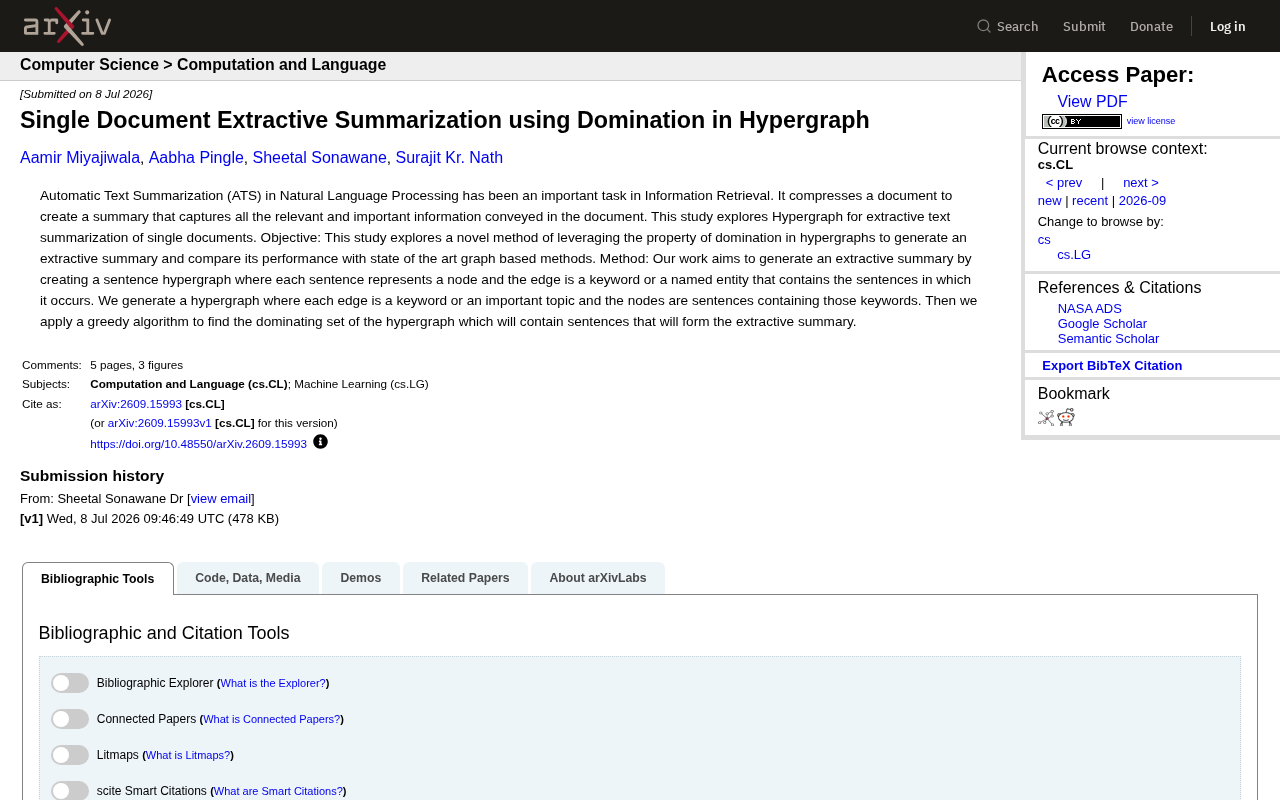
Extractive summarization via hypergraph dominating sets, using keywords as hyperedges and greedy selection.
This research introduces hypergraph domination theory to single-document extractive summarization. Unlike TextRank and similar methods that rely on pairwise sentence similarity, this approach builds a sentence hypergraph where sentences are nodes and keywords or named entities are hyperedges, capturing multi-way thematic relationships. A greedy algorithm then finds a dominating set whose selected sentences cover all key topics in the document, balancing comprehensiveness and redundancy reduction. Requiring no large-scale training, offering strong interpretability, and producing no hallucinations, this method holds practical value for high-reliability, low-compute document processing and opens new theoretical perspectives for incorporating higher-order semantic structure into summarization.
Automatic Text Summarization (ATS) has long been a core task in natural language processing and information retrieval. Its goal is to compress a lengthy document into a concise summary while preserving all relevant and important information from the original text. A recent paper published on arXiv proposes an intriguing approach — leveraging the domination properties of hypergraphs to perform single-document extractive summarization — and benchmarks it against mainstream graph-based methods.
From Ordinary Graphs to Hypergraphs: An Upgrade in Modeling
Traditional graph-based summarization methods (such as TextRank and LexRank) typically treat sentences as nodes and inter-sentence similarity as edges, then apply graph centrality algorithms to select the most important sentences. The limitation of these approaches is that edges can only express pairwise relations between two sentences, making it difficult to capture higher-order associations where multiple sentences cluster around the same topic.
Hypergraphs are introduced precisely to address this problem. By mathematical definition, a hyperedge in a hypergraph can connect any number of nodes simultaneously — not just two. This structure is naturally suited to express multi-way relationships like "multiple sentences sharing the same keyword or topic," enabling richer semantic modeling than ordinary graphs.
TextRank and LexRank are two classic unsupervised extractive summarization methods. TextRank draws on the PageRank algorithm, treating sentences as nodes and constructing a directed graph based on lexical overlap, then iteratively computing "vote weights" to rank sentences. LexRank builds an undirected graph using TF-IDF cosine similarity and measures sentence importance via spectral centrality. Both methods share a core assumption: sentences pointed to by more similar sentences are more important. The drawback of this pairwise similarity modeling is that it can only capture direct relationships between sentence pairs. When a topic is spread across multiple sentences that aren't directly similar but all revolve around the same keyword, a pairwise graph fails to unify them — whereas a hyperedge can naturally include all such sentences within a single edge, explicitly capturing the multi-way radiating structure of a topic.
How the Sentence Hypergraph Is Constructed
The core of this research is constructing a sentence hypergraph: each sentence in the document becomes a node, and each hyperedge corresponds to a keyword or named entity. Specifically, the hyperedge for a given keyword connects all sentences that contain that keyword.
In other words, if an important topic appears repeatedly across multiple sentences, those sentences are "bundled together" by the same hyperedge. The resulting hypergraph essentially encodes the document's thematic structure into the graph's topology — keywords and named entities serve as the skeleton organizing the sentences, while sentences cluster around these topics.
Dominating Sets: Greedy Algorithm for Selecting Summary Sentences
The key mechanism of this method is the dominating set, a concept from graph theory. In graph theory, a dominating set is a subset of nodes such that every node in the graph either belongs to the set or is adjacent to at least one node in the set. Intuitively, a dominating set is a group of representative nodes that "covers" the entire graph.
The researchers transfer this idea to the summarization task: a greedy algorithm is used to find a dominating set on the sentence hypergraph, and the sentences in that set form the final extractive summary. The logic is straightforward — sentences in the dominating set cover all key topics (hyperedges) in the document, so theoretically they compose a summary that comprehensively captures the original text's important information while avoiding redundancy.
Finding the Minimum Dominating Set (MDS) is NP-hard on general graphs, so in practice a greedy approximation strategy is used: in each round, the node that covers the most currently uncovered nodes is added to the set, repeating until all nodes are covered. This greedy method runs in polynomial time and is guaranteed to produce a solution no larger than O(ln n) times the optimal solution (where n is the number of nodes). In the hypergraph setting, "coverage" is generalized as follows: a node is covered if and only if it is in the dominating set, or shares at least one hyperedge with a node in the dominating set. The greedy algorithm thus prioritizes sentence nodes that participate in the most hyperedges — which is equivalent to prioritizing sentences that involve the most key topics, directly aligning with the summarization objective of maximizing topic coverage.
Value and Limitations of the Method
The significance of this research lies in connecting hypergraph domination theory — a relatively abstract mathematical framework — with the practical NLP task of text summarization, offering a modeling perspective distinct from mainstream sentence similarity graphs. Using keywords and named entities as hyperedges makes "topic coverage" an explicit criterion for sentence selection, which aligns closely with the core summarization goal of being comprehensive yet non-redundant.
However, several issues are worth noting based on what can be gathered from the paper. First, the quality of keyword and named entity extraction directly determines the quality of the hypergraph structure — if keyword identification is inaccurate, the semantic skeleton of the entire hypergraph becomes distorted. Second, while the greedy algorithm for finding the dominating set is efficient, it typically yields only an approximate solution, and the final summary quality depends on the specific design of the greedy strategy. Third, extractive summarization is inherently constrained by the original sentences and cannot reorganize or compress language the way abstractive summarization can.
Positioning in the Era of Large Language Models
In an era dominated by generative large language models, graph-theory-based extractive methods may seem "classical," but they still offer unique value: they require no large-scale training, are highly interpretable, have low computational costs, and suffer no hallucination problem — every sentence in the summary comes directly from the original document. For information retrieval and document processing scenarios that demand high reliability and low computational overhead, these structured methods remain a worthy area of research. The hypergraph domination approach also provides a valuable exploration for integrating higher-order semantic relationships into summarization modeling in future work.
Related articles

AI Agent Earns $10K in One Week: 3 Key Upgrades Explained
A blogger shares how he earned $10K in a week with an AI Agent — not by adding more skills, but through verification, approval gates, and subagents to raise trust and enable true automation.
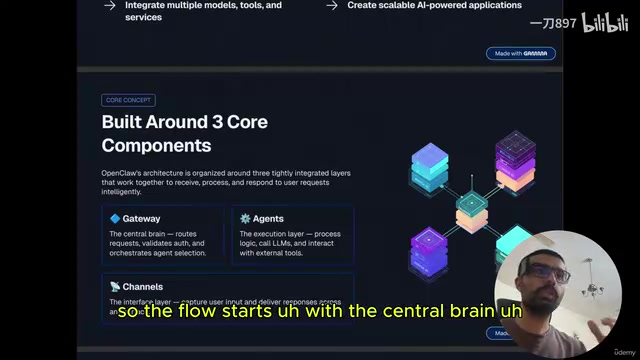
Getting Started with OpenClaw: Multi-Channel AI Agent Gateway and Automated Workflow Guide
OpenClaw is an open-source multi-channel AI agent gateway. This guide covers its three core components — gateway, agents, and channels — plus tool integration and memory mechanisms.
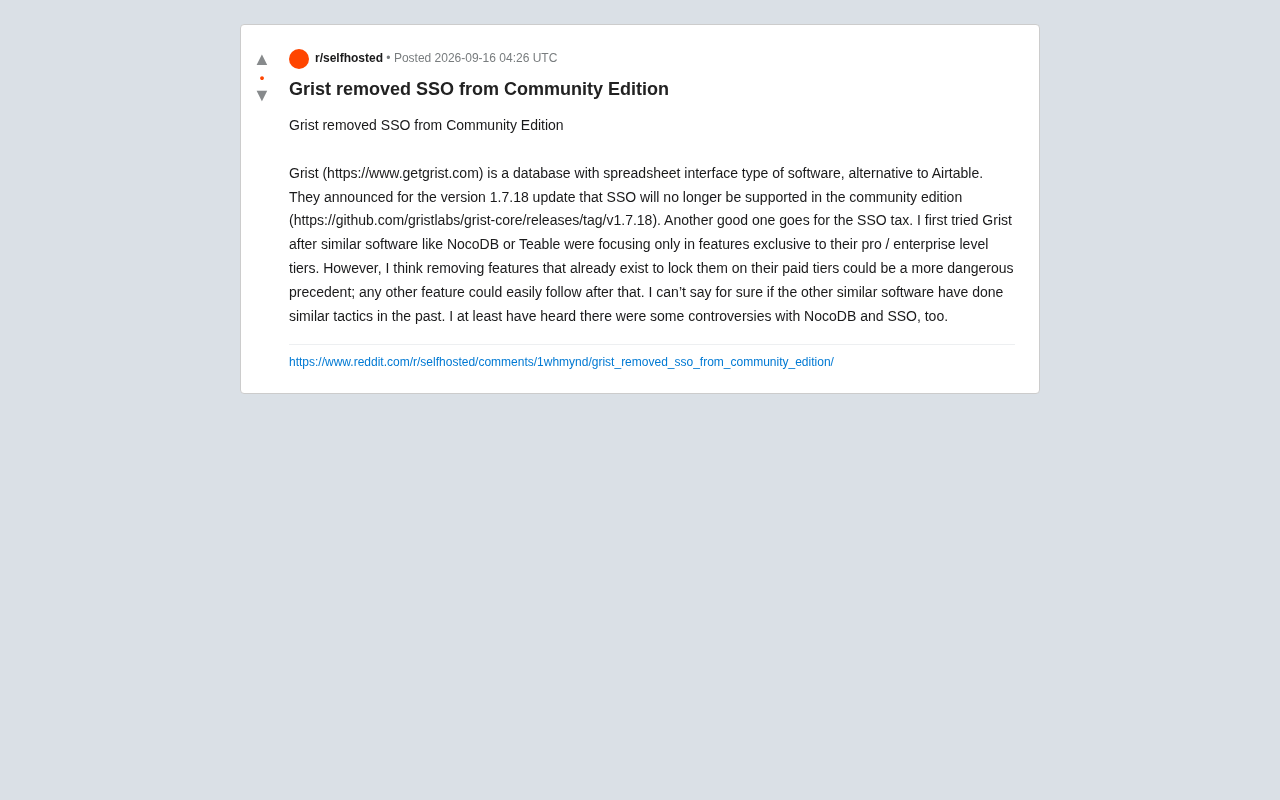
Grist Removes SSO from Community Edition: The 'SSO Tax' Debate Resurfaces
Grist v1.7.18 removed SSO from its Community Edition, locking it behind a paid tier and reigniting the 'SSO Tax' debate. We analyze the incident, open-source monetization tensions, and what it means for self-hosted users.