Hypervibe: Run Multiple AI Coding Agents in Parallel on an Infinite Canvas

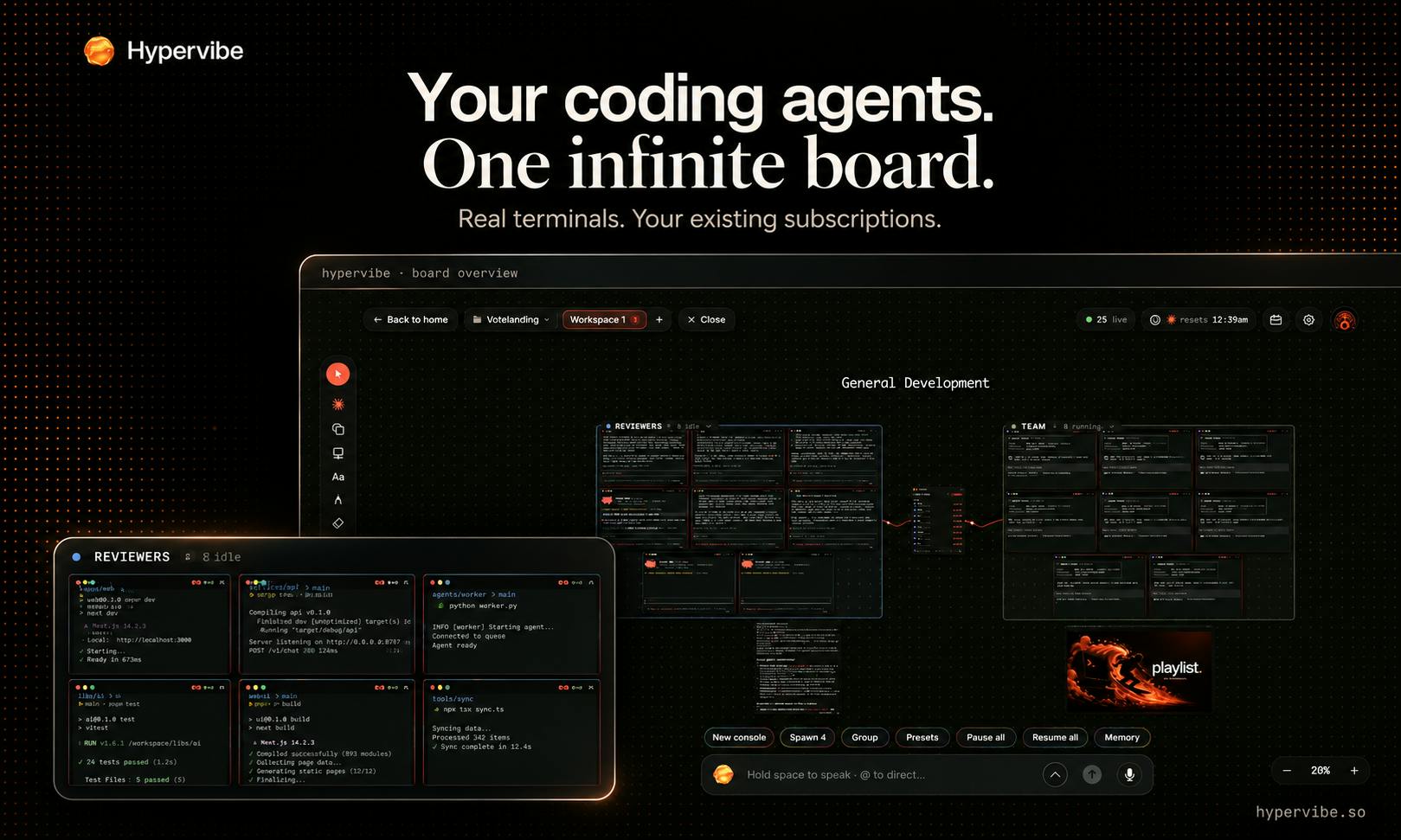
Hypervibe is a Mac-native app that brings multiple AI CLI coding agents together on one infinite canvas.
Hypervibe is a Mac-native tool for heavy AI coding users that places multiple CLI agents — Claude Code, Codex, Gemini, and more — side by side on a freely zoomable infinite canvas backed by real terminals. It reuses your existing agent accounts with no re-authentication required. Beyond multi-agent parallel running, it adds agent status monitoring, team collaboration, voice control, and live previews. Currently requires macOS 14+ and Apple Silicon; still in early stages.
When Multiple AI Coding Agents Need to Work Together
Using AI coding tools has become second nature for developers, but a practical problem is emerging: when you're juggling multiple command-line agents like Claude Code, Codex, and Gemini simultaneously, switching between terminal windows becomes a real headache. Each agent occupies its own window, state is scattered across different places, there's no unified view, and collaborative efficiency takes a serious hit.
Hypervibe is a Mac-native app that earned 65 upvotes and a #17 ranking on Product Hunt — and it's built specifically to solve this problem. Its core idea is refreshingly straightforward: put your AI coding agents on an "infinite canvas" and run them side by side, giving your multi-agent workflow a single, centralized workspace.
Infinite Canvas + Real Terminals
Hypervibe's most distinctive design choice is its "infinite board." Unlike the tab or split-pane logic of traditional IDEs, it lets you place multiple agent instances on a freely zoomable and pannable canvas — managing your AI workflows like arranging task cards on a whiteboard.
The key detail: these aren't simulated interfaces — they're real terminals. Claude Code, Codex, Gemini, and other CLI agents run natively inside them, which means you keep the full power of the command line while gaining a visual, bird's-eye view of everything happening at once. For developers who are already comfortable wrangling agents in the terminal, this approach of "keeping the CLI while layering on spatial management" meaningfully reduces the cognitive load of running multiple tasks in parallel.
The "infinite canvas" interaction paradigm first gained traction in collaborative design tools like Miro and FigJam, where its core advantage was breaking free from the fixed layouts of traditional tabs or split screens — letting users organize information freely in space. Bringing this paradigm to terminal management is essentially transplanting the idea of "workflow visualization" into developer tooling. Each running agent is no longer just an abstract process; it becomes a visual object on the canvas with a position, a boundary, and the ability to be dragged around. This spatial layout is especially valuable for parallel multitasking: the human brain processes spatial information far more effectively than abstract lists. "Placing" multiple agent states in a 2D space is simply more aligned with how working memory functions than toggling between tabs.
Use the Accounts You Already Have
One notable product decision worth highlighting: Hypervibe supports using the agent accounts you already own. It doesn't try to re-proxy or re-wrap anyone's model subscriptions. Instead, it acts as a frontend orchestration layer that calls directly into your locally configured Claude, Codex, Gemini, and other accounts.
This positioning matters on two levels. First, it eliminates the friction of paying twice or re-authenticating for a new tool. Second, it firmly positions Hypervibe as an orchestration and interface tool — not a model middleman. For teams already deeply invested in a few CLI agents, the migration cost is essentially zero.
CLI agents (command-line interface agents) are AI coding tools that use the terminal as their primary interaction mode. Claude Code is Anthropic's terminal-native coding agent; Codex refers to OpenAI's code generation model and associated toolchain; Gemini CLI is Google's command-line coding assistant. These tools typically authenticate locally via API key or OAuth, accepting natural language instructions directly in the terminal and operating on codebases. Unlike IDE-integrated plugins like Copilot, CLI agents are closer to "autonomous task executors" — they can read and write files, run commands, and call external services, giving them significantly more autonomous capability while also requiring some terminal fluency from the user. Hypervibe's positioning as a "frontend orchestration layer" is built on the premise that these tools are already running fully and locally on the developer's machine.
Features for Collaborative and Multimodal Workflows
Beyond its core multi-agent side-by-side functionality, Hypervibe integrates several features aimed at real-world work scenarios:
- Agent status: A centralized view of each agent's current state, so you're not constantly switching windows to check whether a task is done.
- Teams: Built-in team collaboration support — a signal that this isn't just a solo developer's toy, but something aimed at team-scale AI coding workflows.
- Voice control: Voice interaction lets you dispatch agents with spoken commands without ever leaving the canvas.
- Live previews: Instant previews of agent-generated output, tightening the feedback loop between generation and verification.
Taken together, these features point in a single direction: consolidating scattered AI coding activity across terminals into a unified workstation that's observable, controllable, and collaborative.
Platform Requirements and Target Audience
Hypervibe is currently a macOS 14+ app that requires Apple Silicon. That means it currently only serves developers on relatively recent Mac hardware — Intel Mac, Windows, and Linux users are out of luck for now. Choosing to ship a native app typically means better performance and system integration, but at the cost of cross-platform reach.
In terms of categorization, it sits under Mac, Developer Tools, and Artificial Intelligence — a very clear product positioning: a professional hub for Mac developers who are heavy users of AI coding agents.
A Few Observations
As CLI-based AI coding agents continue to multiply, "how to manage and orchestrate them all at once" is emerging as a genuine product opportunity. Hypervibe's answer — combining an infinite canvas with real terminals and the ability to reuse existing accounts — is a relatively restrained and pragmatic one: don't replace the tools you already use, just help you organize them better.
That said, as a product that just launched on Product Hunt, its real-world stability, canvas performance under the load of many simultaneous agents, and the maturity of its team collaboration features all need more validation from actual users. The single review it has so far also signals that it's still very early days. For Mac developers curious about multi-agent workflows, it's worth a try — but whether it can become a go-to daily driver is something only time will tell.
Related articles

Random Pruning of the DPO Computation Graph: 1.4x Training Speedup and Lower Peak Memory
DPO training too slow and memory-hungry? This paper proposes a random pruning framework for the DPO computation graph, sampling independently across position, sequence, and branch dimensions; branch pruning achieves a 1.426x step-time speedup and cuts training time by about 30%, with in-depth attribution of memory and time gains.

Why Does JEPA Underperform MLM in Longitudinal EHR Representation Learning?
New study compares JEPA and MLM for longitudinal EHR representation learning on MIMIC-IV: three JEPA variants train stably without collapse but underperform MLM; target size, not heterogeneity, drives prediction error.

Transfer Learning + Visible Light Communication: A New Approach to Energy-Efficient Indoor Positioning
A study proposes a transfer learning-based visible light communication indoor positioning method, achieving 47% accuracy improvement on the BOSCH factory dataset, 67.5% model efficiency under high noise, and introducing the ME composite metric for energy-efficient positioning in energy-constrained industrial IoT scenarios.