I Built an App to Quit Doomscrolling—and Accidentally Got Addicted to Math

A CS student built the Bunkr app, using a 10-minute hard lock and push-up unlock to fight doomscrolling—and unexpectedly fell in love with math.
A CS student, addicted to doomscrolling and frustrated that market blocking tools were too easy to bypass, developed the app Bunkr - done scrolling. Its core mechanism: after blocking apps, the first 10 minutes are a hard lock with no exit, and afterward users must complete tasks like taking a photo or doing push-ups to unlock. Based on the idea that "10 minutes of sustained investment leads to focus" and using physical tasks to raise the cost of distraction, the author calls the strategy "fighting fire with fire" and unexpectedly develops an addiction-like engagement with studying math.
Have you ever counted how many times a day you unconsciously unlock your phone, tap that familiar icon, and then half an hour just vanishes? A CS student on Reddit shared his unconventional solution to fighting doomscrolling—writing his own app to lock himself out. The result was unexpected: he not only broke free from phone dependency, but became "addicted" to studying math.
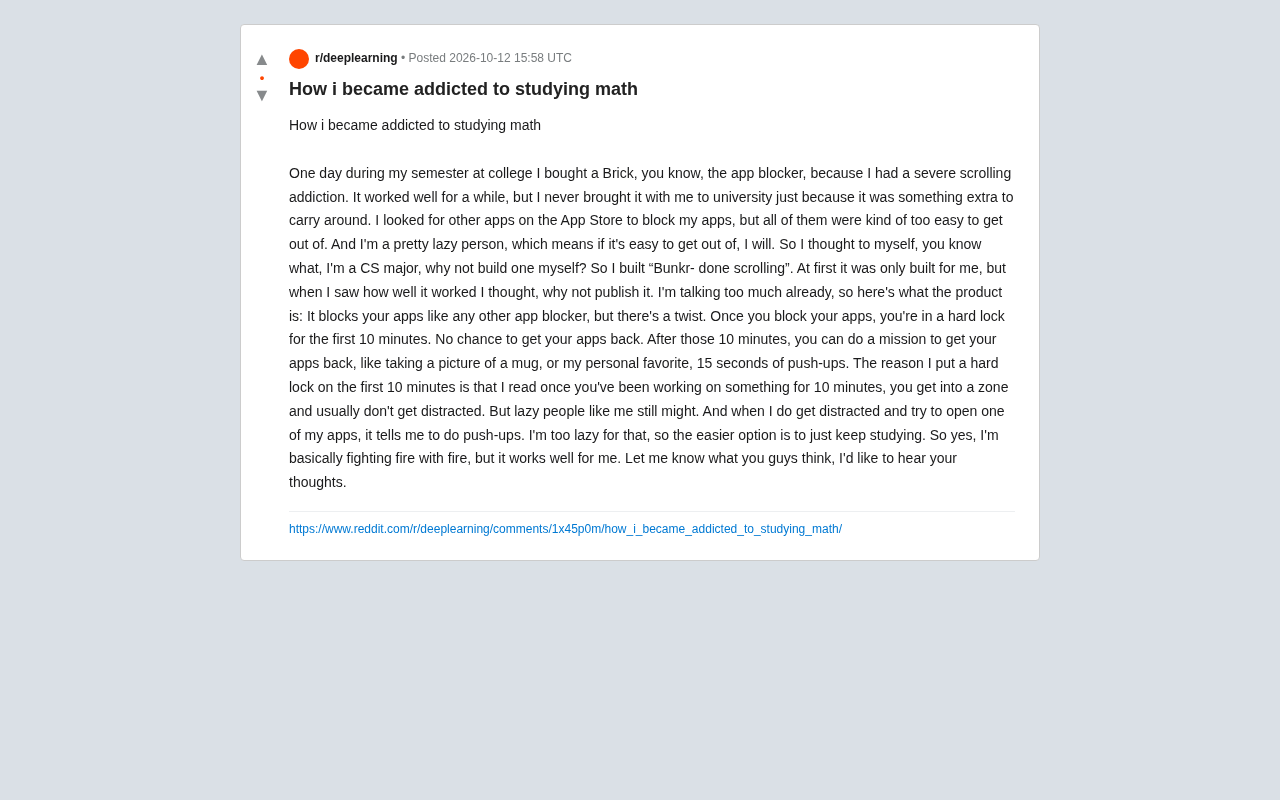
From "Buying a Physical Lock" to "Writing Code to Lock Myself"
This student initially bought a hardware device called Brick to block phone apps. It worked well, but he never took it to school—carrying one extra thing was too much hassle. So he searched the App Store for alternatives and found that most app-blocking tools were "too easy to bypass." He knew himself well: "I'm a very lazy person. If it's easy to quit, I will definitely quit."
Since a low barrier to exit was the problem, the solution was to raise it. As a computer science student, he decided to build his own app called Bunkr - done scrolling. That decision itself contains an interesting logic: a person who gets distracted easily is precisely the one who knows best what kind of mechanism can truly trap them.
Core Mechanism: 10-Minute Hard Lock + Task Unlock
Bunkr's operation isn't complicated, but it has one key design: once you choose to block certain apps, the first 10 minutes are a hard lock—you absolutely cannot regain access. After 10 minutes, you still can't just take the app back directly. Instead, you need to complete a "task" to unlock it—like taking a photo of a mug, or his personal favorite: doing push-ups for 15 seconds.
Why 10 minutes? He explained in the post that he'd read somewhere: when you keep investing in something for 10 minutes, you enter a focused state and usually stop getting distracted easily. But this mechanism has a second layer of insurance: for lazy people like him, even if they start getting distracted after 10 minutes, opening a blocked app would require doing push-ups. Compared to that, "keep studying" is actually the less effortful choice.
In his words, it's basically "fighting fire with fire." It sounds a bit absurd, but the actual results surprised even him—he started becoming obsessed with studying math.
The "commitment device" in behavioral design is the theoretical backdrop for understanding tools like Bunkr. It refers to people actively setting restrictions on themselves to counter short-sighted impulses that may arise in the future. Classic examples include locking snacks in a cabinet, transferring salary into a savings account in advance, and Odysseus having his sailors tie him to the mast to resist the Sirens' song. The key to a commitment device's effectiveness is: the decision happens in a "cool" state, while the constraint acts on an "impulsive" state. Bunkr's 10-minute hard lock is essentially a digital commitment device—users set blocking rules when calm, and the rules stop them when impulses strike.
The claim that "10 minutes gets you into a focused state" is often cited in pop psychology and relates to the concept of "flow" proposed by Mihaly Csikszentmihalyi. Flow refers to a state of complete immersion and self-forgetful engagement, which usually requires accumulated sustained attention to enter. Although "10 minutes" is not a strict scientific threshold, neuroscience research does show that switching attention from one task to another carries a time cost (attention residue), and sustained investment helps reduce this switching cost. However, the time needed to enter focus varies greatly across tasks and individuals, so 10 minutes is more of a practical heuristic than a universal rule.
Why This Rough Product Actually Works
From a product design perspective, Bunkr has no polished interface and no complex algorithms, but it precisely hits several key points in behavior change.
First, raise the immediate exit cost. Many blocking tools on the market allow users to turn them off with one tap or skip by entering a password, whereas Bunkr uses a 10-minute hard lock to forcibly create an "irreversible window," breaking the loop of "instant gratification."
Second, replace finger swiping with a physical task. Doing push-ups isn't for fitness—it's to insert an uncomfortable buffer between impulse and action. When unlocking your phone becomes more tiring than continuing to study, the rational choice naturally tilts.
Third, the developer himself is the target user. He explicitly calls himself "lazy" and admits the product was initially made just for himself. This approach of building from one's own pain points often captures real behavioral friction better than general-purpose products.
"Raising the immediate exit cost" corresponds to the design idea of "friction" in behavioral economics. In Nudge, Richard Thaler and Cass Sunstein proposed that tiny environmental friction can significantly change behavioral choices. For example, placing healthy food at eye level and hiding junk food can influence dietary decisions. Through hard locks and physical tasks, Bunkr artificially creates asymmetric friction between "opening the phone" and "continuing to study": distraction becomes harder, focus becomes easier. This approach does not rely on the user's willpower or self-control, but guides behavior by changing the choice architecture, making it especially effective for people who consider themselves "lazy" or weak-willed.
A CS Student's Unexpected Gain
The ending of this story exceeded his initial expectations. He originally just wanted to solve his doomscrolling problem, but found that he developed an "addiction-like" sense of engagement with studying math. There may be an underrated mechanism behind this: when environmental blocking is strong enough, the learning behavior itself gradually gains positive feedback.
Of course, this is not a one-size-fits-all solution. For some people, a 10-minute hard lock may be too aggressive; for others, doing push-ups may instead become a new form of avoidance. But his original intention in sharing was simple—put the work out there and hear what others think. If you've also struggled repeatedly in the cycle of "just scroll a bit, then study," this rough yet effective idea may be worth borrowing: rather than relying on willpower, design an environment where distraction becomes more effortful than focus.
One-line Summary
A CS student built the Bunkr app, using a 10-minute hard lock and push-up unlock to fight doomscrolling—and unexpectedly fell in love with math.
Paragraph Summary
A CS student, addicted to doomscrolling and frustrated that market blocking tools were too easy to bypass, developed the app Bunkr - done scrolling. Its core mechanism: after blocking apps, the first 10 minutes are a hard lock with no exit, and afterward users must complete tasks like taking a photo or doing push-ups to unlock. This design is based on the idea that "sustained investment for 10 minutes leads to a focused state," and uses physical tasks to raise the cost of distraction. The author describes the strategy as "fighting fire with fire," and ultimately developed an addiction-like engagement with studying math. The product was initially built only for himself and released after it worked well; its core value lies in raising the immediate cost of distraction rather than relying on willpower.
Related articles

CSS Anchor Positioning: A New UI Positioning Approach Without JavaScript
A deep dive into CSS Anchor Positioning: from anchor-name and position-anchor to the anchor() function, position-area shorthand, position-try-fallbacks, anchor-size, and upcoming anchor queries.

New AI Chart Interaction: Continuous Follow-up Questions and Visualization in Conversation
Explore a new AI interaction method for continuously generating charts in conversation. Use the /visualize command to ask follow-up questions and visualize answers in the same chat window, improving data analysis efficiency.

Cursor Merges Into X Subscription: Paid Plans Share Unified Usage Pool, Grok Model Coding Usage Doubled
Cursor joins The X Subscription with a unified usage pool and doubled Grok coding quota. Third-party models shift to API pricing. Existing users can keep or migrate plans.